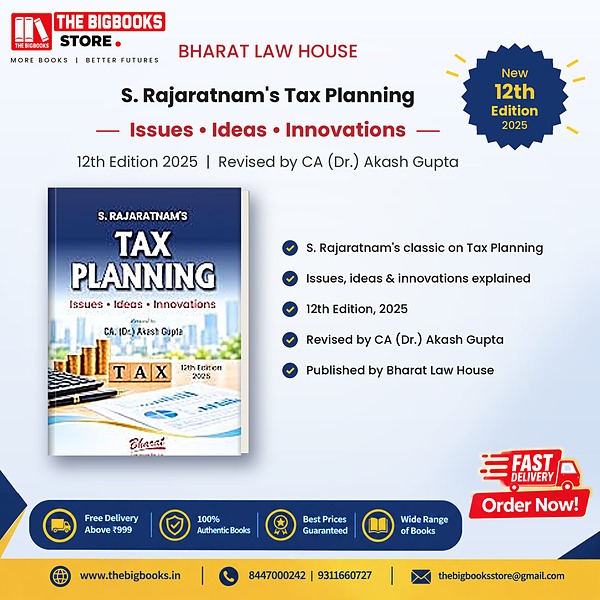
Bharat's S. Rajaratnam's Tax Planning - Issues, Ideas, Innovations - 12th Edition, Revised by CA (Dr.) Akash Gupta
| Author : | CA.(Dr.) Akash gupta, S. Rajaratnam |
|---|
| Bharat Law House's S. Rajaratnam's Tax Planning - Issues, Ideas, Innovations, 12th Edition revised by CA (Dr.) Akash Gupta, is a 2,256-page hardbound work in 63 chapters opening with an analysis of the Finance Act, 2026. It covers the interpretation of tax laws, documents and evidence, the principle of mutuality, diversion of income by overriding title and the concept of real income; Hindu law and HUFs including partition; charitable and private trusts; agricultural income; the corporate sector with amalgamation, MAT, conversion of entities, slump sale, LLPs and firms and partners; interest income, borrowings, PPF, residential status, year of taxability, salary and perquisites, professionals and house property; business income, depreciation, revenue versus capital expenditure and presumptive taxation; capital gains with exemptions and reinvestment benefits; export incentives and tax holidays; non-residents, advance rulings and DTAAs; valuation, cash transactions, TDS and TCS; returns, assessment and appeals, survey, search and seizure and penalties; and the concept of transfer, benami transactions, family arrangement, gifts and the Insolvency and Bankruptcy Code, with a full subject index. For chartered accountants, tax advocates, corporate tax teams, departmental officers and advisers to HUFs and trusts. |


2256

English

12th Edition

Tags: PROFESSIONAL BOOKS, Direct Tax Laws & International Taxation, Income Tax, Tax Planning
Bharat's S. Rajaratnam's Tax Planning – Issues • Ideas • Innovations, 12th Edition, revised by CA (Dr.) Akash Gupta
Bharat Law House presents the 12th Edition of S. Rajaratnam's Tax Planning – Issues • Ideas • Innovations, revised by CA (Dr.) Akash Gupta — a 2,256-page hardbound work in 63 chapters, opening with an analysis of the Finance Act, 2026.
The standing of this book
Rajaratnam's Tax Planning has been the reference work on legitimate tax planning in India across twelve editions. It is not a compliance manual and not a ready reckoner: it is a book about what the law permits, where the boundaries lie, and how courts have drawn them — which is why it is read as much for the chapters on real income, diversion by overriding title and the concept of "transfer" as for the planning ideas themselves.
What the 63 chapters cover
- Foundations — the Finance Act, 2026 analysed; tax planning issues and ideas; interpretation of tax laws; documents and evidence; the principle of mutuality; diversion of income by overriding title; the concept of real income.
- Hindu law and HUF — applicability, how an HUF is constituted, partition and partial partition, across three chapters.
- Charitable trusts and institutions, private trusts, and compulsory maintenance of accounts and audit.
- Agricultural income, and the corporate sector — amalgamation, MAT and Alternate Minimum Tax, conversion of business entities, slump sale, LLPs, and firms and partners with salary and interest to partners.
- Income streams — interest income, borrowings and investments, Public Provident Fund, residential status and the choice of residence, profit-sharing, year of taxability, salary and perquisites, professionals, housing investment and income from house property.
- Business income — deductions, depreciation, amortisation and allowances, revenue versus capital expenditure, and presumptive taxation.
- Capital gains — the charge, and exemptions and reinvestment benefits.
- Incentives — aggregation of income, export incentives, tax holidays and new industrial undertakings, non-controversial tax planning, and relaxations for sick companies.
- Cross-border — non-residents and schedule-based exemptions, advance rulings, and Double Taxation Avoidance Agreements.
- Special subjects — intellectual property, tax planning for senior citizens, valuation, and cash transactions.
- Procedure and disputes — tax planning in returns, assessment and appeals; TDS and TCS; survey; search and seizure; penalties; and the Settlement Commission and the Vivad se Vishwas Schemes as historical reference.
- Allied — the concept of "transfer", benami transactions, family arrangement, gifts, wealth tax as historical reference, the Right to Information Act, 2005 and the confidentiality of tax records, and the Insolvency and Bankruptcy Code.
- Closing with a full Subject Index.
Why buy this edition
- Opens with the Finance Act, 2026 analysed, so the planning positions are stated against the current law.
- 2,256 pages across 63 chapters — the most comprehensive single work on Indian tax planning.
- Judicially grounded. The doctrinal chapters set out how the courts have treated each device, which is what distinguishes planning from avoidance.
- Historical-reference chapters retained on the Settlement Commission, Vivad se Vishwas, wealth tax and PMGKY — still needed for older assessment years and pending matters.
- Hardbound, and revised by a practising Chartered Accountant.
Who should buy this book
- Chartered Accountants and Cost Accountants in direct tax practice.
- Tax advocates and senior counsel appearing before the ITAT, High Courts and the Supreme Court.
- In-house tax heads, CFOs and corporate tax departments.
- Income Tax Department officers, for whom the doctrinal chapters set out the other side's case.
- Family offices and advisers to HUFs, trusts and high-net-worth individuals.
- Academics, researchers and senior CA/CS/CMA students.
About the author and reviser
S. Rajaratnam is the original author of this work, long established as a leading authority on Indian direct taxation. The 12th Edition has been revised by CA (Dr.) Akash Gupta, a practising Chartered Accountant.