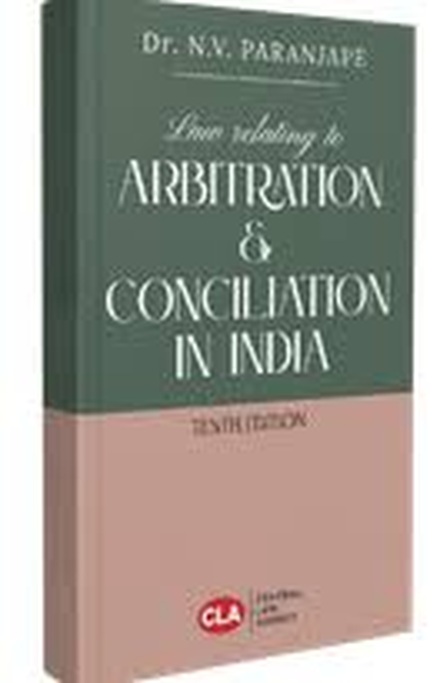
CLA's Law Relating to Arbitration & Conciliation in India by Dr. N. V. Paranjape - 10th Edition
| Author : | DR. N.V. PARANJAPE |
|---|
| CLA's Law Relating to Arbitration & Conciliation in India by Dr. N. V. Paranjape, Tenth Edition, published by Central Law Agency, is the standard student and practitioner text on the Arbitration and Conciliation Act, 1996, carrying the 2015, 2019 and 2021 amendments with critical commentary and the leading case law. Part I covers the arbitration agreement, reference and interim measures, composition and challenge of the arbitral tribunal, jurisdiction and kompetenz-kompetenz, the conduct of proceedings, the making of the award, recourse and the grounds for setting aside including public policy and patent illegality, finality, enforcement and appeals. Part II deals with the enforcement of New York and Geneva Convention foreign awards, Part III with conciliation and the settlement agreement, Part IV with the supplementary provisions and Schedules, and Part V with alternative dispute resolution — negotiation, mediation, Lok Adalats and section 89 CPC — followed by appendices carrying the bare text. Paperback, English. |


Tags: ACADEMIC LAW BOOKS, Arbitration & Conciliation ( ADR ), Mediation Law, Alternative Dispute Resolution
CLA's Law Relating to Arbitration & Conciliation in India by Dr. N. V. Paranjape, published by Central Law Agency, is the Tenth Edition of the standard student and practitioner text on the Arbitration and Conciliation Act, 1996 and the wider field of alternative dispute resolution. Paperback, English.
Arbitration has moved from the margins of Indian practice to the centre of it. Commercial contracts now arbitrate by default, the courts have been pushed steadily towards non-interference, and the Act itself has been amended repeatedly — in 2015, 2019 and 2021 — to cut delay, tighten the grounds for setting aside an award, and make India a workable seat for international commercial arbitration. A student or a junior coming to the subject has to understand not just the sections but the direction of travel.
Dr. Paranjape's text is prescribed across Indian law faculties precisely because it does both. It states the statutory scheme section by section, and it supplies the critical commentary and case law that explain why the provisions read as they do — including, as the author puts it, the areas where judicial vigilance can usefully be invoked so that messy arbitrations are avoided.
Key Features
- Tenth Edition, Central Law Agency
- Section-wise treatment of the Arbitration and Conciliation Act, 1996
- The 2015, 2019 and 2021 amendments and the contemporary trends they reflect
- Critical commentary with the leading Supreme Court and High Court authority
- Separate parts on foreign awards, conciliation and ADR
- Appendices with the bare text and allied material
- A prescribed text in LL.B. and LL.M. ADR courses across Indian universities
- Paperback · English
Coverage
Part I — Arbitration. General provisions and definitions; the arbitration agreement and its essentials; reference of parties to arbitration and interim measures by the court; composition of the arbitral tribunal, appointment, grounds of challenge and termination of mandate; jurisdiction of the arbitral tribunal and the doctrine of kompetenz-kompetenz; the conduct of arbitral proceedings, equal treatment of parties, place and language, evidence and expert assistance; the making of the arbitral award and termination of proceedings, form and contents, settlement and costs; recourse against an arbitral award and the grounds for setting aside, including public policy and patent illegality; finality and enforcement of awards; appeals; and miscellaneous provisions including limitation and deposits.
Part II — Enforcement of Certain Foreign Awards. New York Convention awards and Geneva Convention awards — when a foreign award is binding, the conditions for enforcement, and the grounds on which enforcement may be refused.
Part III — Conciliation. Application and scope, the commencement of conciliation proceedings, the appointment and role of conciliators, communication and disclosure, the settlement agreement and its status, confidentiality, and the termination of proceedings.
Part IV — Supplementary Provisions. The rule-making powers and the Schedules to the Act.
Part V — Alternative Dispute Resolution. The ADR movement and its rationale; negotiation, mediation and conciliation compared; Lok Adalats and the Legal Services Authorities Act; court-annexed mediation and section 89 of the Code of Civil Procedure; and the place of institutional arbitration.
Appendices. The bare text of the Act and allied material for ready reference.
Who Should Buy This Book?
- LL.B., B.A. LL.B. and B.B.A. LL.B. students taking Arbitration / ADR as a paper
- LL.M. students and research scholars in dispute resolution
- Advocates appearing in section 11, section 34 and section 37 matters
- Juniors and in-house counsel handling commercial contracts and arbitration clauses
- Arbitrators, conciliators and mediators
- Candidates for judicial service examinations with an ADR component
- Company secretaries and professionals dealing with commercial dispute resolution
- Law college and university libraries
Why Choose This Book?
The first reason is that it is a teaching text that practitioners can still use. Most arbitration books in the Indian market are either slim exam guides or thousand-page commentaries. This one explains the scheme well enough for a student meeting section 34 for the first time, while carrying enough authority to be useful when that student is drafting a petition three years later.
The second is the ADR part. Arbitration is only one route out of court, and university syllabi increasingly examine negotiation, mediation, conciliation and Lok Adalats alongside it. Having all of them in the prescribed text, rather than scattered across handouts, is a real convenience.
The third is continuity. A book that has reached a tenth edition has been revised through every major amendment to the 1996 Act, and the author has had the chance to see which of his earlier criticisms the legislature and the courts eventually took up.