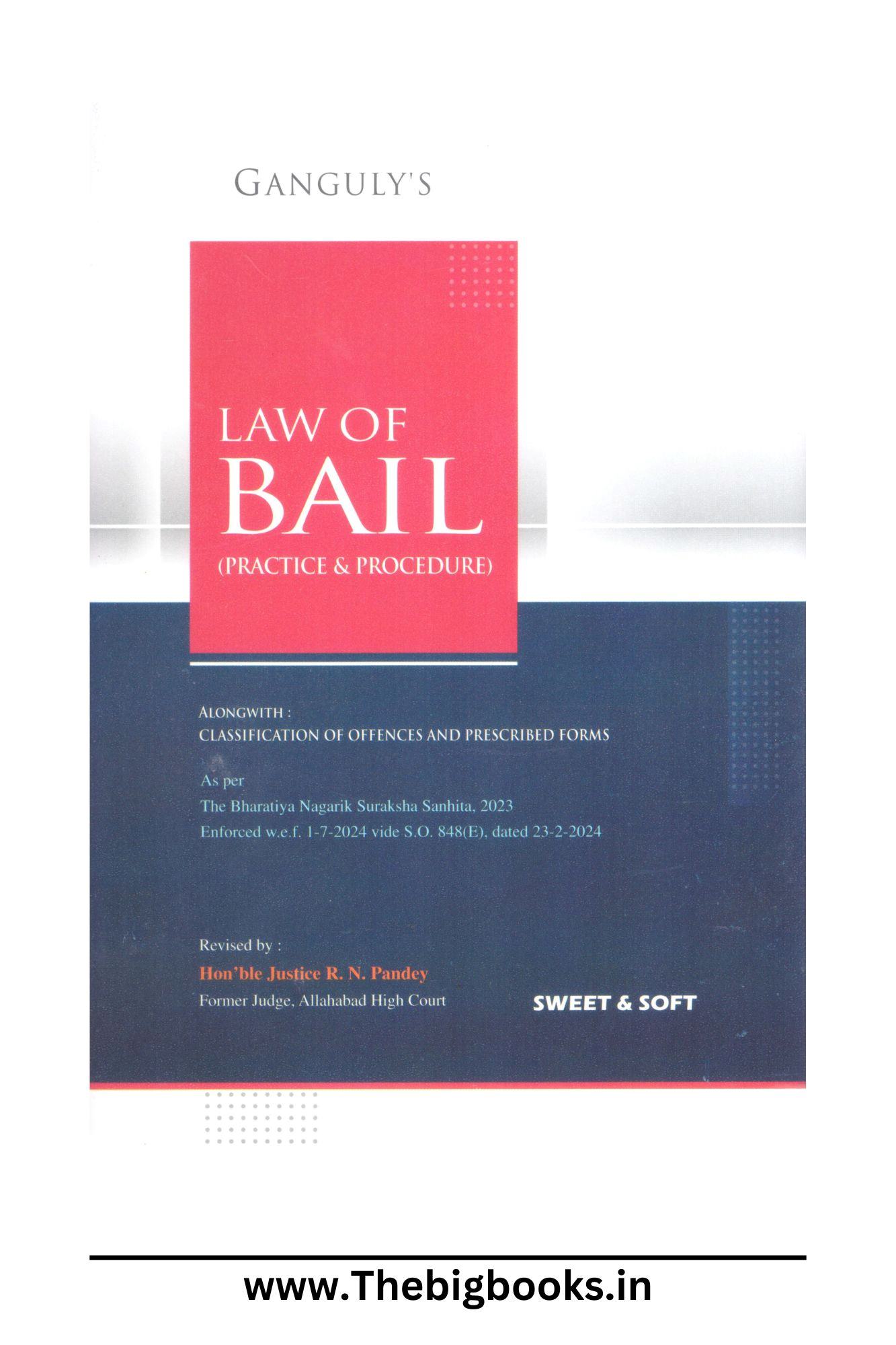
Ganguly`s Law Of Bail (Practice & Procedure) Alongwith : Classification Of Offences And Prescribed Forms As Per The Bharatiya Nagarik Suraksha Sanhita, Edition 2024.
| Author : | GANGULY`S |
|---|
Ganguly`s Law Of Bail (Practice & Procedure) Alongwith : Classification Of Offences And Prescribed Forms As Per The Bharatiya Nagarik Suraksha Sanhita, Edition 2024.


Estimate Delivery Times: 3-5 Business Days.
Return Within 4 Days of Purchase. Duties & Taxes are Non-Refundable.
Tags: LEGAL BOOKS, Bail, Bharatiya Nagarik Suraksha Sanhita(BNSS)
Share This Product
Key Topics Covered:
1. Bail - Definition, Types, and Law
- Bail is the process by which an accused person is released from police or judicial custody, subject to certain conditions, pending trial.
- The book details different types of bail:
- Regular Bail
- Interim Bail
- Anticipatory Bail
- Bail on Merits vs Bail on Surety
- Bail Conditions: The book delves into the conditions under which bail may be granted or rejected, along with a detailed discussion on judicial discretion in granting bail.
2. Practice and Procedure of Bail
- Provides a step-by-step guide on the procedural aspects of bail applications.
- Explains the jurisdiction and authority of courts in granting bail (e.g., Sessions Court, Magistrate Court, High Court, and Supreme Court).
- Bail Bonds and the procedure for submitting them.
- Time limits for granting bail and the process of revocation of bail.
- Case law references: Includes important judgments and precedents that shape the practice of granting bail.
3. Classification of Offences (Under BNSS)
- The Bharatiya Nagarik Suraksha Sanhita (BNSS) classifies offences into Cognizable and Non-Cognizable offences, helping define the gravity of crimes and their corresponding bail procedures.
- Cognizable Offences: Serious crimes, where the police have authority to arrest without a warrant and initiate investigations (e.g., murder, rape).
- Non-Cognizable Offences: Lesser crimes that require a warrant to arrest (e.g., minor theft).
- The book offers an exhaustive list of offences classified under these two categories and the procedure for granting bail accordingly.
4. Prescribed Forms under BNSS
- The Bharatiya Nagarik Suraksha Sanhita introduces a set of prescribed forms for various stages of the bail process, including:
- Bail Application Forms
- Surety Forms
- Forms for Revocation and Modification of Bail
- These forms are standardized and are to be used by law enforcement agencies, courts, and legal practitioners to ensure uniformity and compliance with legal procedures.
5. Rights of the Accused
- The book highlights the fundamental rights of the accused, particularly their right to seek bail under various circumstances, as guaranteed by the Indian Constitution and Criminal Procedure Code (CrPC).
- Emphasis on the right to a fair trial and the right to liberty in the context of bail laws.
6. Practical Aspects of Bail Applications
- Includes practical advice and strategies for lawyers handling bail cases.
- Offers insights into the drafting of bail petitions, responding to objections raised by the prosecution, and handling appeals related to bail decisions.
- Case Studies: Examples of typical bail cases and how they should be handled in different courts.