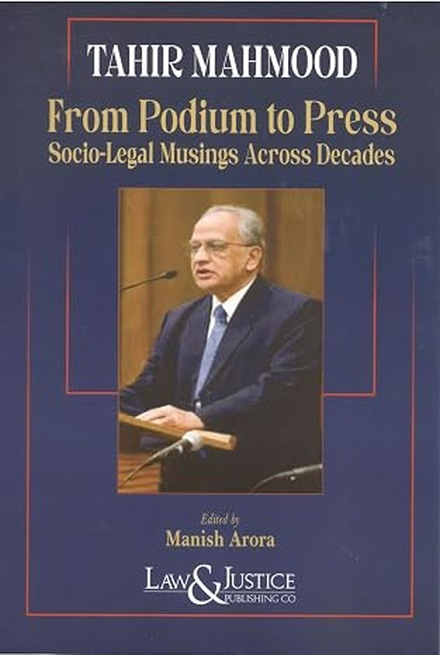
L&J's Tahir Mahmood: From Podium to Press - Socio-Legal Musings Across Decades
| Author : | Tahir Mahmood |
|---|
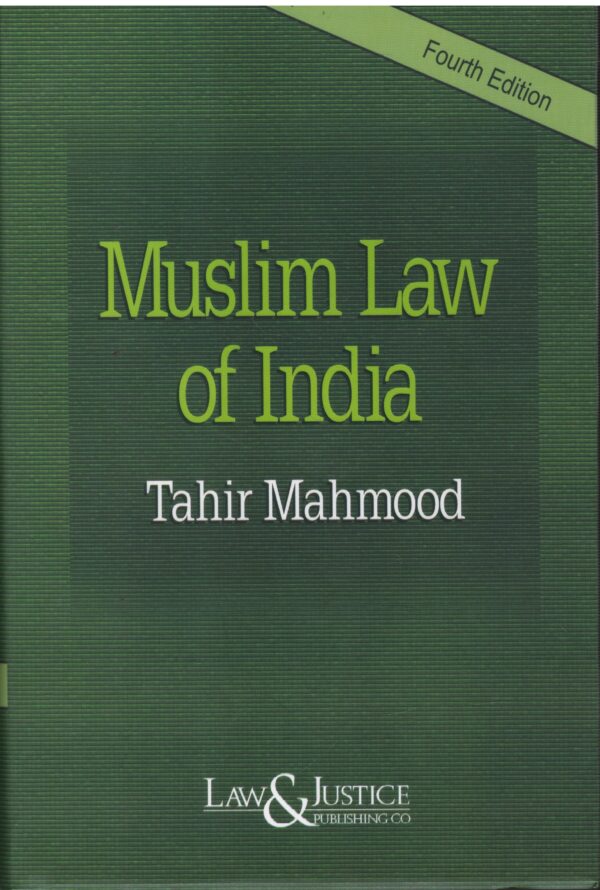
| Tahir Mahmood: From Podium to Press - Socio-Legal Musings Across Decades, edited by Manish Arora and published by Law & Justice Publishing Co., collects the lectures, addresses and press writings of Professor Tahir Mahmood, former Dean of the Faculty of Law at Delhi University, former Chairman of the National Commission for Minorities and former Member of the Law Commission of India. Spanning decades, the pieces range across Muslim personal law, the uniform civil code debate, religion-State relations, minority rights under Articles 29 and 30, family law reform across the Hindu, Muslim, Christian and Parsi systems, the position of women and children, comparative personal law and legal education. Academic addresses and journalistic commentary appear side by side, giving both the considered view and the first public reaction to the questions of the day. English. |


Tags: Family Law, Sociology, Muslim Law, Minority Rights
Tahir Mahmood: From Podium to Press — Socio-Legal Musings Across Decades, edited by Manish Arora and published by Law & Justice Publishing Co., gathers in one volume the lectures, addresses and newspaper writings of Professor Tahir Mahmood, one of India's most cited authorities on religion–State relations, Islamic law and Indian family law.
Professor Mahmood has spent more than fifty years writing in two very different registers. From the podium — as Dean of the Faculty of Law at the University of Delhi, as Chairman of the National Commission for Minorities, as a Member of the Law Commission of India, and from countless university and conference platforms in India and abroad — he addressed lawyers and scholars. In the press, he addressed the general reader, intervening in the public arguments of the day on personal law, minority rights, religious freedom and family law reform as they were actually unfolding. This collection brings the two bodies of work together, so that the considered academic position and the contemporaneous public comment can be read side by side.
Read in sequence, the pieces amount to an informal running commentary on half a century of Indian socio-legal history — the Shah Bano years, the long argument over a uniform civil code, the working of the minority-rights machinery, the reform of Muslim, Hindu and Christian family law, and the shifting relationship between religion and the Indian State.
Key Features
- A collected volume of Professor Tahir Mahmood's lectures, addresses and press writings, edited by Manish Arora
- Published by Law & Justice Publishing Co.
- Spans decades of writing by a scholar frequently cited in the judgments of the Supreme Court and the High Courts
- Covers religion–State relations, Islamic law, minority rights and Indian family law
- Academic addresses and journalistic commentary presented together, giving both the settled view and the first reaction
- Written in accessible prose — usable by the general reader as well as the specialist
- English
Coverage
Muslim Personal Law in India. Marriage, divorce and talaq, maintenance, dower, guardianship and succession under Muslim law as it is applied in India, and the author's long-argued case for reform from within the tradition rather than by abolition of it.
The Uniform Civil Code Debate. Article 44 and the Directive Principles, the judicial observations on a uniform civil code from Shah Bano onward, the distinction between uniformity and reform, and the practical shape a common code could take.
Religion and the State. The constitutional guarantees of freedom of religion, the secular character of the Indian State, religious endowments and institutions, conversion, and the law's treatment of religious practice.
Minority Rights. Articles 29 and 30, minority educational institutions, the working of the National Commission for Minorities, and the gap between the constitutional promise and administrative practice — written by a former Chairman of the Commission.
Family Law Reform. Reform across all the personal-law systems — Hindu, Muslim, Christian and Parsi — together with the secular statutes on marriage, adoption, maintenance and guardianship, and the case for a common law of the family built by consent.
Women, Children and the Family. The position of women under the personal laws, maintenance and matrimonial relief, custody and guardianship of children, and the interaction of personal law with the modern protective statutes.
Comparative and Foreign Law. How Muslim family law has been codified and reformed in other jurisdictions, and what Indian law-making can learn from those experiments.
Legal Education and the Profession. Addresses on legal education, the teaching of personal law, research in law, and the responsibilities of the academic lawyer in public debate.
Occasional Writings. Convocation and memorial addresses, tributes, reflective essays and press columns written across the decades on the questions of the moment.
Who Should Buy This Book?
- Students and teachers of Family Law, Muslim Law and Personal Laws in LL.B., B.A. LL.B. and LL.M. programmes
- Research scholars working on religion and law, minority rights or family law reform
- Advocates practising in matrimonial, family and personal-law matters
- Candidates for judicial service and other examinations with a personal law or constitutional law paper
- Policy professionals, commission and tribunal members, and civil servants dealing with minority affairs
- Journalists and commentators writing on personal law and the uniform civil code
- General readers interested in the public life of Indian law
- Law college, university and institutional libraries
Why Choose This Book?
Collected writings of this kind do something a treatise cannot. A commentary tells the reader what the law is now; this volume shows how a leading scholar argued it into its present shape, and what the arguments looked like before they were settled. For anyone writing on personal law reform, that record of the debate as it happened is hard to find anywhere else in one place.
The second reason is the authority behind it. Professor Mahmood's work is cited in the judgments of the Supreme Court and the High Courts, and he has served on the bodies — the Law Commission of India and the National Commission for Minorities — whose decisions these pieces discuss. The commentary here is that of a participant, not an observer.
The third is readability. Because much of the material was written for the podium and the press rather than the law journal, it is clear, direct and free of apparatus. It is a book that can be read continuously, by a student meeting personal law for the first time or by a practitioner who wants the argument rather than the citations.