
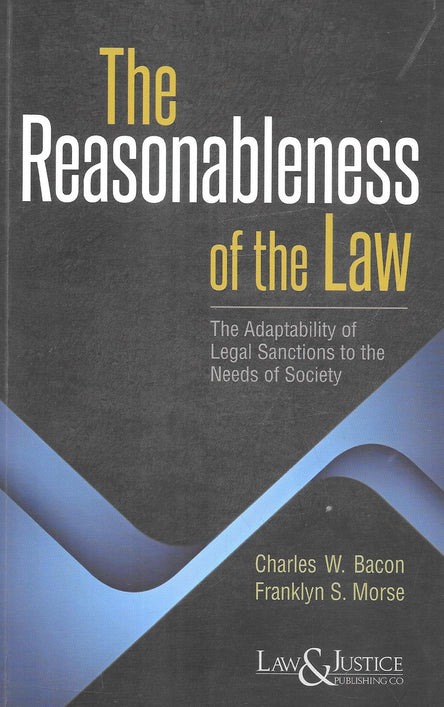
L&J's The Reasonableness of the Law the adaptability of legal sanctions to the needs of society -Edition 2025
| Author : | Charles W. Bacon |
|---|
The Reasonableness of the Law: The Adaptability of Legal Sanctions to the Needs of Society by Charles W. Bacon presents a thoughtful and analytical exploration of how legal systems evolve to meet the changing demands of society. The book examines the principles of reasonableness, flexibility, and proportionality in legal sanctions and discusses the dynamic relationship between law and social progress. Written in a clear and scholarly tone, it is highly relevant for students of jurisprudence, legal theorists, and practitioners interested in the philosophical foundations of law. This edition provides readers with insights into how laws must adjust to remain fair, effective, and socially responsive.


“The Reasonableness of the Law: The Adaptability of Legal Sanctions to the Needs of Society” by Charles W. Bacon is a profound and timeless exploration of how legal systems evolve to meet the changing demands of society. This classic work examines the philosophical foundations of law, the purpose of punishment, and the essential connection between social progress and the development of legal sanctions.
Charles W. Bacon presents a thoughtful and analytical discussion on how law remains relevant only when it aligns with the moral, economic, cultural, and social realities of the time. The book argues that reasonableness is the central pillar of law, and that every legal rule and sanction must adapt to shifting societal needs to remain effective, just, and credible.
The text opens with an in-depth analysis of the nature and scope of legal reasonableness, explaining how judges, lawmakers, and legal institutions use reason as the guiding principle in shaping policy, interpreting statutes, and applying punishment. Bacon compares ancient, medieval, and modern legal systems, demonstrating how each responded to the unique challenges of its era.
A major theme of the book is the adaptability of legal sanctions, where Bacon explains how punishments evolve according to public expectations, technological advancements, demographic changes, and socio-economic pressures. He discusses topics such as:
-
The evolution of punitive philosophy
-
The shift from retributive justice to corrective and rehabilitative sanctions
-
The relationship between individual rights and collective welfare
-
Social progress and the expanding boundaries of legal responsibility
-
Equity, fairness, and proportionality in punishment
-
Judicial discretion and its role in maintaining justice
-
The influence of social values on the interpretation of legal standards
Bacon also highlights how societies move away from rigid legal codes toward flexible, pragmatic, and humane systems that prioritize constructive justice over mere punishment. The book’s analysis includes reflections on community expectations, changing moral norms, and the growing emphasis on reformative justice.
Supported by examples, legal theories, and comparative insights, the book provides readers with a rich understanding of how law is not static but a living institution that must continually evolve. Bacon’s arguments remain relevant to modern debates on criminal justice reforms, regulatory governance, constitutional interpretation, and the dynamic function of courts in shaping societal order.
Written in a scholarly yet accessible style, this book is highly valuable for law students, academicians, jurists, policymakers, sociologists, philosophers, and researchers. It offers a deep theoretical foundation for those studying jurisprudence, legal philosophy, sociology of law, and the evolution of punishments.
Overall, “The Reasonableness of the Law” is a significant contribution to the study of legal theory, demonstrating the enduring truth that law must grow, adapt, and transform with society. Bacon’s insightful analysis continues to inspire modern discussions on justice, fairness, and the role of law in shaping a civilized and progressive society.