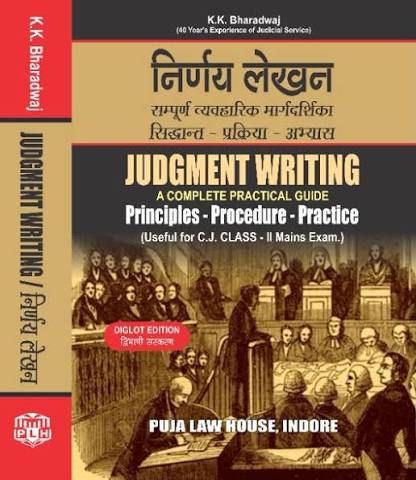
Puja's निर्णय लेखन / Judgment Writing - A Complete Practical Guide (Principles - Procedure - Practice) Diglot - Edition 2026
| Author : | K.K. Bharadwaj |
|---|
| निर्णय लेखन / Judgment Writing — A Complete Practical Guide by K.K. Bharadwaj (Puja Law House, Indore) is a diglot Hindi–English manual on the writing of judgments, drawn from the author's forty years' experience of the judicial service and built on three parts — principles, procedure and practice. It covers what a judgment must contain under Order XX CPC and section 354 CrPC, the structure of a civil judgment from the framing of issues to the decree, the structure of a criminal judgment from the charge to the order on sentence, the appreciation of evidence, appellate and revisional judgments, interlocutory orders, the errors that cause remands, and sets of facts with model judgments for practice. Marked useful for the C.J. Class II Mains Examination. 976 pages. |


Tags: All State Civil Judge Examination, Diglot, Key to Civil Court practice and procedures, Civil Judge ( J.D. ) and H.J.S.
निर्णय लेखन — सम्पूर्ण व्यावहारिक मार्गदर्शिका / Judgment Writing — A Complete Practical Guide: Principles, Procedure, Practice by K.K. Bharadwaj, published by Puja Law House, Indore, is a diglot (Hindi–English) manual on the writing of judgments, drawn from the author's forty years' experience of the judicial service. 976 pages. Marked on the cover as useful for the Civil Judge Class II Mains Examination.
Judgment writing is the one paper in the judicial services examination that cannot be answered from memory. A candidate is handed a set of facts and must produce a judgment that frames the right issues, marshals the evidence against each, applies the law, and reaches a decree or a sentence in the form a court would actually pass. The same skill, once appointed, becomes the daily work of the office. This book treats it as a craft to be taught step by step — the theory, the procedure, and then the practice.
Key Features
- Diglot edition — text in Hindi and English
- Written by an author with 40 years' experience of the judicial service
- Built on three parts — सिद्धान्त (Principles) · प्रक्रिया (Procedure) · अभ्यास (Practice)
- Specifically useful for the C.J. Class II Mains Examination and for higher judicial service papers
- Model and specimen judgments for practice
- 976 pages
- Published by Puja Law House, Indore
Coverage
Principles of Judgment Writing. What a judgment is and what it must contain; the requirements of Order XX of the Code of Civil Procedure and of section 354 CrPC / section 392 BNSS; the difference between a judgment, a decree and an order; the duty to give reasons; and the qualities of a good judgment — clarity, brevity, sequence and finality.
Structure of a Civil Judgment. The cause title and parties; the pleadings summarised; the framing of issues and the burden on each; the evidence of the plaintiff and the defendant set against each issue; the findings with reasons; and the relief and decree, including costs, interest and directions.
Structure of a Criminal Judgment. The prosecution case and the charge; the plea of the accused and the statement under section 313 CrPC / section 351 BNSS; the points for determination; the appreciation of ocular, documentary, medical and circumstantial evidence; the finding of guilt or acquittal; and the order on sentence, including the hearing on sentence and the considerations that govern it.
Appreciation of Evidence. How the evidence is weighed and how the reasoning is set down — the treatment of interested and hostile witnesses, contradictions and omissions, the benefit of doubt, and the standard of proof in civil and in criminal cases.
Appellate and Revisional Judgments. The duty of the first appellate court to deal with the points arising, the scope of second appeal and of revision, and the form of a judgment of remand.
Interlocutory and Miscellaneous Orders. Orders on temporary injunction, attachment, maintenance, bail and other interlocutory applications, and the reasons they must record.
Common Errors. The faults that cost marks in the examination and cause remands in practice — issues wrongly framed, evidence not discussed issue-wise, findings without reasons, relief not moulded to the pleadings, and the operative portion left ambiguous.
Practice (अभ्यास). Sets of facts with model judgments, and exercises for the reader to write, in the pattern of the Civil Judge and higher judicial service papers.
Who Should Buy This Book?
- Candidates for the Civil Judge (Junior Division) and Class II Mains examinations
- Candidates for Higher Judicial Service examinations
- Hindi-medium judicial service aspirants who need both texts together
- Newly appointed judicial officers and probationers
- Judicial academy trainees and their instructors
- Law clerks and research assistants to judges
- Advocates who draft and argue on the form of judgments and orders
- LL.B. students taking practical training papers and moot court
Why Choose This Book?
Most preparation material for the judiciary teaches the law; very little teaches the writing. Yet in the Mains the judgment paper carries heavy marks and is where the strongest candidates separate themselves, because it rewards form as much as knowledge — the issue framed correctly, the evidence discussed under the issue it decides, the operative portion written so that it can be executed.
The strength of this volume is that it comes from forty years on the bench rather than from a coaching syllabus, and that the practice section gives the reader judgments to write rather than only judgments to read. The diglot format also makes it usable in the Hindi-medium states, where the answer is written in Hindi while the authorities and the statutory language are in English — both are on the page.