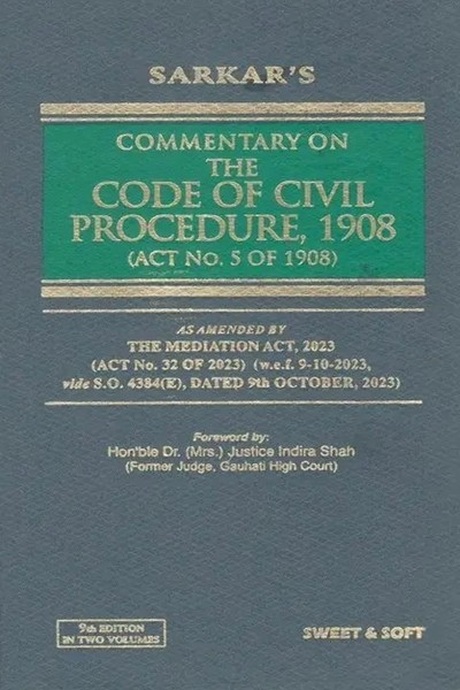
Sarkar's Commentary on The Code of Civil Procedure, 1908 (In 2 Volumes) - 9th Edition
| Author : | SARKAR`S |
|---|
| A two-volume hardbound practitioner's commentary on the Code of Civil Procedure, 1908, as amended by the Mediation Act, 2023 (Act No. 32 of 2023) with effect from 9 October 2023, with a Foreword by Hon'ble Dr. (Mrs.) Justice Indira Shah, former Judge of the Gauhati High Court. Sarkar's commentary, first published in 1937, takes each section and each Order and Rule in turn, states its object and principle, and sets out how the Supreme Court and the High Courts have applied it, noting the Central and State amendments that make civil procedure differ from one jurisdiction to the next. Coverage runs from jurisdiction, res judicata and place of suing through pleadings and amendment, summons and service, temporary injunctions and attachment before judgment, discovery and admissions, issues and evidence, ex parte decrees and restoration, judgment, decree, interest and costs, summary suits under Order XXXVII, suits against the Government and by indigent persons, the whole of execution under Order XXI, appeals, second appeals, reference, review and revision, caveat and compromise, Section 89 as recast by the Mediation Act, and the Commercial Courts Act amendments. 9th Edition, in two volumes, Sweet & Soft. |


Tags: Code Of Civil Procedure, Mediation Law, Civil Trial, Pleadings and Practice
Sarkar's Commentary on the Code of Civil Procedure, 1908 (Act No. 5 of 1908), published by Sweet & Soft, with a Foreword by Hon'ble Dr. (Mrs.) Justice Indira Shah, former Judge, Gauhati High Court, is a two-volume practitioner's commentary on the Code. 9th Edition, in two hardbound volumes.
This edition is as amended by the Mediation Act, 2023 (Act No. 32 of 2023), brought into force with effect from 9 October 2023 vide S.O. 4384(E) dated 9th October 2023. That matters directly to civil practice: the Mediation Act has amended Section 89 of the Code and reworked the statutory scheme for referring a pending suit to mediation, and it sits alongside the pre-institution mediation requirement under the Commercial Courts Act. A CPC commentary that predates it is out of step with the first question a civil court now asks about a new suit.
The Sarkar commentary is among the oldest continuing works on the Code in India, first published in 1937. Its method has not changed: take each section and each Order and Rule in turn, state the object and principle behind it, then set out how the Supreme Court and the High Courts have actually applied it — including the divergences between High Courts and the State amendments that make civil procedure differ materially from one jurisdiction to the next.
Key Features
- Two hardbound volumes covering the Code in full — the sections in the body and the Orders and Rules of the First Schedule.
- Amended by the Mediation Act, 2023 (Act No. 32 of 2023), w.e.f. 9 October 2023, with the consequent changes to Section 89 and court-referred mediation.
- Foreword by Hon'ble Dr. (Mrs.) Justice Indira Shah, former Judge of the Gauhati High Court.
- Section-wise and Order-wise commentary, giving the object and principle of each provision before the case law.
- Supreme Court and High Court decisions collected under the provision they interpret.
- Central and State amendments to the Code noted where they apply — indispensable in a statute as heavily amended State by State as the CPC.
- The Commercial Courts Act, 2015 interface, including the amended procedure for commercial suits and the costs regime.
- Full treatment of execution — the part of the Code that generates the most litigation and the least clarity.
- A commentary first published in 1937 and carried forward through successive editions as a standard civil-side reference.
Coverage
- Jurisdiction of civil courts: Section 9 and the bar of jurisdiction, res judicata under Section 11, res sub judice under Section 10, and the foreign judgment provisions of Sections 13 and 14.
- Place of suing: Sections 15 to 20, territorial and pecuniary jurisdiction, and transfer of suits under Sections 22 to 25.
- Institution of suits and parties: Order I joinder and misjoinder, representative suits, Order II frame of suit, and the consequences of splitting a claim.
- Pleadings: Order VI particulars and amendment, Order VII plaint and rejection of plaint, Order VIII written statement, set-off and counter-claim.
- Summons and service: Order V, substituted service, and service on a defendant outside the jurisdiction.
- Interlocutory proceedings: Order XXXVIII attachment before judgment, Order XXXIX temporary injunctions and the three-fold test, Order XL receivers, and the inherent power under Section 151.
- Discovery, inspection and admissions: Orders XI and XII, interrogatories, production of documents, and judgment on admissions.
- Issues, hearing and evidence: Orders XIV, XVI, XVII and XVIII, examination-in-chief on affidavit, adjournments and costs.
- Ex parte proceedings and restoration: Order IX, dismissal for default, and setting aside an ex parte decree.
- Judgment and decree: Order XX, preliminary and final decrees, interest under Section 34, and costs under Sections 35, 35A and 35B.
- Summary procedure: Order XXXVII and leave to defend.
- Special suits and parties: suits by or against the Government under Section 80, minors and persons of unsound mind under Order XXXII, indigent persons under Order XXXIII, partnership firms, interpleader suits and suits relating to public charities.
- Execution of decrees: Sections 36 to 74 and Order XXI — transfer of decree, modes of execution, attachment and sale of property, arrest and detention, objections to attachment, and the adjudication of claims by third parties.
- Appeals: first appeals under Section 96 and Order XLI, second appeals and the substantial question of law under Section 100, appeals from orders under Order XLIII, and Letters Patent appeals.
- Reference, review and revision: Sections 113, 114 and 115, with Order XLVI and Order XLVII.
- Caveat, withdrawal and compromise: Section 148A, Order XXIII, and the recording of a lawful compromise.
- Section 89 and alternative dispute resolution as recast by the Mediation Act, 2023, together with the pre-institution mediation requirement in commercial suits.
- Commercial Courts Act, 2015 amendments to the Code: case management hearings, the amended Order XI disclosure regime, verification of pleadings, and actual costs.
- Limitation and procedure interface, condonation of delay, and the Code's residual and inherent powers.
Who Should Buy This Book?
- Civil side advocates practising before the District Courts, Commercial Courts and High Courts.
- Judges and judicial officers of the civil courts, for whom the Code is the daily instrument.
- Execution practitioners, given the volume's full treatment of Order XXI.
- Law firms with a civil and commercial litigation practice, and in-house counsel managing recovery and contractual suits.
- Judicial service aspirants at both the Civil Judge and Higher Judicial Service levels, where the CPC is a core paper.
- LL.B. and LL.M. students of Civil Procedure needing a reference beyond the standard textbook.
- Law libraries, bar associations and court libraries maintaining a current CPC commentary.
Why Choose This Book?
The Code of Civil Procedure is not a difficult statute to read and is a very difficult one to practise. Its working rules sit in the interaction between a section and an Order, in the State amendment that applies in your High Court and not in the next, and in a century of judicial gloss on words like "sufficient cause" and "substantial question of law". A full-length two-volume commentary is not a luxury here; it is the only format that can carry that material.
What recommends this edition specifically is its currency to the Mediation Act, 2023. The amendment to Section 89 is small in word count and large in consequence — it changes how and when a civil court refers a pending suit out to mediation, and it has to be read with the pre-institution mediation requirement that already governs commercial suits. For a practitioner replacing an older CPC commentary, that is the single clearest reason to move to this one. The foreword by Hon'ble Dr. (Mrs.) Justice Indira Shah, former Judge of the Gauhati High Court, speaks to the volume's standing on the bench side as well as at the bar.