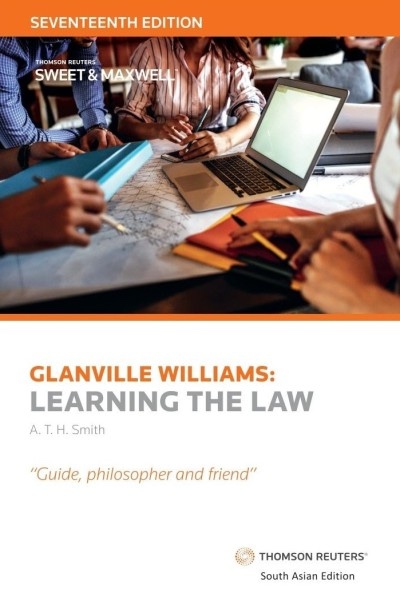
Sweet & Maxwell's Glanville Williams: Learning The Law By A. T. H. Smith - 17th South Asian Edition
| Author : | A. T. H. Smith |
|---|
| Glanville Williams: Learning the Law by A. T. H. Smith is the Seventeenth Edition of the classic introduction to studying law, published by Sweet & Maxwell (Thomson Reuters) in a South Asian Edition. First published in 1945, it has introduced students to the foundation skills needed to study law effectively for over seventy years, and is described on its own cover as a “guide, philosopher and friend”. It covers the divisions and sources of law, how to read and use case law and statutes, legal reasoning and argument, methods of study, note-taking, legal research and writing, answering problem and essay questions, examination technique, mooting, and the choices open to a law graduate. Paperback, 289 pages. |


Tags: Research & Legal Methodology, Legal Research And Writing, Legal Method, Foreign & International Book's in indian Reprint
Glanville Williams: Learning the Law by A. T. H. Smith is the Seventeenth Edition of the book that has taught generations of students how to study law. Published by Sweet & Maxwell (Thomson Reuters) in a South Asian Edition, it carries on its cover the description that has followed it for decades: “guide, philosopher and friend”.
First published in 1945, this is not a textbook on any branch of law. It is a book about how to do law — how to read a case, how to use a statute, how to construct an argument, how to research, how to write, and how to sit an examination. Those skills are assumed by every other book on a law student's shelf and taught explicitly by almost none.
Key Features
- Seventeenth Edition, South Asian Edition
- Published by Sweet & Maxwell / Thomson Reuters
- In print and continuously revised since 1945 — over seventy years
- Revised by Professor A. T. H. Smith
- Covers the foundation skills needed to study law effectively
- Paperback, 289 pages
- Affordably priced South Asian Edition of a leading UK title
What the Book Covers
The book begins with the divisions and sources of law and the vocabulary a new student meets, then turns to the two skills at the centre of legal study: reading and using case law — law reports, ratio and obiter, precedent and how to distinguish a case — and reading and interpreting statutes.
It then addresses legal reasoning and argument, and the practical craft of study: methods of working, note-taking, use of the library and electronic sources, legal research and citation. A substantial part is devoted to writing — answering problem questions and essay questions, structuring an argument, and the standard of English expected of a lawyer.
Later chapters cover examination technique, mooting and oral argument, and the question every student eventually faces — the career choices open to a law graduate, at the Bar, in a solicitor's office, and beyond legal practice altogether.
Who Should Buy This Book?
- First-year law students beginning an LL.B. or B.A. LL.B.
- Students of the five-year integrated law programmes
- LL.M. students and those returning to legal study
- Students preparing for moots and legal writing competitions
- Candidates for judicial service and other law examinations wanting to sharpen answer technique
- Law teachers and tutors guiding first-year students
- Law college and university libraries
- Anyone considering law as a career and wanting to know what studying it involves
Why Choose This Book?
Most law books tell a student what the law is. Very few tell them how to learn it, and fewer still are written well enough to be read for pleasure. Learning the Law has survived eighty years and seventeen editions because it does both, and because it is honest about what legal study actually demands.
The South Asian Edition makes a title long regarded as standard in the United Kingdom available at a price suited to students here — which is why it is so often the first book recommended to a new law student.