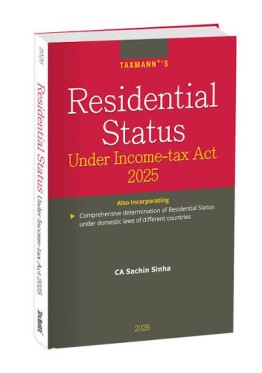
Taxmann's Residential Status Under Income-tax Act 2025 - 1st Edition 2026
| Author : | CA Sachin Sinha |
|---|
| Taxmann's Residential Status under Income-tax Act 2025 by CA Sachin Sinha is a single-subject treatise devoted entirely to the determination of residential status, being the 1st Edition updated till August 2026. Written on the new Income-tax Act, 2025, it carries more than fifty bracketed in-line mappings tying each provision to its Income-tax Act, 1961 counterpart in both directions, and a dedicated chapter of nineteen FAQs on the repeal and savings clause. It covers the individual residence tests, RNOR, deemed residency, HUF, firm and AOP, company residence and POEM, trusts, the Tax Residency Certificate, GAAR, and the treaty tie-breaker under Article 4, with a full chapter comparing the domestic residence rules of eleven other jurisdictions. Fifteen worked case studies, day-count and computation tables and a 63-entry List of Cases carry the arithmetic in full. Hardbound, 196 pages. |


Tags: Income Tax, International Taxation, Income Tax Bill, INCOME TAX 2026
Taxmann's Residential Status under Income-tax Act 2025 by CA Sachin Sinha is a single-subject treatise, written for the practitioner who must reach a defensible conclusion on a residence question and produce the working to support it. The Present Publication is the 1st Edition, updated till August 2026.
It is among the first titles to restate residence law under the new enactment, and is built for the transition: more than fifty bracketed in-line mappings tie each provision to its Income-tax Act, 1961 counterpart in both directions, and a dedicated chapter of nineteen FAQs deals with the repeal, the savings clause and the questions that arise when a taxpayer's history straddles the two Acts.
Key Features
- 1st Edition, 2026 – updated till August 2026
- Written on the Income-tax Act, 2025, with dual-Act usability
- Over fifty in-line mappings to the Income-tax Act, 1961, running both ways
- A transition chapter of nineteen FAQs on repeal, savings and reassessment after 1st April 2026
- The author takes positions where the authorities conflict, and says so where a point cannot be settled
- A full chapter on the residence rules of eleven other jurisdictions
- Primary material reproduced, not paraphrased — OECD Commentary on Article 4, UN Model Commentary, CBDT Guiding Principles on POEM
- Fifteen worked case studies on dated fact patterns, with full workings
- Day-count, year-wise stay, income-analysis and country-snapshot tables
- Aligned to the 2026 Rules and Forms — Rule 8, Rule 75, Rule 76 and Forms 41 and 42
- 63-entry List of Cases, indexed by paragraph number rather than page
- Hardbound, 196 pages
Important Areas Covered
The book opens by inventorying the provisions across the Act whose operation turns on residential status — the charging and scope provisions, resident-only benefits, provisions confined to non-residents, transfer pricing, agency and withholding — then works through the terms they turn on, including 'business controlled in India' against 'business controlled from India', 'set up' and 'ordinarily resident'.
The individual residence tests receive the most computation-heavy treatment: the 182-day and alternative tests, the treatment of arrival and departure dates, the meaning of 'day' and 'year', 'leaves India for the purposes of employment', visa category, crew members under Rule 8, evidence of days and lost passports, the visiting-NRI relaxation and a fully worked computation of the fifteen-lakh threshold. Separate chapters address HUF, firm and AOP, the deemed resident and 'liable to tax', and the three RNOR limbs with worked examples.
Company residence is treated at length, breaking the POEM definition into its five constituent phrases, with CBDT Circular No. 6 of 2017 reproduced in full including the active-business test, the two-stage process and five worked illustrations. Further chapters cover the interplay of GAAR with the residence test, the residence of specific and discretionary trusts, the Tax Residency Certificate traced from Circular No. 789 through Azadi Bachao Andolan to Blackstone Capital Partners and Tiger Global, and the treaty tie-breaker under Article 4 with the OECD Commentary reproduced paragraph by paragraph alongside member States' Observations and Reservations.
The comparative chapter covers Singapore, Mauritius, the UAE, the United Kingdom, the United States, Australia, China, France, Germany, Hong Kong and the Netherlands, each for individuals and companies, including the UK Statutory Residence Test, the US Substantial Presence Test, the Chinese six-year rule and the Dutch durable-personal-ties approach.
Who Should Buy This Book?
Taxmann's Residential Status under Income-tax Act 2025 is intended for:
- Chartered Accountants and Tax Practitioners advising internationally mobile individuals, expatriates, seafarers, NRIs, PIOs and returning Indians
- International Tax and Transfer Pricing Specialists handling treaty entitlement, tie-breaker analysis and POEM exposure
- Corporate Tax Teams and In-house Counsel of multinational groups with foreign subsidiaries or offshore management arrangements
- Advocates and Litigators appearing in residency, treaty-benefit, TRC and GAAR disputes
- Officers of the Tax Administration assessing residence claims, deemed residency cases and POEM determinations
- Trustees, Fiduciaries and Private Client Advisers determining the status of specific and discretionary trusts
- Payers and Withholding-tax Teams who must classify a payee before deducting tax
- NRIs, HNIs and Globally Mobile Professionals with income and homes in more than one country
- Academicians, Faculty and Advanced Students of international taxation
- Candidates for the CA Final and the ICAI Diploma in International Taxation
Why Choose Taxmann's Residential Status under Income-tax Act 2025?
Residence is the question on which a great deal of Indian tax liability turns, and it is now being asked under a brand-new statute while positions taken under the 1961 Act are still live. A general commentary gives the topic a few pages. This book gives it a volume, and is built so that a reader carrying forward an old position can follow it across the change without a separate concordance.
It is also written to be worked from rather than merely read: dated fact patterns, day-count tables, computation tables with a Remarks column and roughly two dozen inline worked examples give the reader arithmetic to follow rather than propositions to accept. Where the authorities conflict, the author reasons to a stated conclusion — and where an answer is genuinely unavailable, he leaves the question open rather than papering over it.