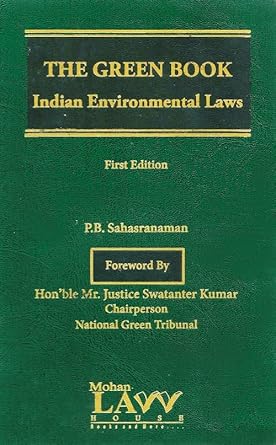
The Green Book Indian Environmental Laws - 1st Edition 2017
| Author : | P.B Sahasranaman |
|---|
The Green Book: Indian Environmental Laws (1st Edition, 2017) is a comprehensive guide to India’s environmental legal framework. It covers key statutes such as the Environment (Protection) Act, Water Act, Air Act, Forest Conservation Act, Wildlife Protection Act, and Biodiversity Act, along with landmark Supreme Court and NGT judgments. Ideal for law students, advocates, judicial service aspirants, environmental professionals, and policy researchers.


Tags: Environmental Law
The Green Book: Indian Environmental Laws – 1st Edition, 2017 is a comprehensive and authoritative reference work that brings together the core framework of environmental law in India in a structured, accessible, and practitioner-friendly manner. Designed to serve as a ready guide, this book provides an in-depth understanding of the statutory, regulatory, and judicial dimensions governing environmental protection and sustainable development in India.
The book systematically covers all major environmental legislations, including the Environment (Protection) Act, 1986, Water (Prevention and Control of Pollution) Act, 1974, Air (Prevention and Control of Pollution) Act, 1981, Forest (Conservation) Act, 1980, Wildlife (Protection) Act, 1972, Biological Diversity Act, 2002, and allied rules, notifications, and regulations. It also explains the role and powers of regulatory bodies such as the Central Pollution Control Board (CPCB), State Pollution Control Boards (SPCBs), and the National Green Tribunal (NGT).
A key strength of The Green Book lies in its clear explanation of environmental principles such as sustainable development, precautionary principle, polluter pays principle, public trust doctrine, environmental impact assessment (EIA), and inter-generational equity. These principles are discussed in the context of leading Supreme Court and High Court judgments, helping readers understand how environmental jurisprudence has evolved in India.
The book also addresses practical compliance aspects, including environmental clearances, consent mechanisms, penalties, offences, liability, and enforcement procedures. It offers valuable insights into litigation before the National Green Tribunal, writ jurisdiction of constitutional courts, and remedies available for environmental violations.
Written in a concise yet analytical style, this book is especially useful for law students, environmental law practitioners, judicial service aspirants, civil service candidates, academicians, policymakers, NGOs, corporate compliance professionals, and environmental consultants. It serves both as a foundational text for beginners and a quick reference guide for experienced professionals.
Despite being the 1st Edition (2017), The Green Book: Indian Environmental Laws remains a relevant and trusted resource for understanding the conceptual and statutory foundations of environmental regulation in India, making it an essential addition to any legal or academic library focused on environmental and sustainability law.