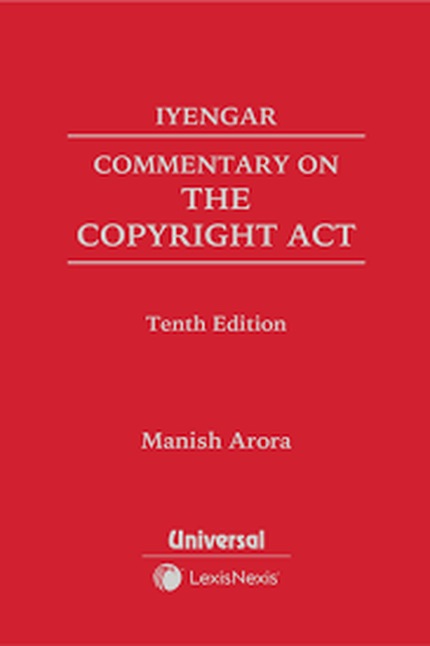
Universal LexisNexis's Iyengar's Commentary on the Copyright Act - Tenth Edition 2026
| Author : | MANISH ARORA |
|---|
| Iyengar's Commentary on the Copyright Act, revised by Manish Arora (Universal / LexisNexis, Tenth Edition), is a section-wise commentary on the Copyright Act, 1957 and the Copyright Rules, running to about 1,630 pages. It covers the subject matter of copyright and the requirement of originality, ownership and term including works made in employment and commissioned works, the exclusive rights under section 14, the author's moral rights under section 57, assignment and licensing with the statutory royalty protections, compulsory and statutory licences, copyright societies, registration, fair dealing and the exceptions under section 52, infringement including substantial similarity and online and intermediary liability, civil remedies including John Doe and Anton Piller orders, offences and penalties, and international copyright under Berne, TRIPS and the WIPO treaties. Hardbound. ISBN 9789391211882. |


1630

English

Tenth Edition

Tags: Copyright Law, Intellectual Property Law, Media & Entertainment, Legal Commentary
Iyengar's Commentary on the Copyright Act, revised by Manish Arora and published by Universal / LexisNexis, is a section-wise commentary on the Copyright Act, 1957 and the Copyright Rules. This is the Tenth Edition. Hardbound, approximately 1,630 pages. ISBN 9789391211882.
Copyright is the intellectual property right that reaches furthest into ordinary commerce. It governs the publishing contract and the film assignment, the software licence and the database, the music royalty and the broadcast, the photograph on a website and the article behind a paywall. It is also the right most exposed to technological change — each new means of copying and distribution has forced the courts to decide again what reproduction, communication to the public and fair dealing mean. A full commentary is the instrument for those questions, and the Iyengar work has been the Indian standard through successive editions.
Key Features
- Tenth Edition, published by Universal / LexisNexis
- Section-wise commentary on the Copyright Act, 1957 with the Copyright Rules
- Revised by Manish Arora, a well-known editor of Indian intellectual property titles
- Supported by the decisions of the Supreme Court and the High Courts, and by English and other foreign authority where Indian law follows it
- Covers the international conventions and India's treaty obligations
- Hardbound · approximately 1,630 pages · English
Coverage
Subject Matter of Copyright. The works in which copyright subsists — original literary, dramatic, musical and artistic works, cinematograph films and sound recordings; the requirement of originality and the modicum of creativity; the idea-expression dichotomy; computer programmes and databases; and works in which copyright does not subsist.
Ownership and Term. The first owner of copyright; works made in the course of employment and under a contract of service; commissioned works; works of joint authorship; Government works and works of public undertakings; and the term of copyright for each class of work.
Rights Conferred. The exclusive rights under section 14 for each class of work — reproduction, issue of copies, performance, communication to the public, adaptation and translation; the rights of the author of a computer programme; and the special provisions for cinematograph films and sound recordings.
Moral Rights. The author's special rights under section 57 — the right of paternity and the right of integrity — and their survival independent of assignment.
Assignment and Licensing. Assignment of copyright and the formalities required; the mode and duration of assignment; royalties and the statutory protections for authors and composers; voluntary licences; compulsory licences for works withheld from the public and for the benefit of persons with disabilities; and statutory licences for broadcasting and for cover versions.
Copyright Societies and Royalties. Registration and functioning of copyright societies, tariff schemes, and the collection and distribution of royalties.
Registration of Copyright. The Register of Copyrights, the procedure for registration, rectification, and the evidentiary value of registration.
Fair Dealing and Exceptions. The acts that do not constitute infringement under section 52 — private and personal use, research, criticism and review, reporting of current events, judicial proceedings, educational use, and the exceptions for libraries, for computer programmes and for accessible-format copies.
Infringement. What constitutes infringement, the tests of substantial similarity and of access and copying; secondary infringement; the importation of infringing copies; and infringement in the digital environment, including online and intermediary liability and the technological protection measures and rights management information provisions.
Civil Remedies. Injunctions, including interlocutory and John Doe orders; damages and accounts of profits; delivery up; Anton Piller orders; and jurisdiction of the court.
Offences and Penalties. The criminal provisions, search and seizure, and the powers of the police and of the customs authorities.
Copyright Board and Appeals. The adjudicating authority and the appellate route.
International Copyright. The Berne Convention, the Universal Copyright Convention, TRIPS and the WIPO treaties; the International Copyright Order; and the protection of foreign works in India.
Who Should Buy This Book?
- Intellectual property practitioners and litigators
- Counsel appearing in copyright infringement and passing-off suits
- Media, entertainment and publishing lawyers
- In-house counsel of film, music, broadcasting, publishing and software companies
- Copyright societies and royalty collection bodies
- Judges of the commercial and IP divisions of the High Courts
- Officers of the Copyright Office and enforcement agencies
- Academicians and LL.M. students of intellectual property law
- Law firm and institutional libraries
Why Choose This Book?
Copyright disputes turn on questions a short text cannot settle — whether what was taken is a substantial part, whether the use falls within fair dealing, who owns a work made by a freelancer, whether an assignment covers a medium that did not exist when it was signed. Those are answered from a line of authority, and a section-wise commentary of this scale is what makes that line findable.
The international chapters are the second reason. Copyright is treaty-driven to an unusual degree: Indian law is shaped by Berne and TRIPS, foreign works are protected here through the International Copyright Order, and Indian courts cite English, American and Australian decisions freely because the underlying concepts are shared. A commentary that carries the conventions and the comparative authority alongside the Indian sections reflects how the subject is actually argued.