Bharat's AIBE-28 Income Tax Act, 1961 - Bare Act Without Notes - Edition 2027
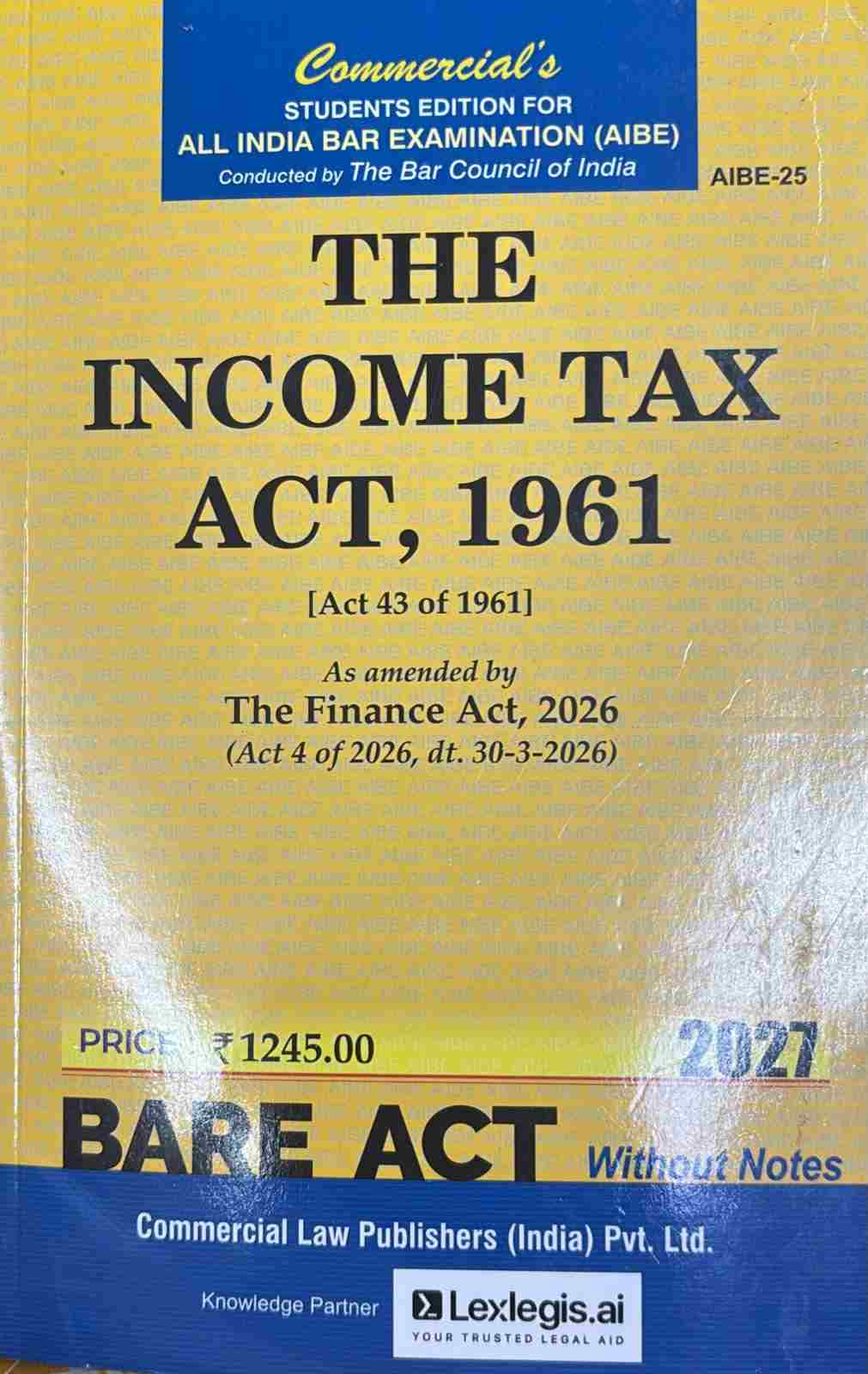
| The Income Tax Act, 1961 as a bare act without notes, published as AIBE-28 in Bharat's numbered All India Bar Examination series and intended as study material for the AIBE conducted by the Bar Council of India — the format the Bar Council permits in the open-book examination hall. This edition is amended by the Finance Act, 2026, whose provisions take effect from different dates, and by the Tribunals Reforms Act, 2026 with effect from 25 August 2026, which repeals the Tribunals Reforms Act, 2021 and reworks the framework within which the Income Tax Appellate Tribunal is constituted. The text runs from the definitions and the basis of charge through residential status and scope of total income, the exemptions, the five heads of income, clubbing and set off and carry forward of losses, Chapter VI-A deductions, double taxation relief, transfer pricing and anti-avoidance, the income tax authorities, the procedure for assessment, reassessment and search assessment, liability in special cases, deduction at source, advance tax, interest, recovery and refunds, appeals to the Commissioner (Appeals), the Appellate Tribunal, the High Court and the Supreme Court, and the penalty, offence and prosecution provisions. 2027 Edition, Bharat Law House Pvt. Ltd. |


Tags: All India Bar Examination, Income Tax, BARE ACT, New Finance Act, 2026-2027
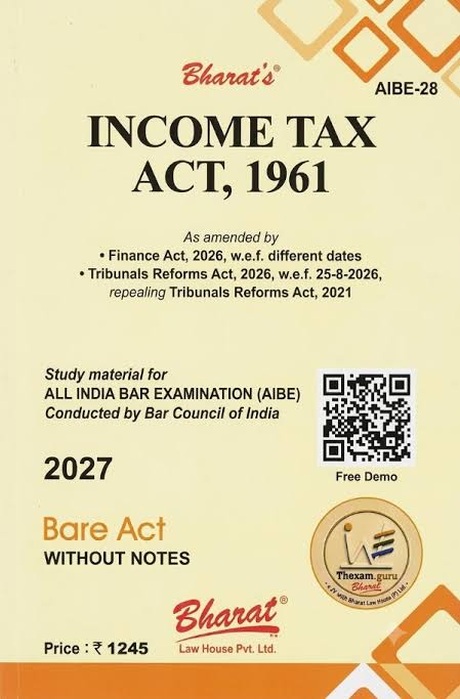
Bharat's Income Tax Act, 1961 — AIBE-28, Bare Act Without Notes, published by Bharat Law House Pvt. Ltd. 2027 Edition. Study material for the All India Bar Examination conducted by the Bar Council of India.
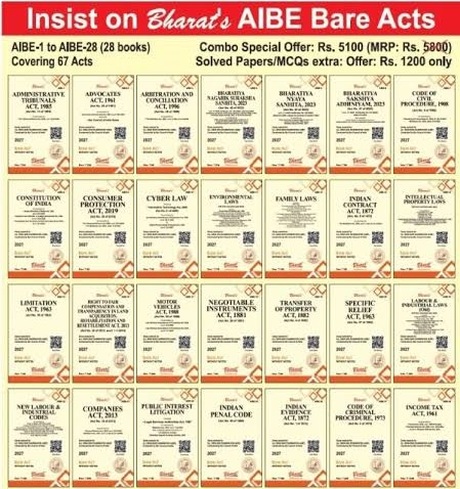
This is volume 28 of Bharat's AIBE bare act series, and it is published in the form the examination requires: the bare text, without notes. That is not a limitation but the point. The AIBE is an open-book examination and the Bar Council permits bare acts without commentary into the hall — an annotated edition is of no use to a candidate because it cannot be carried in. A volume in the wrong format is a volume left outside.
The edition is current to two significant amendments. It incorporates the Finance Act, 2026, whose provisions take effect from different dates, and the Tribunals Reforms Act, 2026 with effect from 25 August 2026, which repeals the Tribunals Reforms Act, 2021. The second of those matters for the Income Tax Act because the Appellate Tribunal provisions — its constitution, the qualifications and tenure of its Members — sit within the tribunals framework that the 2026 Act has replaced.
Key Features
- Bare Act without notes — the format permitted in the AIBE examination hall.
- Published as AIBE-28 in Bharat's numbered All India Bar Examination series.
- As amended by the Finance Act, 2026, with effect from the different dates specified.
- As amended by the Tribunals Reforms Act, 2026, with effect from 25 August 2026, repealing the Tribunals Reforms Act, 2021.
- Study material for the All India Bar Examination conducted by the Bar Council of India.
- 2027 Edition, from Bharat Law House Pvt. Ltd.
- Carries a QR code for a free demo of the publisher's associated study resources.
Coverage
- Preliminary and definitions — assessee, assessment year, previous year, person, income and the interpretation clauses.
- Basis of charge — residential status, scope of total income, and income deemed to accrue or arise in India.
- Incomes which do not form part of total income, including the exemptions under Section 10 and the provisions on charitable and religious trusts.
- Heads of income — salaries, income from house property, profits and gains of business or profession, capital gains, and income from other sources.
- Income of other persons included in the assessee's total income, clubbing provisions, and the set off and carry forward of losses.
- Deductions to be made in computing total income — Chapter VI-A.
- Rebates and reliefs, and double taxation relief.
- Special provisions relating to avoidance of tax, transfer pricing, and the General Anti-Avoidance Rule.
- Income tax authorities — their appointment, jurisdiction and powers.
- Procedure for assessment — return of income, self-assessment, regular assessment, best judgment assessment, reassessment, and search assessment.
- Liability in special cases — representative assessees, legal representatives, firms, companies and successors.
- Collection and recovery of tax — deduction at source, advance tax, interest and the recovery machinery.
- Refunds, and the provisions on interest on refunds.
- Settlement, appeals and revision — appeal to the Commissioner (Appeals), the Appellate Tribunal as constituted under the tribunals framework, reference and appeal to the High Court, and appeal to the Supreme Court.
- Penalties imposable and the provisions on immunity and waiver.
- Offences and prosecutions, and compounding.
- Miscellaneous provisions and the Schedules.
Who Should Buy This Book?
- AIBE candidates — law graduates sitting the All India Bar Examination, for whom this is the prescribed-format volume for the taxation component.
- Candidates building the AIBE set volume by volume, or replacing a single outdated title.
- Final-year LL.B. and B.A. LL.B. students taking Taxation Law, who want the bare text at hand.
- Junior advocates wanting an inexpensive, current copy of the Act for chamber use.
- Chartered Accountancy and Company Secretary students needing an unannotated reference copy.
- Coaching institutes and law college libraries running AIBE preparation.
Why Choose This Book?
Two things make a bare act of the Income Tax Act worth buying new rather than using an old copy. The first is that the Act is amended every single year by the Finance Act, and the amendments are not cosmetic — rates, thresholds, procedural timelines and entire chapters move. A copy that is two Finance Acts behind is actively misleading. The second is this year's Tribunals Reforms Act, 2026, which took effect on 25 August 2026 and repealed the 2021 Act, reworking the framework within which the Income Tax Appellate Tribunal is constituted.
For an AIBE candidate specifically, the format is the deciding factor. "Bare Act without notes" is what the Bar Council permits, and buying a commentary edition by mistake — however good the commentary — means arriving at the hall without a usable copy of the Act. This volume is published for that purpose, numbered to match the rest of the series, so it slots straight into a set assembled title by title.