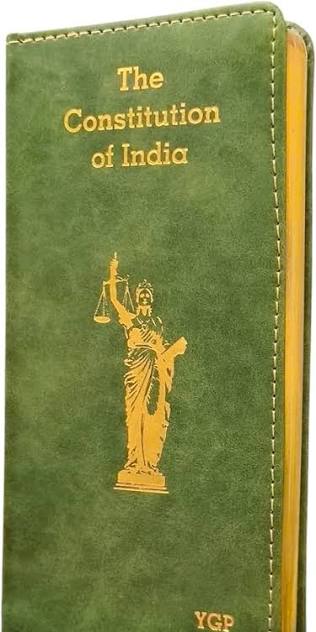
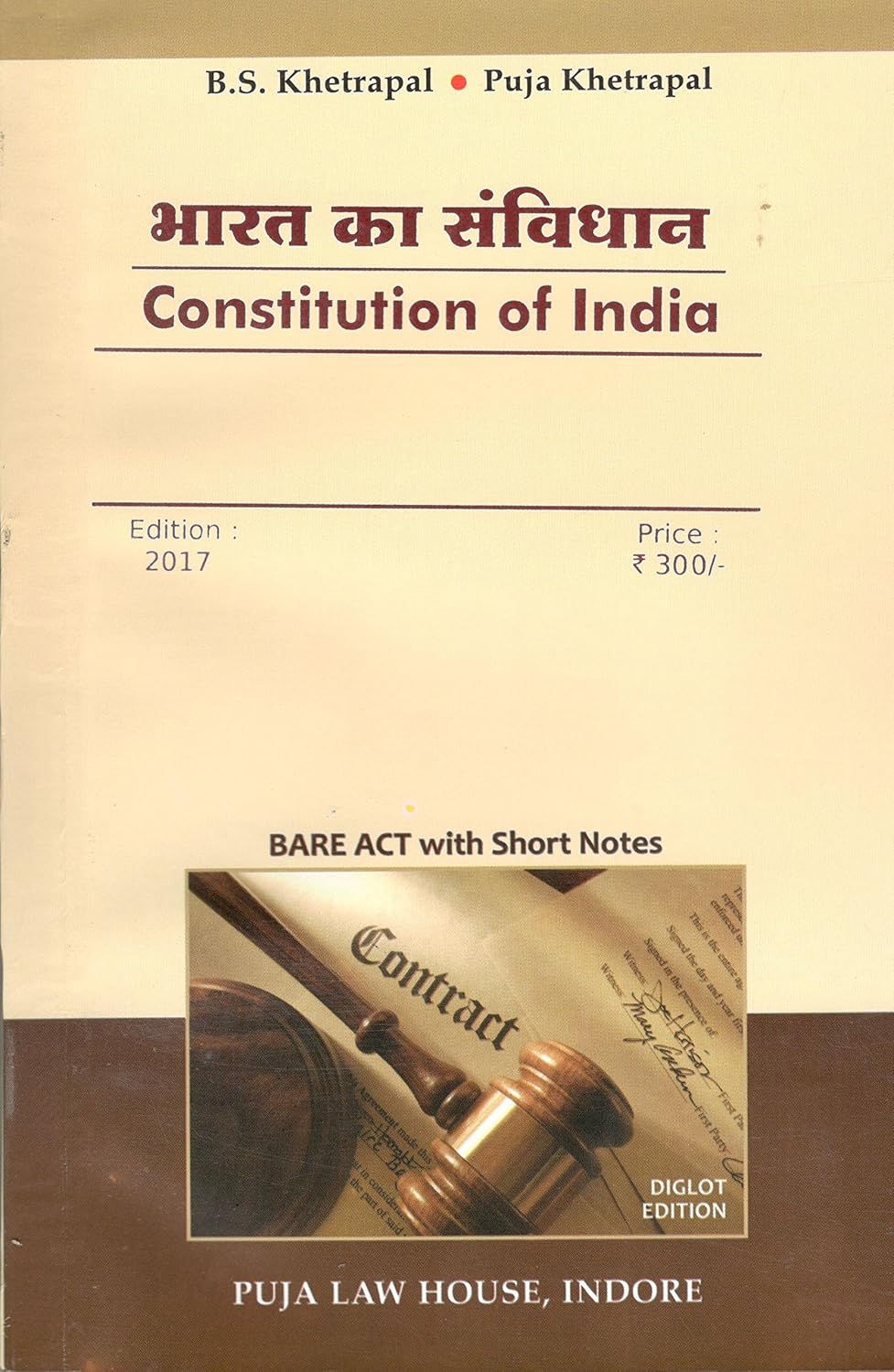
Puja's भारत का संविधान / Constitution of India - Bare Act with Short Notes (Diglot) - Edition 2026
| Puja Law House's भारत का संविधान / Constitution of India by B.S. Khetrapal and Dr. Puja Khetrapal is a diglot (Hindi–English) Bare Act with short notes, carrying the complete text of the Constitution in both languages with the latest citations of the Supreme Court and the High Courts under each Article. Against the provisions that recur in examinations it records where the question appeared — CJ, ADJ, PSC and ADPO — making it a revision volume as well as a bare act. Covers the Preamble, Fundamental Rights, Directive Principles and Fundamental Duties, the Union and the States, the Supreme Court and the High Courts, Union–State relations, services and tribunals, official language, emergency provisions, amendment of the Constitution and all twelve Schedules. 512 pages. |


Tags: All State Civil Judge Examination, Constitutional of India, Diglot, BARE ACT
Puja Law House's भारत का संविधान / Constitution of India by B.S. Khetrapal and Dr. Puja Khetrapal, published by Puja Law House, Indore, is a diglot (Hindi–English) Bare Act with short notes — the full text of the Constitution set out in both languages, with the latest citations and with competitive-examination questions attached to the provisions they were asked on. 512 pages.
A bare act of the Constitution is a book a law student, an examinee and a practitioner each use differently, and this edition is built to serve all three. The Hindi and English texts run together, which matters in the Hindi-medium judicial services where the paper is set in Hindi but the authorities are reported in English. The short notes carry the leading decisions under each Article. And against the provisions that recur in examinations, the book records where the question appeared — CJ, ADJ, PSC and ADPO.
Key Features
- Diglot edition — complete text in Hindi and English
- Bare Act with short notes under each Article
- Latest citations of the Supreme Court and the High Courts
- Competitive examination questions, with a reference to each Article as it appeared in CJ, ADJ, PSC and ADPO examinations
- 512 pages
- Published by Puja Law House (Khetrapal Publications), Indore
Coverage
The Preamble and Part I — The Union and its Territory. Articles 1 to 4, the name and territory of the Union, admission and formation of new States, and alteration of boundaries.
Part II — Citizenship. Articles 5 to 11, citizenship at the commencement of the Constitution and the power of Parliament to regulate it.
Part III — Fundamental Rights. Articles 12 to 35 — the definition of "State" and the doctrine of eclipse and severability under Article 13; equality under Articles 14 to 18; the freedoms under Article 19 and the reasonable restrictions on them; protection in respect of conviction and the rights of the accused under Articles 20 to 22; the prohibition of traffic in human beings and child labour under Articles 23 and 24; freedom of religion under Articles 25 to 28; cultural and educational rights of minorities under Articles 29 and 30; and constitutional remedies and the writs under Article 32.
Part IV and IV-A — Directive Principles and Fundamental Duties. Articles 36 to 51A, the directive principles of State policy and their relationship with Part III, and the fundamental duties of the citizen.
Parts V and VI — The Union and the States. The President, the Council of Ministers, the Attorney-General, Parliament and its legislative procedure, the Supreme Court under Articles 124 to 147; and the Governor, the State legislature and the High Courts under Articles 214 to 231, together with the subordinate judiciary under Articles 233 to 237.
Parts IX, IX-A and IX-B — Local Self-Government. Panchayats, Municipalities and Co-operative Societies.
Part XI — Relations between the Union and the States. The distribution of legislative powers, the residuary power, and the administrative relations.
Parts XII to XV. Finance, property, contracts and suits; trade and commerce under Articles 301 to 307; services under the Union and the States and the Public Service Commissions; tribunals under Articles 323A and 323B; and elections and the Election Commission.
Parts XVI to XXII. Special provisions relating to certain classes; the official language under Articles 343 to 351; emergency provisions under Articles 352 to 360; miscellaneous provisions; the amendment of the Constitution under Article 368; and the temporary, transitional and special provisions.
Schedules. All twelve Schedules, including the Seventh Schedule legislative lists, the Eighth Schedule languages, and the Ninth, Tenth, Eleventh and Twelfth Schedules.
Who Should Buy This Book?
- Candidates for Civil Judge (CJ) and Additional District Judge (ADJ) examinations
- Candidates for State PSC and ADPO examinations
- Hindi-medium judicial service aspirants who need both texts side by side
- LL.B. and B.A. LL.B. students of Constitutional Law
- Advocates practising in constitutional and writ matters
- Judicial officers and court staff
- Government officers and public servants
- Law libraries and coaching institute collections
Why Choose This Book?
The Constitution is set in an examination twice over: once as text, where the exact words of an Article decide the answer, and once as authority, where the leading case decides it. A plain bare act gives the first and not the second; a commentary gives the second at a length no one can revise from. This edition sits between them — the full text, with short notes carrying the citations, in a single 512-page volume.
The diglot format is the practical reason to prefer it in the Hindi-belt judiciaries. A candidate writing in Hindi still has to read and cite judgments reported in English, and having the official Hindi text of an Article printed against the English removes the step of translating back. The examination references against each Article — showing where it was asked in CJ, ADJ, PSC and ADPO papers — also make it possible to revise by what has actually been tested rather than by reading the whole Constitution evenly.