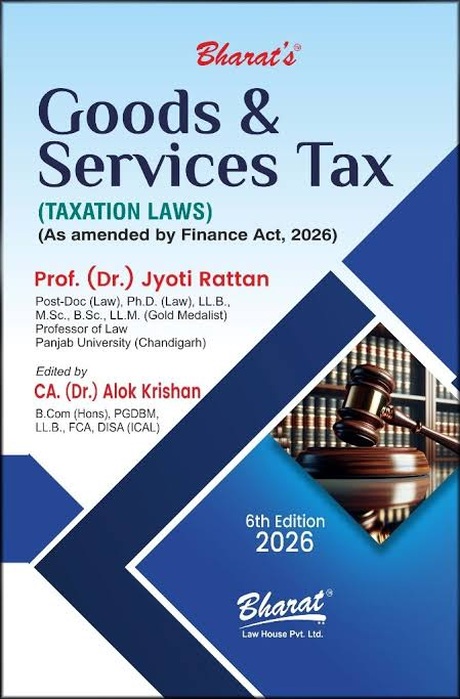
Bharat's Goods & Services Tax (Taxation Laws) by Prof. (Dr.) Jyoti Rattan - 6th Edition 2026
| Author : | Dr. Jyoti Rattan, CA (Dr.) Alok Krishan |
|---|
| Bharat's Goods & Services Tax (Taxation Laws) by Prof. (Dr.) Jyoti Rattan, Professor of Law at Panjab University, edited by CA (Dr.) Alok Krishan, 6th Edition 2026, is a student-oriented text on GST as amended by the Finance Act, 2026. Across thirty-two chapters it begins with the tax structure in India, the defects of the pre-GST indirect tax system, the roadmap to GST and taxation under the Indian Constitution, then works through basic concepts, compensation cess, administration, supply, levy and collection, time and value of supply, place of supply, the composition scheme, input tax credit, returns, registration, tax invoices and credit and debit notes, accounts and records, e-ledgers and payment of tax, TDS and TCS, refunds, assessment, audit, appeals and revision, inspection, search, seizure and arrest, demands and recovery, liability to pay in certain cases, GST and the Limitation Act, offences and penalties, the GST Council, e-way bill rules and anti-profiteering. For LL.B., B.Com and MBA students, CA, CS and CMA candidates, teachers and young practitioners. |


369

English

6th Edition 2026

Tags: ACADEMIC LAW BOOKS, Indirect Tax Laws, GST Books, GST Law & Procedure
Bharat's Goods & Services Tax (Taxation Laws) by Prof. (Dr.) Jyoti Rattan – 6th Edition 2026
Bharat Law House publishes the Sixth Edition (2026) of Goods & Services Tax (Taxation Laws) by Prof. (Dr.) Jyoti Rattan, Professor of Law, Panjab University, Chandigarh, edited by CA (Dr.) Alok Krishan. The text is as amended by the Finance Act, 2026.
This is a teaching text rather than a practitioner's manual. It is written for the LL.B. and B.Com. classroom and for professional examinations, and it does what a commentary generally will not: it explains why GST exists before it explains how it works — the defects of the pre-GST indirect tax structure, the constitutional distribution of fiscal powers, and the roadmap by which the levy was introduced. Only then does it turn to the mechanics.
Contents — thirty-two chapters
Background and constitutional framework — tax structure in India; defects in the pre-GST indirect tax structure and the roadmap for introducing GST; taxation under the Indian Constitution, federal structure and fiscal distribution; reasons, aims and objectives and an overview of the GST law.
Core concepts and the charge — basic concepts; GST compensation cess; administration; supply; levy and collection; time and value of supply of goods and services; place of supply of goods or services; the composition scheme.
Input tax credit and compliance — input tax credit; statements and returns; registration; documents under GST including the tax invoice and credit and debit notes; accounts and records; e-ledgers and payment of tax; TDS and TCS under GST.
Refunds, proceedings and enforcement — refunds; assessment; audit; appeals and revision; inspection, search, seizure and arrest; demands and recovery; liability to pay in certain cases; GST and the Limitation Act; offences and penalties.
Institutions and special topics — the GST Council; e-way bill rules; and anti-profiteering.
Why this book
- Updated by the Finance Act, 2026 — the amendments worked into the text rather than appended.
- Written for students — concepts explained from first principles, with illustrations and worked examples.
- Constitutional grounding — three opening chapters on why the levy took the shape it did, which is where university papers and viva questions tend to go.
- Complete coverage from supply and valuation through to anti-profiteering, in one affordable volume.
- Authored by a Professor of Law and edited by a practising Chartered Accountant — academic structure with professional accuracy.
Who should buy this book
- LL.B. and B.A. LL.B. students taking Taxation Laws or GST as a paper.
- B.Com., M.Com. and MBA students reading indirect taxation.
- CA, CS and CMA candidates at the foundation and intermediate levels.
- Teachers and academics needing a classroom-ordered treatment of the GST law.
- Young practitioners and accounts staff who want the subject explained before they consult a practitioner's manual.
About the author
Prof. (Dr.) Jyoti Rattan is Post-Doc (Law), Ph.D. (Law), LL.B., M.Sc., B.Sc. and LL.M. (Gold Medalist), and Professor of Law at Panjab University, Chandigarh. She is the author of Bharat's long-running Taxation Laws series. The editor, CA (Dr.) Alok Krishan, is B.Com (Hons), PGDBM, LL.B., FCA and DISA (ICAI).