Commercial's Concise Commentary On GST ( vol of 2 ) -5th Edition 2027
| Author : | V . Raghuraman |
|---|
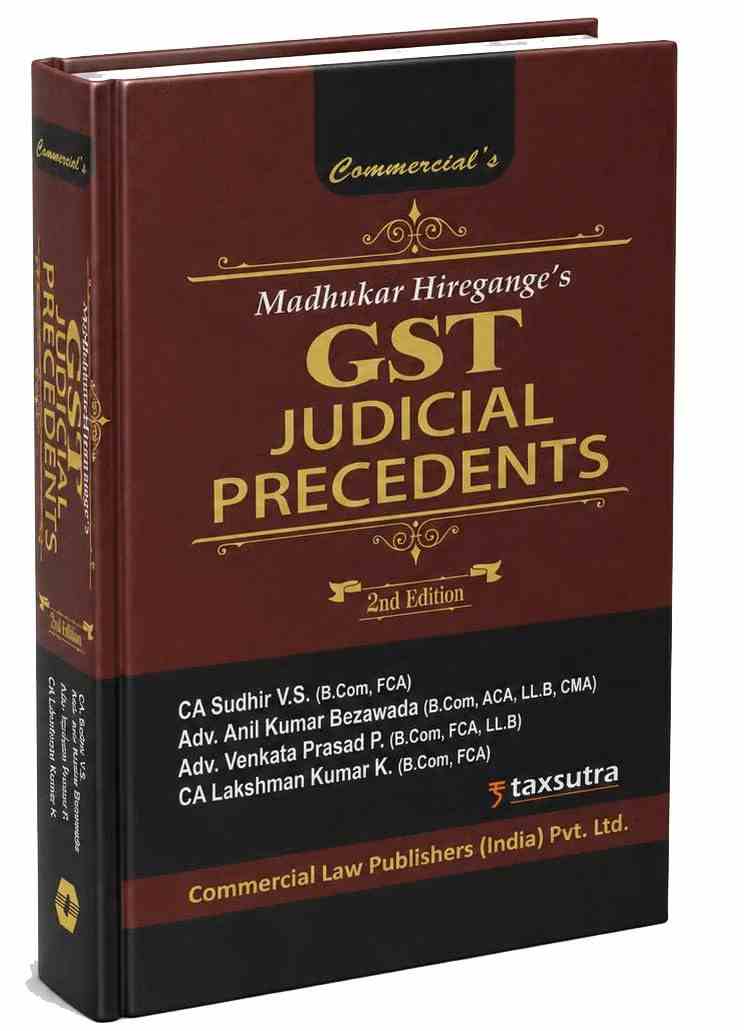
| Commercial's Concise Commentary on GST by V. Raghuraman, Senior Advocate, with a foreword by Justice S.R. Krishna Kumar, Judge, High Court of Karnataka — 5th Edition, set of 2 volumes, published by Commercial Law Publishers (India) Pvt. Ltd. Volume 1 covers the scheme of GST, the interpretation of taxing statutes, the constitutional provisions, supply and levy, place and time of supply, import and export and zero-rated supplies, classification, valuation and composition, and exemptions. Volume 2 covers input tax credit and blocked credits, registration, invoices, returns and procedures, refunds and the inverted duty structure, assessment and audit, inspection, search and seizure, demands under sections 73 and 74, appeals and the GST Appellate Tribunal, offences, penalties and prosecution, advance rulings, and miscellaneous provisions including job work, e-commerce and transitional credit. Hardbound. ISBN 9788199729674. |


1963

English

5th Edition 2027

Tags: Indirect Tax Laws, GST Books, GST Litigations, GST Law & Procedure
Commercial's Concise Commentary on GST by V. Raghuraman, Senior Advocate, with a foreword by Justice S.R. Krishna Kumar, Judge, High Court of Karnataka, published by Commercial Law Publishers (India) Pvt. Ltd., is a two-volume commentary on the goods and services tax law. This is the 5th Edition, in a set of 2 volumes. Hardbound. ISBN 9788199729674.
GST is now old enough to have generated a substantial body of authority, and young enough that a great deal of it is still unsettled. The questions that occupy practitioners — whether a transaction is a supply at all, where and when it is treated as made, what may be claimed as input tax credit and what is blocked, how a classification dispute is argued, when a demand is time-barred — are answered from the Act read against the notifications, the circulars, the advance rulings and a rapidly growing line of High Court decisions. This commentary is written to hold those together provision by provision.
Key Features
- 5th Edition in a set of 2 volumes, published by Commercial Law Publishers (India) Pvt. Ltd.
- Authored by V. Raghuraman, Senior Advocate, a specialist in indirect taxation
- Foreword by Justice S.R. Krishna Kumar, Judge, High Court of Karnataka
- Organised in divisions and chapters rather than section order, so a question is found by subject
- Opens with chapters on the interpretation of taxing statutes and the constitutional provisions underlying GST
- Hardbound · English
Coverage — Volume 1
Introduction and Overview. The scheme of GST, the transition from the earlier indirect tax regime, and the architecture of the Central, State, Union Territory and Integrated levies.
Interpretation of Taxing Statutes. The canons applied to fiscal legislation — strict construction of the charging provision, the treatment of exemptions and machinery provisions, and the weight given to circulars and departmental clarifications.
Constitutional Provisions. Article 246A and the legislative competence of the Union and the States, Article 279A and the GST Council, and the constitutional limits on the levy.
Supply and Levy. The meaning and scope of supply under section 7 and the Schedules; composite and mixed supplies; consideration; the scope of Schedule III; the levy and collection under section 9; and reverse charge.
Place and Time of Supply. Place of supply of goods and of services, domestic and cross-border; and the time of supply determining when the liability arises.
Import and Export of Goods and Services. Zero-rated supplies, exports with and without payment of tax, imports and the interface with customs, and deemed exports.
Classification, Valuation and Composition. Classification under the tariff and the principles applied to it; the value of taxable supply under section 15, inclusions, exclusions and discounts; valuation between related and distinct persons; and the composition levy.
Exemptions. The exemption notifications and their construction.
Coverage — Volume 2
Input Tax Credit. Eligibility and conditions under section 16; blocked credits under section 17(5); apportionment and reversal; credit on capital goods; the input service distributor; and the matching and reconciliation provisions.
Registration, Returns and Procedures. Liability to register, compulsory registration, amendment and cancellation and revocation; tax invoices, credit and debit notes; the e-way bill; returns and the payment of tax; and the electronic credit and cash ledgers.
Refunds. Refund of unutilised credit, the inverted duty structure, refund on exports, limitation, and unjust enrichment.
Assessment and Audit. Self-assessment, provisional assessment, scrutiny of returns, best judgment assessment, and departmental and special audit.
Inspection, Search and Seizure. Powers of inspection, search, seizure and arrest, and the safeguards attached to them.
Demands, Adjudication and Appeals. Demands under sections 73 and 74 and the distinction between them; show cause notices and limitation; recovery; appeals to the Appellate Authority and the GST Appellate Tribunal; and revision.
Offences, Penalties and Prosecution. The offences under section 122, general penalties, detention and confiscation, compounding, and prosecution.
Advance Rulings. The Authority and Appellate Authority for Advance Ruling, the questions on which a ruling may be sought, and the binding effect of a ruling.
Miscellaneous. Anti-profiteering, job work, e-commerce operators and tax collection at source, transitional provisions, and the liability to pay in special cases.
Who Should Buy This Book?
- Chartered Accountants and GST practitioners
- Advocates appearing in GST writ petitions and before the GST Appellate Tribunal
- Indirect tax consultants and tax advisory teams
- Company Secretaries and corporate tax departments
- In-house finance and compliance teams of manufacturers, traders and service providers
- Officers of the Central and State GST departments
- Members and staff of Advance Ruling Authorities and the GSTAT
- Academicians, researchers and students of indirect taxation
- Professional firms and institutional libraries
Why Choose This Book?
Most GST publications are either a bare Act with rules, or a ready reckoner organised for compliance. Neither helps when the question is contested. A commentary sets out how a provision has been read, where the readings conflict, and what the argument on each side is — which is what a practitioner needs when drafting a reply to a show cause notice or a writ petition.
The two features that distinguish this work are the opening chapters and who wrote it. Beginning with the interpretation of taxing statutes and the constitutional provisions before reaching supply and levy gives the reader the tools with which the later disputes are actually argued. And the commentary comes from V. Raghuraman, Senior Advocate — written from the perspective of counsel who argues these matters, with a foreword from a judge of the High Court of Karnataka, one of the courts that has shaped GST jurisprudence most.