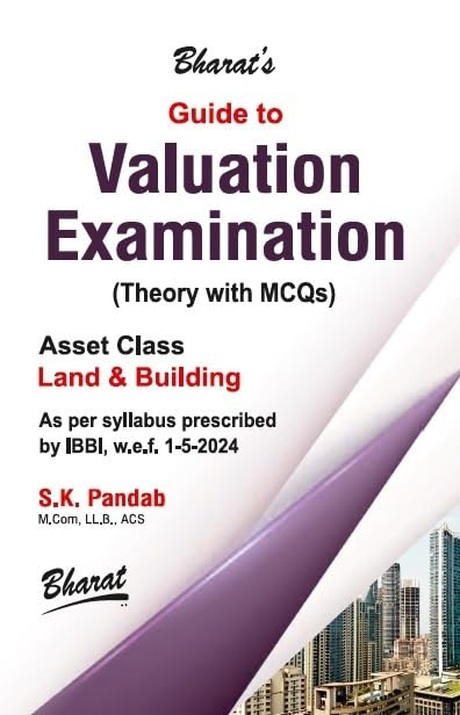
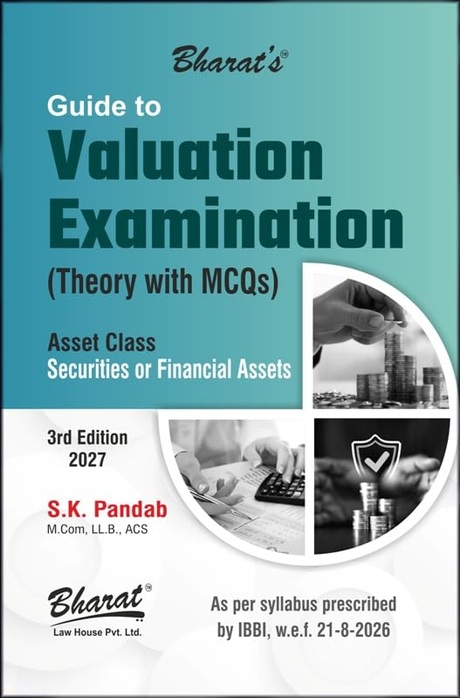
Bharat's Guide to Valuation Examination (Theory with MCQs) - Securities or Financial Assets by S. K. Pandab - 3rd Edition 2027
| Author : | S.K. PANDAB ( M.COM, LL.B., ACS) |
|---|
| Bharat's Guide to Valuation Examination (Theory with MCQs) - Asset Class: Securities or Financial Assets by S. K. Pandab, 3rd Edition 2027, is a 688-page guide written to the IBBI syllabus effective 21 August 2026. Theory is set out point by point in plain language with the MCQs placed immediately after each topic, so reading and self-assessment happen together, and case laws and case studies each carry their own questions. The twelve chapters cover macroeconomics, finance and financial statement analysis, professional and business ethics and standards, general laws, financial reporting under Indian Accounting Standards, overview of valuation, valuation approaches, valuation application, judicial pronouncements on valuation, case studies, self-test questions, and the model question papers issued by the IBBI for the 2022, 2024 and current 2026 syllabi. For Registered Valuer aspirants, CAs, CSs, CMAs, insolvency professionals and finance practitioners preparing for the IBBI valuation examination. |


688

English

3rd Edition 2027

Tags: EXAMINATION BOOKS, Insolvency and Bankruptcy Code, Valuation, Corporate Restructuring, Valuation and Insolvency
Bharat's Guide to Valuation Examination (Theory with MCQs) – Asset Class: Securities or Financial Assets by S. K. Pandab (3rd Edition 2027)
Bharat Law House publishes the Third Edition (2027) of S. K. Pandab's Guide to Valuation Examination (Theory with MCQs) for the Securities or Financial Assets asset class, written as per the syllabus prescribed by the IBBI with effect from 21 August 2026. It runs to 688 pages.
The Valuation Examination conducted by the Insolvency and Bankruptcy Board of India is the gate to registration as a valuer under the Companies (Registered Valuers and Valuation) Rules, 2017. It is an objective paper over a wide syllabus, and the method that works is to read a topic and immediately answer questions on it. That is exactly how this book is built: theory point by point, with the MCQs placed after each topic rather than collected at the back.
Key features
- Theory with MCQs on every topic — each point of theory is followed by the questions that test it, so reading and self-assessment happen together.
- Written in plain, memorable language, point by point, rather than as continuous prose.
- Case laws and case studies, each followed by its own questions, to show the form in which the examiner puts them.
- Self-test questions in a dedicated chapter.
- Model Question Papers issued by the IBBI for the old 2022 syllabus, the old 2024 syllabus and the current 2026 syllabus — so the shift in pattern can be seen for itself.
- Updated to the IBBI syllabus effective 21 August 2026.
Contents
- Macroeconomics
- Finance and Financial Statement Analysis
- Professional / Business Ethics and Standards
- General Laws — the statutory framework bearing on valuation, treated at length
- Financial Reporting under Indian Accounting Standards (Ind AS)
- Overview of Valuation
- Valuation Approaches
- Valuation Application
- Judicial Pronouncements on Valuation
- Case Studies
- Self-Test Questions
- Model Question Papers issued by IBBI — Old Syllabus 2022, Old Syllabus 2024 and Current Syllabus 2026
Prefaced by notes on the book, the author, and the syllabus, format and frequency of the examination.
Who should buy this book
- Registered Valuer aspirants sitting the IBBI Valuation Examination for the Securities or Financial Assets asset class.
- Chartered Accountants, Company Secretaries and Cost Accountants adding valuation to their practice.
- Insolvency professionals and those on resolution, liquidation and restructuring work.
- Finance professionals and analysts wanting a compact, test-driven route through Indian valuation standards and practice.
- RVO training bodies and institutional libraries.
About the author
S. K. Pandab (M.Com., LL.B., ACS) holds a Master's in Commerce and an LL.B. from the University of Calcutta and is an associate member of the Institute of Company Secretaries of India. He practised as a Company Secretary in Kolkata, has taught as a guest lecturer for over twenty years, and has written more than thirty-five books. He is also the author of Bharat's companion guides for the Land & Building and Plant & Machinery asset classes.