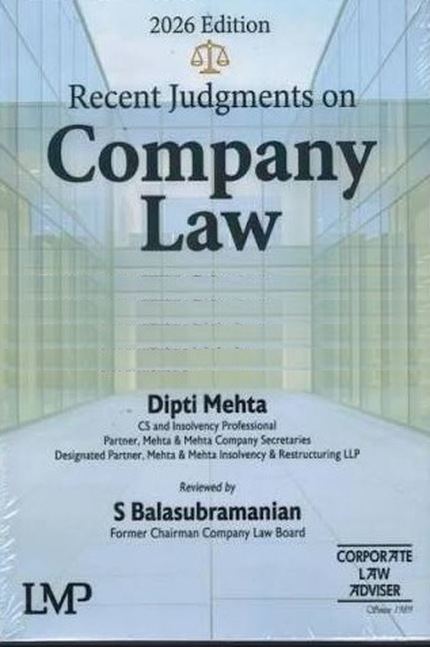
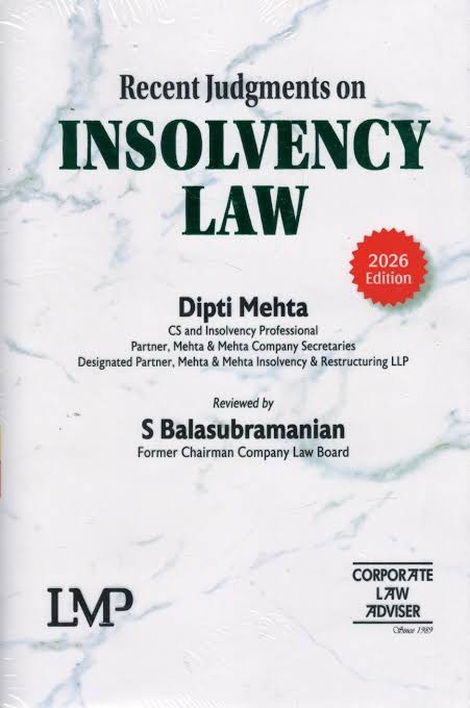
LMP's Recent Judgments on Insolvency Law (Reviewed by S. Balasubramanian, Former Chairman Company Law Board) - 2026 Edition
| Author : | Dipti Mehta |
|---|
| LMP's Recent Judgments on Insolvency Law by Dipti Mehta, Company Secretary and Insolvency Professional, reviewed by S. Balasubramanian, former Chairman of the Company Law Board, 2026 Edition, is a subject-wise collection of recent Supreme Court, NCLAT and NCLT decisions under the Insolvency and Bankruptcy Code, 2016. It covers applications by financial and operational creditors under sections 7, 9 and 10, debt, default and pre-existing dispute, limitation, financial debt and the position of real estate allottees and guarantees, the scope of the moratorium under section 14, the appointment and duties of the resolution professional, the constitution of the committee of creditors and the reviewability of its commercial wisdom, submission and verification of claims, eligibility under section 29A, approval of resolution plans under section 31 and the clean slate principle, withdrawal under section 12A, liquidation and the waterfall under section 53, avoidance of preferential and fraudulent transactions, personal guarantors to corporate debtors, pre-packaged insolvency for MSMEs, and appeals before the NCLAT. Hardbound, English, ISBN 9789384345846. |


Tags: Insolvency and Bankruptcy Code, Insolvency, Case Laws, Corporate Law Book
LMP's Recent Judgments on Insolvency Law by Dipti Mehta — Company Secretary and Insolvency Professional, Partner at Mehta & Mehta Company Secretaries and Designated Partner at Mehta & Mehta Insolvency & Restructuring LLP — reviewed by S. Balasubramanian, former Chairman of the Company Law Board, published by LMP (Corporate Law Adviser), 2026 Edition. Hardbound, English.
Insolvency is the fastest-moving area of Indian commercial law, and it is moving almost entirely through case law. The Insolvency and Bankruptcy Code, 2016 is a short statute; what a practitioner actually needs to know — when an application under section 7 must be admitted and when the Adjudicating Authority retains discretion, how far the commercial wisdom of the committee of creditors is beyond review, what survives the approval of a resolution plan, who is caught by section 29A — has been built by the NCLT, the NCLAT and the Supreme Court judgment by judgment.
That is why a current digest matters more here than in most subjects. This volume collects the recent decisions, arranged by subject, so that counsel can find the authority on the point at issue rather than reading a commentary's account of it. The author is a practising Insolvency Professional, which shows in the selection: the cases chosen are the ones that decide live applications, not merely the ones that are jurisprudentially interesting.
Key Features
- 2026 Edition, LMP — Corporate Law Adviser
- Recent judgments of the Supreme Court, NCLAT and NCLT on insolvency law
- Written by Dipti Mehta, CS and practising Insolvency Professional
- Reviewed by S. Balasubramanian, former Chairman, Company Law Board
- Subject-wise arrangement for use at the hearing
- Companion volume to the same author's Recent Judgments on Company Law
- Hardbound · English · ISBN 9789384345846
Coverage
Initiation of Insolvency. Applications by a financial creditor under section 7, by an operational creditor under section 9 and by a corporate applicant under section 10; the existence of debt and default; pre-existing dispute in operational creditor matters; limitation and acknowledgement; and the discretion of the Adjudicating Authority to admit or refuse.
Financial and Operational Debt. What constitutes a financial debt and the place of guarantees, allottees in real estate projects and inter-corporate deposits; what constitutes an operational debt; and the treatment of claims that fall between the two.
Moratorium. The scope of the moratorium under section 14, the proceedings it stays and those it does not, its effect on guarantors, on arbitration and on criminal and regulatory proceedings.
The Resolution Professional and the Committee of Creditors. The appointment, powers and duties of the interim resolution professional and resolution professional; constitution of the committee of creditors and voting; related party exclusion; and the scope of the committee's commercial wisdom and its reviewability.
Claims and Verification. Submission, verification and admission of claims, belated claims, the treatment of contingent and disputed claims, and the position of statutory and government dues.
Resolution Plans. Eligibility of a resolution applicant and section 29A; the contents of a plan; approval under section 31 and its binding effect; the clean slate principle and the extinguishment of claims not part of the plan; distribution among classes of creditors; withdrawal and modification of an approved plan; and section 12A withdrawal of the application.
Liquidation. Orders of liquidation, the liquidator and the liquidation estate, sale as a going concern, the distribution waterfall under section 53, avoidance of preferential, undervalued, extortionate and fraudulent transactions, and dissolution.
Personal Guarantors. Insolvency resolution and bankruptcy of personal guarantors to corporate debtors, the interplay with proceedings against the corporate debtor, and the effect of approval of a plan on the guarantor's liability.
Pre-Packaged Insolvency and MSMEs. The pre-packaged insolvency resolution process for micro, small and medium enterprises, and the special provisions applicable to MSME promoters.
Procedure, Appeals and Allied Questions. Jurisdiction of the NCLT and NCLAT, limitation in appeals, condonation of delay, review and recall, the interplay of the Code with the SARFAESI Act, the Arbitration and Conciliation Act and the Companies Act, and the conduct and discipline of insolvency professionals.
Who Should Buy This Book?
- Insolvency Professionals, interim resolution professionals and liquidators
- Advocates appearing before the NCLT and NCLAT
- Company Secretaries, chartered accountants and cost accountants in insolvency practice
- Banks, ARCs and financial creditors — recovery and legal departments
- Operational creditors and their advisers
- In-house counsel of corporate debtors and prospective resolution applicants
- Members of the NCLT and NCLAT, and judicial and technical members' research staff
- CS Professional and CA Final students taking insolvency papers
- Law firm, corporate and institutional libraries
Why Choose This Book?
The argument for a judgments digest in insolvency is stronger than in almost any other field. The Code is young and the law is judge-made; a commentary written a year ago may state a position the NCLAT has since departed from. A current, subject-wise collection of decisions is the instrument that actually gets used at the hearing.
The second reason is the author's standing. Dipti Mehta is a practising Insolvency Professional and Company Secretary, not an academic compiler, and the review by S. Balasubramanian — a former Chairman of the Company Law Board — adds the perspective of the adjudicator.
The third is that it pairs with the companion volume on company law by the same author. Corporate insolvency practice rarely stays inside the Code: oppression and mismanagement, scheme sanctions and directors' liability sit alongside it, and the two volumes together cover the field a corporate litigator actually works in.