EBC's Comparative Public Law and Systems of Governance - 1st Edition 2026
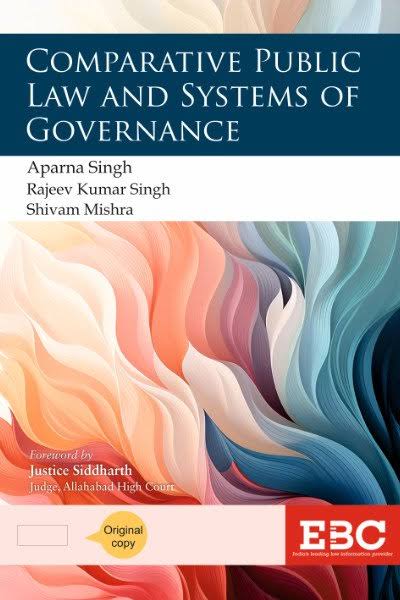
| Comparative Public Law and Systems of Governance by Aparna Singh, Rajeev Kumar Singh and Shivam Mishra (Eastern Book Company, 1st Edition 2026), with a foreword by Justice Siddharth, Judge, Allahabad High Court, is a systematic textbook written to the LL.M., B.A. LL.B. and UGC-NET Law syllabi. Organised by theme rather than by country, it covers the comparative method and legal transplants, constitutions and constitutionalism including the basic structure doctrine, the parliamentary, presidential and semi-presidential systems of governance, federalism and the distribution of powers, separation of powers, the legislature, the executive and emergency powers, judicial appointment and judicial review including public interest litigation, bills of rights, due process and proportionality, administrative law and the Ombudsman, and the rule of law and good governance. Paperback. ISBN 9788168089013. |


893

English

1st Edition 2026

Tags: Administrative Law, Constitutional of India, Political Science, Comparative Public Law
Comparative Public Law and Systems of Governance by Aparna Singh, Rajeev Kumar Singh and Shivam Mishra, with a foreword by Justice Siddharth, Judge, Allahabad High Court, published by Eastern Book Company, is a systematic textbook on comparative public law. This is the 1st Edition, 2026. Paperback. ISBN 9788168089013.
Comparative public law asks a question that a purely domestic course cannot: why is our constitution arranged the way it is, and what were the alternatives. India's framers borrowed the parliamentary executive from Britain, the written constitution, judicial review and the federal structure from the United States, the Directive Principles from Ireland and the emergency provisions from Germany — and each borrowing has behaved differently in Indian soil than it did at home. The subject is now a standard paper in LL.M. and B.A. LL.B. programmes and a unit of the UGC-NET Law syllabus, and this book is written to that syllabus.
Key Features
- 1st Edition, 2026, published by Eastern Book Company
- Foreword by Justice Siddharth, Judge, Allahabad High Court
- Systematic treatment organised by theme rather than by country, so the comparison is on the page
- Written to the LL.M., B.A. LL.B. and UGC-NET Law syllabi
- Authored by three academics in constitutional and public law
- Paperback · English
Coverage
Comparative Method in Public Law. What comparison is for and its limits; functional and contextual approaches; legal transplants and why a borrowed institution behaves differently in a different constitutional culture; and the common law, civil law and hybrid traditions.
Constitutions and Constitutionalism. Written and unwritten constitutions; rigid and flexible constitutions; constitutionalism as limited government; constituent power and constitution-making; and the amendment process compared — including the Indian basic structure doctrine and its counterparts elsewhere.
Systems of Governance. The parliamentary system on the Westminster model, the presidential system of the United States, and the semi-presidential model of France; the position of the head of State; collective and individual ministerial responsibility; the confidence relationship between executive and legislature; and the arguments of stability against accountability.
Federalism and Distribution of Powers. Federal, unitary and quasi-federal arrangements; the American, Canadian, Australian and Indian models compared; the distribution of legislative powers and the residuary power; fiscal federalism; and centralising and decentralising tendencies.
Separation of Powers and Checks and Balances. The doctrine in its strict American form and its diluted parliamentary form; delegated legislation; and the boundaries between the three branches in practice.
The Legislature. Unicameral and bicameral arrangements; composition and powers of second chambers; legislative procedure; parliamentary privilege; and legislative oversight through committees.
The Executive. The real and titular executive; appointment and removal; emergency powers compared; and the administrative state and the growth of executive rule-making.
The Judiciary and Judicial Review. Appointment of judges — collegium, commission and executive appointment models; independence and tenure; the scope and intensity of judicial review; constitutional courts against general courts; judicial activism and restraint; and public interest litigation as an Indian contribution.
Fundamental Rights and Their Protection. Bills of rights compared; the doctrines of due process and of reasonable restrictions; horizontal and vertical application; proportionality as a standard of review; and socio-economic rights and their justiciability.
Administrative Law and Accountability. Principles of natural justice; the grounds of review — illegality, irrationality and procedural impropriety; the Ombudsman and its variants; administrative tribunals; and transparency and right to information regimes.
Rule of Law and Good Governance. Dicey's formulation and its modern restatements; the rule of law in developing constitutional systems; accountability, participation and transparency; and the international influences on domestic public law.
Who Should Buy This Book?
- LL.M. students taking Comparative Public Law and Systems of Governance
- B.A. LL.B. and LL.B. students of constitutional and administrative law
- UGC-NET and JRF Law candidates, for whom this is a prescribed unit
- Candidates for judicial service and civil services examinations
- Research scholars in constitutional law and governance
- Teachers of public law
- Practitioners arguing constitutional matters who need comparative authority
- Policy researchers and public administration professionals
- Law school and university libraries
Why Choose This Book?
Most material available to Indian students on this paper is either a foreign text that assumes no interest in India, or a set of notes that lists countries one after another without actually comparing them. A book organised by theme — taking federalism, or judicial appointment, or emergency powers, and setting the systems side by side under it — teaches the subject the way the examination asks about it.
Being an Eastern Book Company title written by Indian academics also means the Indian position is the reference point rather than an afterthought, which matters for a paper where the expected answer almost always closes by applying the comparison back to the Indian Constitution. The foreword by a sitting judge of the Allahabad High Court reflects that practical orientation.


![Constituent Assembly Debates (Set Of 5 Book) [Hardcover] Lok Sabha Secretariat, Govt. of India](uploaded_files/product/1788866874.jpg "Constituent Assembly Debates (Set Of 5 Book) [Hardcover] Lok Sabha Secretariat, Govt. of India")