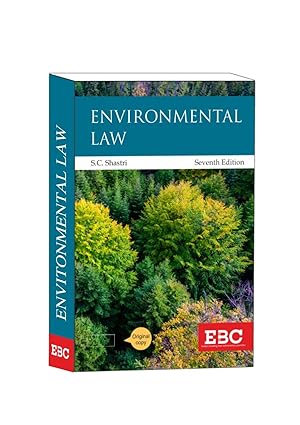
EBC's Environmental Law - 3rd Edition 2026
| Author : | Gurdip Singh |
|---|
| An authoritative commentary and textbook on Indian environmental law in 640 pages, revised and expanded with recent case law and current to the Jan Vishwas (Amendment of Provisions) Act, 2023 and the Water (Prevention and Control of Pollution) Amendment Act, 2024. Dr. Gurdip Singh opens with the international framework and sustainable development — the precautionary principle, polluter pays and intergenerational equity as the Indian courts have adopted them — then the environment under the Constitution through Article 21, Articles 48A and 51A(g), before a full part on the role of public interest litigation in environmental protection and on the legal regulation of hazardous substances and absolute liability. The statutory part covers the Environment (Protection) Act, 1986, water, air and noise pollution control, the National Green Tribunal at length, and the legal protection of forests, wildlife and biological diversity, identifying the shortcomings and loopholes in the specialised legislation rather than merely reproducing it. With Table of Cases, Table of Statutes, Stop Press and Subject Index. 3rd Edition, Eastern Book Company. |


640

English

3rd Edition 2026

Tags: Environmental Law, Public Interest Lawyering, The Scheduled Tribes and other Traditional Forest Dwellers ( Recognition of Forest Right), The Environment Protection Act
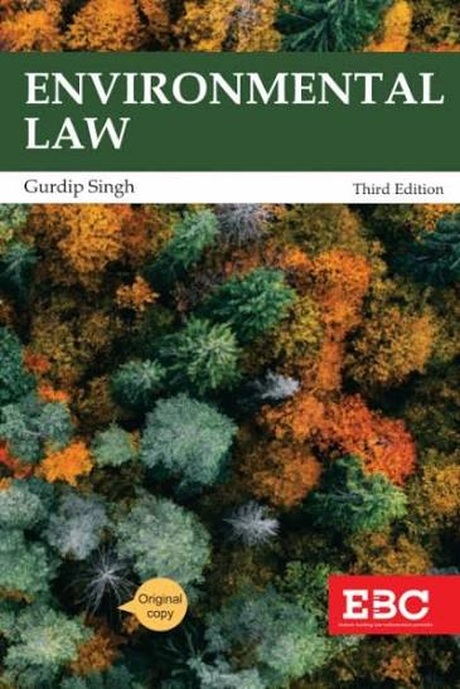
Environmental Law by Dr. Gurdip Singh, published by Eastern Book Company, is an authoritative commentary and textbook on environmental law in India. Third Edition, 640 pages.
Environmental law in India is unusual in that the courts, rather than the legislature, did most of the building. The statutory scheme — the Water Act, the Air Act, the Environment (Protection) Act — is in places thin and in places unenforced, and what gives the subject its shape is a body of constitutional jurisprudence read into Article 21 through public interest litigation. A book that sets out the statutes alone will not explain the law as it is actually applied. This one works from both directions: the constitutional and judicial foundation first, then the specialised legislation, with an explicit account of where that legislation falls short.
This edition is revised and expanded with recent case law and carries two significant statutory developments: the amendments made by the Jan Vishwas (Amendment of Provisions) Act, 2023 — which decriminalised and recast penalties across the Air Act, the Environment (Protection) Act, the Indian Forest Act and the Public Liability Insurance Act — and the Water (Prevention and Control of Pollution) Amendment Act, 2024. Both change the enforcement architecture rather than the standards, which is exactly the kind of change a practitioner can miss.
Key Features
- Covers the Jan Vishwas (Amendment of Provisions) Act, 2023 — its amendments to the Air Act, the Environment (Protection) Act, the Forest Act and the Public Liability Insurance Act.
- Covers the Water (Prevention and Control of Pollution) Amendment Act, 2024.
- Special emphasis on the National Green Tribunal — its establishment, its working and its future direction.
- Full analysis of biodiversity law, a subject most Indian textbooks still treat briefly.
- Critical rather than descriptive — the book identifies the shortcomings and loopholes in the specialised legislation instead of simply reproducing it.
- A dedicated part on public interest litigation, which is where most Indian environmental law was in fact made.
- Table of Cases, Table of Statutes, a Stop Press section and a full Subject Index.
- 640 pages, paperback, from Eastern Book Company.
Coverage
Part I — General
- Introduction — the scope of environmental law and the international framework from which much of it derives.
- Sustainable Development — the principle and its components, including the precautionary principle, the polluter pays principle and intergenerational equity, as the Indian courts have adopted them.
- The Environment and the Constitution of India — Article 21 and the right to a clean environment, Articles 48A and 51A(g), the distribution of legislative powers, and the writ jurisdiction.
Part II — Public Interest Litigation and Liability
- Role of Public Interest Litigation in Environmental Protection — the relaxation of locus standi, the leading environmental PILs, continuing mandamus, expert committees and the limits of judicial supervision.
- Legal Regulation of Hazardous Substances — absolute liability, the Public Liability Insurance Act, hazardous waste rules, and the regulation of chemicals and industrial activity.
Part III — Statutory Provisions Relating to Different Kinds of Pollution
- The Environment (Protection) Act, 1986 — the central government's powers, standards, environmental clearance and the offence and penalty provisions as amended.
- Water Pollution Control — the Water Act, the Pollution Control Boards, consent to establish and operate, and the 2024 amendment.
- Air Pollution Control — the Air Act, air quality standards, and enforcement after the Jan Vishwas amendments.
- Noise Pollution Control — the rules, permissible limits and the case law on loudspeakers and silence zones.
- National Green Tribunal — its constitution, jurisdiction, powers, the relief it may grant, appeals, and an assessment of its record.
- Legal Protection of Forests — the Indian Forest Act, the Forest (Conservation) Act and its amendment, and forest clearance.
- Legal Protection of Wildlife — the Wild Life (Protection) Act, protected areas, the schedules and offences.
- Legal Protection of Biological Diversity — the Biological Diversity Act, access and benefit sharing, and the regulatory authorities.
Who Should Buy This Book?
- LL.B. and B.A. LL.B. students taking Environmental Law — this is a core textbook for the paper.
- LL.M. students and researchers in environmental and natural resources law.
- Advocates appearing before the National Green Tribunal and in environmental writ matters.
- Judges and judicial officers, and members and staff of the NGT.
- Officials of the Ministry of Environment, Forest and Climate Change, and of the Central and State Pollution Control Boards.
- Environmental NGOs and activists conducting or supporting litigation.
- Corporate environmental compliance and EHS teams, and consultants handling clearances.
- Judicial service and civil services aspirants.
- Law college and university libraries.
Why Choose This Book?
What separates this from the general run of environmental law textbooks is that it is willing to say where the law does not work. Indian environmental legislation is often generous in its standards and weak in its enforcement machinery, and a book that reproduces the sections without saying so leaves a student with a false picture and a practitioner without an argument. The treatment here identifies the loopholes deliberately.
The two other reasons to prefer this edition are concrete. The National Green Tribunal gets sustained attention rather than a short chapter — which matters because the NGT is now where most environmental litigation in India actually happens. And the book is current to the Jan Vishwas Act, 2023 and the Water Amendment Act, 2024, which between them rewrote the penalty and enforcement provisions across four of the principal environmental statutes. An edition that predates them describes an enforcement regime that no longer exists.