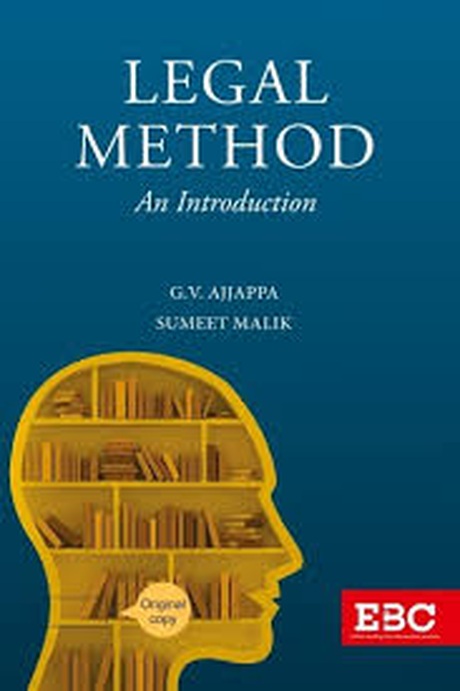
EBC's Legal Method: An Introduction - Edition 2026
| Author : | G. V. Ajjappa, Sumeet Malik |
|---|
| An introductory textbook for the first-year LL.B. Legal Method paper prescribed by the Bar Council of India, written within the Indian legal system rather than illustrated from English, American or French materials. G. V. Ajjappa and Sumeet Malik take the student through what jurisprudence is and the schools of thought, the nature of law and its competing definitions, the use of a law library — statutes, law reports, digests and citations, in print and online — the classifications of law, the sources of law including legislation, precedent and custom with ratio decidendi, obiter dicta and the doctrine of binding precedent, the concept and classification of legal systems, the common law family and tradition, and the Indian legal system itself: its historical formation, the Constitution, the court hierarchy, and the way personal laws and customary practice modify the general law. With appendices on Austin's analysis, jurisprudence and the definition of law, a Table of Cases and a Subject Index. Sumeet Malik is Editor of SCC Online and Associate Editor of Supreme Court Cases. 216 pages, Eastern Book Company. |


216

English

1st Edition, 2023 (Reprint 2026)

Tags: Research & Legal Methodology, Indian Legal System, Jurisprudence, Legal Method
Legal Method: An Introduction by G. V. Ajjappa and Sumeet Malik, published by Eastern Book Company, is the first book a law student in India should read. Written for the first-year LL.B. paper prescribed by the Bar Council of India. 216 pages.
Legal method is the subject that teaches a student how law works before teaching any particular law — what a legal system is, where law comes from, how a case is read, how a library is used. It is taught first for good reason, and it is also the paper most poorly served by the available books. Most of what is on the market draws its examples from English, American or French materials, which is how the subject is taught in those countries and which leaves an Indian student learning about a legal system that is not the one they will practise in.
This book was written against that problem. It presents legal method within the Indian legal system — a system in which personal laws and customary practice can modify the general law, particularly in family matters, and in which the common law inheritance sits alongside a written Constitution. The chapter order was settled after reviewing the other legal method books in the field, which shows: the progression from jurisprudence to the nature of law to sources and then to legal systems is the one a beginner can actually follow.
The authors bring complementary backgrounds. G. V. Ajjappa is a professor with long academic experience. Sumeet Malik is Editor of SCC Online and Associate Editor of Supreme Court Cases, and teaches legal research at several law schools — which is why the chapter on using a law library is practical rather than ceremonial.
Key Features
- Written for the first-year LL.B. Legal Method paper as prescribed by the Bar Council of India.
- Grounded in the Indian legal system rather than illustrated from English, American or French materials.
- Accounts for personal laws and customary practice, and how they modify the general law — a feature of Indian law that foreign textbooks cannot address.
- Chapter sequence designed after a review of the existing textbooks, for a beginner's reading order.
- A practical chapter on using a law library, by the Editor of SCC Online.
- Appendices on Austin's analysis, jurisprudence and the definition of law, for students who want to go further.
- Table of Cases and Subject Index.
- 216 pages, paperback — short enough to be read in the first semester, and priced for a first-year student.
Coverage
- Introduction — what legal method is and why it is studied before any substantive subject.
- What is "Jurisprudence"? — the meaning of the term, the schools of thought, and what jurisprudence is for.
- Nature of Law — the competing definitions of law, law and morality, and law as a system of rules.
- Using a Law Library — statutes, law reports, digests, citators and commentaries; how a citation is read; and how to find the law on a question, in print and online.
- Classifications of Law — public and private, civil and criminal, substantive and procedural, and the distinctions that matter in practice.
- Sources of Law — legislation, precedent, custom, and the place of equity and justice; ratio decidendi and obiter dicta, and the doctrine of binding precedent.
- Concept of a Legal System — what makes a body of rules a system, and the institutions that constitute one.
- Classification of Legal Systems — the major legal families and the criteria by which they are grouped.
- Common Law Family and Tradition — its development, its characteristics, and the distinction from the civil law tradition.
- The Indian Legal System — its historical formation, the Constitution, the court hierarchy, the interaction of general law with personal laws and custom, and what makes it distinctive.
- Epilogue, and appendices on Austin's analysis, jurisprudence and the definition of law.
Who Should Buy This Book?
- First-year LL.B. and B.A. LL.B. students — this is a textbook for the prescribed Legal Method paper.
- Students entering a five-year integrated law programme, for whom this is the introduction to the discipline.
- Law teachers taking the Legal Method or Introduction to Law course.
- Students preparing for law entrance examinations who want to understand the subject before they begin it.
- Candidates for judicial service and other law examinations revising jurisprudence and the Indian legal system.
- Anyone coming to law from another discipline — journalists, civil servants, company executives — who wants a short, reliable account of how the Indian legal system works.
- Law college and school libraries.
Why Choose This Book?
The honest case for this book is its focus. A first-year student does not need a 600-page treatise on jurisprudence; they need to be shown, once and clearly, what a source of law is, what a precedent binds, and how to find a case. At 216 pages this does that and stops, which is why it can actually be read in the semester it is prescribed for rather than consulted in a panic before the examination.
The Indian grounding is the other reason, and it is not a small point. A student who learns legal method from English examples will understand the common law tradition but not the system they are joining — one where a question of succession may turn on which personal law applies, and where custom still has force. Taking that as the starting point rather than as a complication is what makes this a book written for its readers. Sumeet Malik's chapter on the law library is worth the price on its own for a student who has never opened a law report.