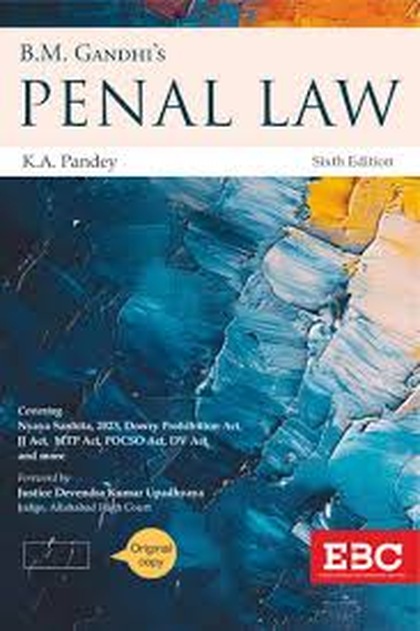
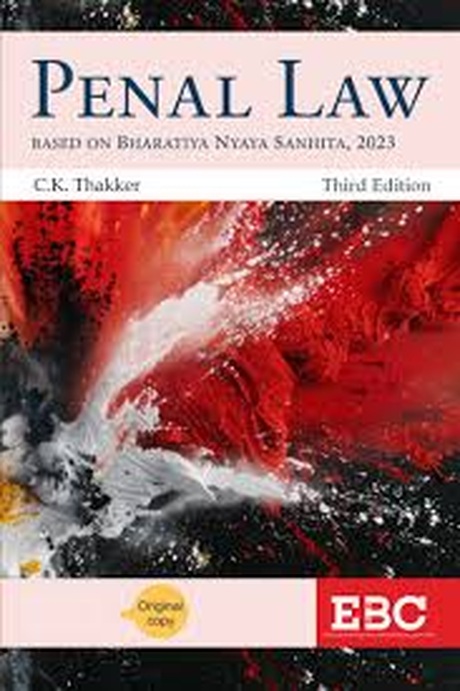
EBC's Penal Law - Based on Bharatiya Nyaya Sanhita, 2023 - 3rd Edition 2026
| Author : | C. K. TAKWANI |
|---|
| An introductory textbook on India's substantive criminal law as it now stands under the Bharatiya Nyaya Sanhita, 2023, by Justice C. K. Thakker, former Judge of the Supreme Court of India. The book opens with the fundamental principles of criminal law and a chapter on why the Sanhita was enacted, then works through title, commencement and applicability, definitions, punishments including community service, the general exceptions and the right of private defence, abetment, criminal conspiracy and attempt, before taking the offences in turn — against women and children, affecting the human body including culpable homicide, murder and the new provision on mob lynching, against the State and society, by or against public servants, against public justice, affecting public health, safety, decency and morality, relating to religion, against property, relating to documents and property marks, and criminal intimidation, insult and defamation — closing with repeal and savings. Because many provisions are new and the case law is still thin, their scope is explained by reference to the legislative object, drawing on the Code Makers' View and Law Commission of India reports. With a Table of Cases and Subject Index. 3rd Edition 2026, 632 pages, Eastern Book Company. |


632

English

3rd Edition, 2026

Tags: Bharatiya Nyaya Sanhita (BNS), Indian Penal Code, New Criminal Law, Criminal Law
Penal Law: Based on the Bharatiya Nyaya Sanhita, 2023 by Justice C. K. Thakker, published by Eastern Book Company, is an introductory text on India's substantive criminal law as it now stands. Third Edition, 2026, 632 pages.
The Bharatiya Nyaya Sanhita replaced the Indian Penal Code, 1860 — a statute that had been read, argued over and judicially glossed for more than a century and a half. The Sanhita drops a number of provisions that had become obsolete and introduces offences that are genuinely new. Those new offences are the difficulty: because they are recent, there is almost no case law on them, and a reader cannot do what Indian criminal lawyers have always done, which is to work out the meaning of a section from the decisions on it. This book addresses that directly. Where authority does not yet exist, it explains the scope of a provision by reference to the legislative object behind it.
Justice C. K. Thakker is a former Judge of the Supreme Court of India, and his student textbooks — published under the name C. K. Takwani — are among the most widely used in Indian law schools. The approach here is the one that made those books standard: fundamental principles established first, then the offences, with the historical material from the Code Makers' View and the Law Commission of India reports brought in where it explains why a provision reads as it does. Each chapter opens with selected quotations.
Key Features
- Written on the Bharatiya Nyaya Sanhita, 2023 from the ground up — not an IPC commentary with the section numbers changed.
- Explains the new offences by reference to legislative object, which is the only responsible method while the case law is still thin.
- Begins with the fundamental principles of criminal law, so the offences are read against a framework rather than memorised.
- A dedicated chapter on why the Nyaya Sanhita was enacted, and what it changed.
- Historical material from the Code Makers' View and Law Commission of India reports, where it illuminates a provision.
- Selected quotations opening each chapter.
- Table of Cases and a full Subject Index.
- By Justice C. K. Thakker, former Judge of the Supreme Court of India, author of the standard student texts published as C. K. Takwani.
- 3rd Edition, 2026, 632 pages, paperback, from Eastern Book Company.
Coverage
- Fundamental Principles of Criminal Law — actus reus and mens rea, strict liability, the presumption of innocence and the burden of proof.
- Why the Nyaya Sanhita, 2023 — the case for replacing the Indian Penal Code and what the new statute set out to achieve.
- Title, Commencement and Applicability — including extra-territorial operation.
- Definitions — the interpretation clauses that carry the weight of the whole statute.
- Punishments — the kinds of punishment, the introduction of community service, fines, solitary confinement and the principles of sentencing.
- General Exceptions — mistake, judicial acts, accident, necessity, infancy, unsoundness of mind, intoxication, consent, and the right of private defence.
- Abetment — instigation, conspiracy and intentional aiding, and the liability of the abettor.
- Criminal Conspiracy.
- Attempt — the line between preparation and attempt, and impossible attempts.
- Offences Against Women and Children — sexual offences, rape and its aggravated forms, cruelty, dowry death, and the offences newly framed in the Sanhita.
- Offences Affecting the Human Body — culpable homicide and murder, the exceptions, causing death by negligence, hurt and grievous hurt, wrongful restraint and confinement, kidnapping, abduction and trafficking, and the new provision on mob lynching.
- Offences Against the State and Society — the offences replacing sedition, terrorist acts and organised crime as now brought into the general penal law, and offences against public tranquillity.
- Offences By or Against Public Servants.
- Offences Against Public Justice — false evidence, fabrication, and contempt of lawful authority.
- Offences Affecting Public Health, Safety, Convenience, Decency and Morality — including adulteration, public nuisance and obscenity.
- Offences Relating to Religion.
- Offences Against Property — theft, extortion, robbery, dacoity, criminal misappropriation, criminal breach of trust, cheating, mischief and criminal trespass.
- Offences Relating to Documents and Property Marks — forgery and its aggravated forms.
- Criminal Intimidation, Insult, Annoyance and Defamation.
- Repeal and Savings — the transition from the Indian Penal Code and what it means for pending matters.
Who Should Buy This Book?
- LL.B. and B.A. LL.B. students taking Criminal Law — this is a core textbook for the paper in its new form.
- LL.M. students and academics working on the transition from the Penal Code to the Sanhita.
- Judicial service aspirants, for whom the BNS is now the examinable substantive criminal law.
- Young advocates building a criminal practice who need the new statute explained rather than merely reproduced.
- Practitioners trained on the Indian Penal Code who have to re-learn the substantive law.
- Police officers and prosecutors framing charges under the new provisions.
- Civil services aspirants and general readers wanting an accessible account of Indian criminal law.
- Law college and university libraries.
Why Choose This Book?
A great many books on the Bharatiya Nyaya Sanhita appeared very quickly after it was passed, and a good number of them are the old Penal Code commentary with a conversion table bolted on. That approach works for the provisions carried over unchanged and fails completely for the ones that are new — which are precisely the provisions a reader most needs help with. Writing from the Sanhita outwards, as this book does, is harder and considerably more useful.
The second thing to say about it is that it is a textbook, written to be understood. Justice Thakker's student books have been standard in Indian law schools for decades because they begin with principle and build, rather than marching through sections. For a student meeting criminal law for the first time, or a practitioner who learned the IPC and now has to start again, that structure is worth more than a larger book with more citations in it. At 632 pages it is substantial enough to be relied on and compact enough to be read.