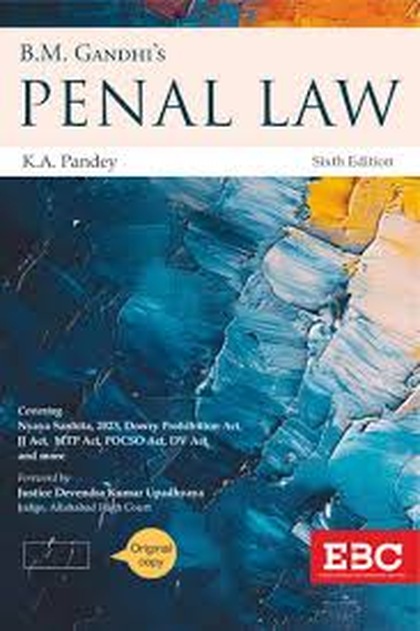
EBC's B.M. Gandhi's Penal Law (Covering Bharatiya Nyaya Sanhita, 2023, Dowry Prohibition Act, JJ Act, MTP Act, POCSO Act, DV Act & more) - 6th Edition 2026
| Author : | K.A Pandey |
|---|
| B.M. Gandhi's Penal Law, 6th Edition, revised by Dr. K.A. Pandey (Eastern Book Company), is the first full recasting of this classic student textbook for the Bharatiya Nyaya Sanhita, 2023, with a foreword by Justice Devendra Kumar Upadhyaya, Judge, Allahabad High Court. It covers the nature of crime and the elements of criminal liability, punishments including community service, the general exceptions and the right of private defence, abetment, criminal conspiracy and attempt, offences against women and children, offences affecting the human body, offences against the State, public tranquillity, public servants, public health, religion and property, forgery, defamation and criminal intimidation, and the new provisions on organised crime and terrorist acts — together with the Dowry Prohibition Act, the Juvenile Justice Act, the MTP Act, the POCSO Act and the Domestic Violence Act, and appendices on the rights of the accused, penology and victimology. 1112 pages. ISBN 9788168799363. |


1112

English

6th Edition 2026

Tags: Bharatiya Nyaya Sanhita (BNS), Indian Penal Code, Women & Criminal Law, Criminal Law
B.M. Gandhi's Penal Law — Covering Bharatiya Nyaya Sanhita, 2023, Dowry Prohibition Act, JJ Act, MTP Act, POCSO Act, DV Act and more, revised by Dr. K.A. Pandey (Kumar Askand Pandey), published by Eastern Book Company, is the Sixth Edition of a textbook that has taught substantive criminal law to generations of Indian law students. This edition carries a foreword by Justice Devendra Kumar Upadhyaya, Judge, Allahabad High Court. 1112 pages, paperback.
The sixth edition is the first full recasting of the work for the Bharatiya Nyaya Sanhita, 2023, which replaced the Indian Penal Code, 1860 with effect from 1 July 2024. The renumbering is not the whole of the change: the Sanhita introduces new offences, redefines others, and drops some altogether, while a century and a half of case law remains stated in the language of the old Code. This edition works through the substantive law as it now stands, and keeps the authority attached to it.
Key Features
- Sixth Edition, published by Eastern Book Company
- Written to the Bharatiya Nyaya Sanhita, 2023, with the corresponding IPC provisions
- Foreword by Justice Devendra Kumar Upadhyaya, Judge, Allahabad High Court
- Allied statutes covered in the same volume — Dowry Prohibition Act, Juvenile Justice Act, MTP Act, POCSO Act and the Domestic Violence Act
- Provisions on environmental protection, food safety, information technology offences and organised crime
- Three appendices — Rights of the Accused, Penology and Victimology
- Subject index
- 1112 pages · Paperback · English
Coverage
General Introduction and Preliminary Provisions. The nature and definition of crime, the elements of criminal liability — actus reus and mens rea — the extent and operation of the Sanhita, and the general definitions.
Punishments. The kinds of punishment under the Sanhita, including community service as a newly introduced sentence; the theories of punishment; fines, solitary confinement and enhanced punishment for repeat offenders; and sentencing discretion.
General Exceptions. Mistake of fact, judicial and statutory acts, accident, necessity, infancy, unsoundness of mind, intoxication, consent, communication made in good faith, compulsion, trifling acts, and the right of private defence of body and property.
Inchoate Offences. Abetment — instigation, conspiracy and intentional aiding; criminal conspiracy; and attempt, with the tests distinguishing preparation from attempt.
Offences Against Women and Children. Rape and the aggravated forms; sexual harassment, assault with intent to outrage modesty, voyeurism and stalking; cruelty by husband or relatives and dowry death; causing miscarriage; and the treatment of these offences under the POCSO Act, the Dowry Prohibition Act, the Protection of Women from Domestic Violence Act and the MTP Act.
Offences Affecting the Human Body. Culpable homicide and murder and the distinction between them; the exceptions reducing murder to culpable homicide; death by negligence; hurt and grievous hurt; wrongful restraint and confinement; criminal force and assault; kidnapping, abduction and trafficking of persons.
Offences Against the State, the Armed Forces and Elections. The offences replacing sedition; offences relating to the army, navy and air force; election offences; and offences relating to coin, currency and government stamps.
Offences Against Public Tranquillity and Public Servants. Unlawful assembly, rioting and affray; offences by and relating to public servants; contempt of the lawful authority of public servants; and false evidence and offences against public justice.
Offences Affecting Public Health, Safety, Decency and Morals. Public nuisance, adulteration of food and drugs, rash driving, obscenity, and the allied provisions on food safety and environmental protection.
Offences Relating to Religion. Injuring a place of worship, deliberate acts to outrage religious feelings, and disturbing a religious assembly.
Offences Against Property. Theft, extortion, robbery and dacoity; criminal misappropriation and criminal breach of trust; receiving stolen property; cheating; fraudulent deeds; mischief; and criminal trespass, house-breaking and lurking house-trespass.
Offences Relating to Documents and Property Marks. Forgery, forged documents and electronic records, counterfeiting and property marks.
Defamation and Criminal Intimidation. Defamation and its exceptions; criminal intimidation, insult and annoyance.
Organised Crime and Terrorist Acts. The provisions of the Sanhita dealing with organised crime, petty organised crime and terrorist acts, and offences relating to information technology.
Appendices. Rights of the Accused; an introduction to Penology; and an overview of Victimology and compensation to victims.
Who Should Buy This Book?
- LL.B. and B.A. LL.B. students taking Criminal Law / Law of Crimes
- LL.M. students and research scholars in criminal law and criminology
- Candidates for judicial service examinations, where the BNS is now the prescribed text
- APO, public prosecutor and law officer examination candidates
- Criminal practitioners moving from the IPC to the Sanhita
- Police officers, investigating officers and training academies
- Teachers of criminal law
- Law libraries and institutional collections
Why Choose This Book?
B.M. Gandhi's text has survived in the Indian classroom because it explains rather than merely states — the ingredients of an offence are broken out, illustrated, and set against the leading authority, in language a student can follow without a commentary at their elbow. Dr. K.A. Pandey's revision has kept that character through the transition to the new Sanhita.
The second reason is the coverage in one volume. Substantive criminal law in practice is not the Sanhita alone: a case involving a child complainant is decided under POCSO, a matrimonial cruelty case under the DV Act and the Dowry Prohibition Act, a juvenile accused under the JJ Act. Having those statutes treated alongside the general law — and the appendices on the rights of the accused, penology and victimology — makes this a single text for a paper that is otherwise assembled from several.