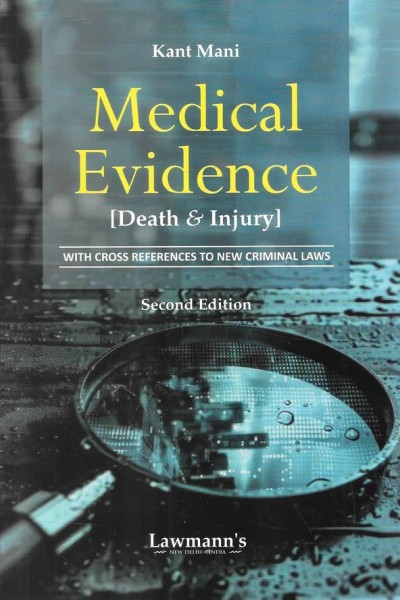
Lawmann's Medical Evidence: Death and Injury (With Cross References to New Criminal Laws) - Edition 2027
| Author : | KANT MANI |
|---|
Lawmann’s Medical Evidence: Death and Injury (Edition 2026) is a comprehensive legal reference examining the role and evaluation of medical and forensic evidence relating to death and bodily injuries in criminal cases. The book integrates principles of medical jurisprudence with criminal law and procedure, providing clear cross-references to the new criminal laws including BNS, BNSS, and BSA. It is an essential guide for advocates, judicial officers, prosecutors, police officers, forensic experts, and law students dealing with criminal trials and evidence assessment.


Tags: Medical Evidence
Lawmann’s Medical Evidence: Death and Injury (With Cross References to New Criminal Laws) – Edition 2027 is a specialised and authoritative legal treatise that provides a thorough analysis of medical and forensic evidence relating to death and bodily injuries within the framework of Indian criminal law. This updated edition has been carefully aligned with the new criminal laws, offering precise cross-references to the Bharatiya Nyaya Sanhita (BNS), Bharatiya Nagarik Suraksha Sanhita (BNSS), and Bharatiya Sakshya Adhiniyam (BSA), making it highly relevant for contemporary criminal practice.
The book comprehensively examines the medical jurisprudence aspects of death and injury, including classification of injuries, causation, nature and gravity of wounds, age of injuries, medico-legal opinion, and their evidentiary value in criminal trials. It provides detailed guidance on post-mortem examinations, determination of cause and manner of death, interpretation of medical reports, and the role of forensic experts in court proceedings.
Special emphasis is placed on the evaluation and appreciation of medical evidence by courts, explaining how medical testimony supports or contradicts ocular and circumstantial evidence. The book addresses common issues arising during trials, such as inconsistencies in medical opinions, expert evidence under the law of evidence, cross-examination of medical witnesses, and the legal consequences of defective or delayed medical reports.
The work also discusses procedural safeguards and investigative standards, including medico-legal examinations of accused and victims, documentation of injuries, preservation of evidence, and coordination between investigating agencies and medical professionals. By integrating legal principles with practical insights, the book bridges the gap between forensic medicine and criminal law application.
Written in a clear, analytical, and practice-oriented style, this book is an invaluable resource for advocates, judicial officers, prosecutors, police officers, forensic experts, medico-legal practitioners, judicial service aspirants, and law students. It supports courtroom practice, academic study, and examination preparation with reliable legal and medical interpretation.
Lawmann’s Medical Evidence: Death and Injury (Edition 2026) stands as a definitive guide on the subject, offering clarity, accuracy, and contemporary relevance in understanding how medical and forensic evidence shapes criminal investigations and trials under India’s reformed criminal justice system.