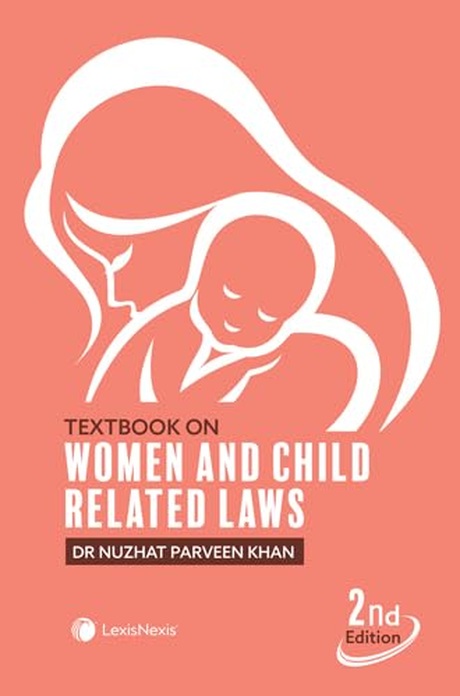
LexisNexis's Textbook on Women and Child Related Laws - 2nd Edition 2025
| Author : | Dr. nuzhat Parveen khan |
|---|
| A research-based textbook on the legal frameworks protecting the rights of women and children in India, in nine chapters across two parts, rewritten for the Bharatiya Nyaya Sanhita, Bharatiya Nagarik Suraksha Sanhita and Bharatiya Sakshya Adhiniyam, 2023 — with particular attention to child trafficking, domestic violence and maintenance. Part I covers domestic violence, employment and labour, sexual harassment at the workplace, anti-discrimination law under Articles 14, 15 and 16, family law and maintenance, property and coparcenary rights, the intersection of women's rights with disability rights, and extra-legal adjudication by Khap Panchayats and Shalishi Adalats. Part II covers the constitutional rights of the child, child trafficking, juvenile justice, POCSO, child labour, the right to education, child marriage, adoption and guardianship, and the position of children from marginalized communities. Dr. Nuzhat Parveen Khan is Senior Professor of Law at Jamia Millia Islamia and a consulting penal member of the National Commission for Women. 2nd Edition 2025, LexisNexis. |


Tags: Juvenile justice, Women & Children, Women & Criminal Law, Gender Justice
Textbook on Women and Child Related Laws by Dr. Nuzhat Parveen Khan, published by LexisNexis, is a research-based study of the legal frameworks protecting the rights of women and children in India. Second Edition, 2025.
The subject has moved a great deal since the first edition. The Bharatiya Nyaya Sanhita, 2023, the Bharatiya Nagarik Suraksha Sanhita, 2023 and the Bharatiya Sakshya Adhiniyam, 2023 have redrawn the offences and the procedure that matter most here — child trafficking, domestic violence and maintenance among them — and a textbook written before them is now teaching a repealed statute. This edition works through those changes specifically and asks the question a critical textbook ought to ask: what do they actually do for the vulnerable groups they are said to protect?
Dr. Nuzhat Parveen Khan is Senior Professor of Law at the Faculty of Law, Jamia Millia Islamia, New Delhi, and the author of Women and the Law, Comparative Constitutional Law and Law and Justice in a Globalized World. She serves as a consulting penal member of the National Commission for Women on age-related issues of juveniles, and her empirical work for the Commission has examined discriminatory practices by Khap Panchayats and Shalishi Adalats. That fieldwork shows in the book: the treatment is doctrinal but never purely doctrinal.
Key Features
- Updated for the new criminal laws — the BNS, BNSS and BSA, 2023 — with specific attention to child trafficking, domestic violence and maintenance.
- Nine chapters in two parts: Women's Rights and Jurisprudence, and Child Rights and Marginalization.
- Critical rather than descriptive — the book reviews recent legislative change and assesses what it means for the groups it is meant to protect.
- Landmark judgments analysed, not merely cited, with attention to how they shaped the present position.
- Interdisciplinary approach suited to students of law, sociology and gender studies alike.
- Written by a Senior Professor of Law at Jamia Millia Islamia who advises the National Commission for Women.
- 2nd Edition, 2025, softcover — current and classroom-ready.
Coverage
Part I — Women's Rights and Jurisprudence
- Domestic violence: the Protection of Women from Domestic Violence Act, 2005, the reliefs available, the role of the Protection Officer, and the position after the new criminal laws.
- Employment and labour: equal remuneration, maternity benefit, conditions of work, and sexual harassment at the workplace under the POSH Act, 2013.
- Anti-discrimination law: the constitutional guarantees of Articles 14, 15 and 16, the scope of protective discrimination, and the limits the courts have set.
- Family law: marriage, divorce, maintenance and custody across the personal law systems, and the uniform civil code debate.
- Property rights: the Hindu Succession (Amendment) Act, 2005 and the daughter's coparcenary right, matrimonial property, and inheritance under the other personal laws.
- Women's rights and disability rights — the intersection, and the compounding of disadvantage.
- Women under repressive legislation, and the experience of law that is nominally protective.
- Extra-legal adjudication: Khap Panchayats, Shalishi Adalats and the constitutional response.
Part II — Child Rights and Marginalization
- Constitutional rights of the child: Articles 21A, 23, 24 and 39, and the Directive Principles as they bear on childhood.
- Child trafficking as reframed by the Bharatiya Nyaya Sanhita, 2023.
- Juvenile justice: the Juvenile Justice (Care and Protection of Children) Act, 2015, children in conflict with the law, children in need of care and protection, and the age determination question.
- Protection from sexual offences under the POCSO Act, 2012, and the procedural safeguards for the child witness.
- Child labour and the prohibition and regulation framework.
- Right to education under Article 21A and the Right of Children to Free and Compulsory Education Act, 2009.
- Child marriage and the Prohibition of Child Marriage Act, 2006.
- Children of marginalized communities — the specific disadvantages and the statutory response.
- Adoption, guardianship and institutional care.
Who Should Buy This Book?
- LL.B. and LL.M. students taking papers on Women and Law, Gender and Law, Child Rights, Family Law or Feminist Jurisprudence.
- Legal practitioners and activists needing current statutory updates and case analysis for advocacy before Family Courts and human rights forums.
- Social workers and policymakers in women and child welfare, and NGOs engaged in policy drafting.
- Protection Officers, Child Welfare Committee members and Juvenile Justice Board members.
- Judicial service aspirants, where women and child legislation is examinable across several papers.
- Students of sociology, social work and gender studies, for whom the interdisciplinary framing is deliberate.
- Law school, university and NGO resource libraries.
Why Choose This Book?
Most books in this field are either compilations of statutes with a short note on each, or advocacy writing with the law sketched in behind it. This one is a textbook in the proper sense — it states the law accurately and then subjects it to criticism, which is what makes it usable both for an examination answer and for an argument. The two-part structure is a real organising choice rather than a convenience: women's rights and child rights are governed by different instruments and different assumptions, and treating them separately before showing where they meet is clearer than running them together.
The decisive reason to prefer this edition over anything earlier is the new criminal laws. The BNS, BNSS and BSA came into force in July 2024, and they touch almost every offence that matters in this subject. A student answering on child trafficking or domestic violence from a pre-2024 text will be citing provisions that no longer exist. This edition deals with the change directly, and — more usefully — evaluates whether it improves the position of the people it concerns.