LMP's Recent Judgments on Company Law By Dipti Mehta (Reviewed by S. Balasubramanian, Former Chairman Company Law Board) - 2026 Edition
| Author : | Dipti Mehta |
|---|
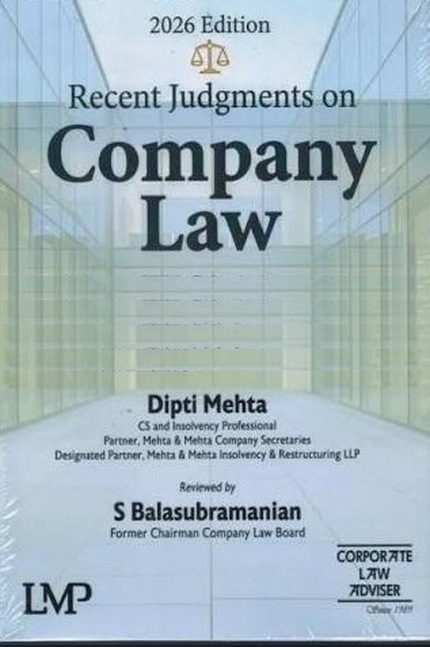
| Recent Judgments on Company Law by Dipti Mehta (CS and Insolvency Professional), reviewed by S. Balasubramanian, former Chairman of the Company Law Board, published by LMP — Corporate Law Adviser, 2026 Edition. A subject-wise collection of recent judgments of the Supreme Court, the High Courts, the NCLAT and the NCLT on company law, covering incorporation and lifting of the corporate veil, share capital and transfer of shares, directors and their disqualification and liability, meetings and resolutions, oppression and mismanagement under sections 241 and 242, accounts and audit, schemes of compromise and amalgamation under sections 230 to 232, the interface with the Insolvency and Bankruptcy Code, striking off and restoration under section 252, SFIO investigation, adjudication and compounding of offences, and procedure before the NCLT and NCLAT. Hardbound. ISBN 9789384345853. |


Tags: Company Law, Case Laws, Corporate Law Book, Companies Act, 2013
Recent Judgments on Company Law by Dipti Mehta — Company Secretary and Insolvency Professional, Partner at Mehta & Mehta Company Secretaries and Designated Partner at Mehta & Mehta Insolvency & Restructuring LLP — reviewed by S. Balasubramanian, former Chairman of the Company Law Board, and published by LMP (Corporate Law Adviser). This is the 2026 Edition. Hardbound. ISBN 9789384345853.
Company law in India is now made as much in the tribunals as in the statute. The Companies Act, 2013 leaves a great deal to be worked out case by case — what amounts to oppression and mismanagement, when a scheme of amalgamation will be sanctioned, how far a director's liability extends, when the corporate veil is lifted — and the answers accumulate in the orders of the NCLT, the NCLAT, the High Courts and the Supreme Court rather than in any amendment. This volume gathers the recent judgments and arranges them so that the current position on each question can be found quickly.
Key Features
- 2026 Edition, published by LMP — Corporate Law Adviser
- Recent judgments of the Supreme Court, High Courts, NCLAT and NCLT on company law
- Authored by a practising Company Secretary and Insolvency Professional
- Reviewed by S. Balasubramanian, former Chairman, Company Law Board
- Arranged by subject for quick reference by practitioners
- Hardbound · English
Coverage
Incorporation and Corporate Personality. Formation and registration of companies, the memorandum and articles, alteration of the objects clause, change of registered office and name, and the lifting of the corporate veil.
Share Capital and Securities. Issue and allotment of shares, private placement and preferential allotment, transfer and transmission, rectification of the register of members, buy-back, reduction of capital, and dematerialisation.
Directors and Key Managerial Personnel. Appointment, resignation and removal of directors; disqualification under section 164 and the consequences of vacation of office; duties under section 166; independent directors; related party transactions; loans to directors; and the liability of directors for the acts of the company.
Meetings and Resolutions. Board and general meetings, notice and quorum, requisitioned meetings, voting and proxies, and the validity of resolutions.
Oppression and Mismanagement. Petitions under sections 241 and 242, the threshold for maintainability, the reliefs the Tribunal may grant, and the line between a corporate grievance and a personal one; class action under section 245.
Accounts, Audit and Disclosure. Financial statements, the Board's report, auditor appointment, removal and resignation, NFRA proceedings, and the reporting of fraud.
Compromises, Arrangements and Amalgamations. Schemes under sections 230 to 232, the role of the Tribunal, objections by shareholders, creditors and statutory authorities, fast-track mergers, and the appointed date.
Insolvency and Winding Up. The interface between the Companies Act and the Insolvency and Bankruptcy Code, 2016, winding up by the Tribunal, striking off and restoration of a company's name under section 252.
Investigation, Inspection and Enforcement. Powers of the Registrar and the Serious Fraud Investigation Office (SFIO), freezing of assets, and prosecution.
Offences, Penalties, Compounding and Adjudication. Adjudication of penalties by the Registrar, appeals to the Regional Director, compounding of offences, and the treatment of continuing defaults.
Procedure Before the NCLT and NCLAT. Jurisdiction, limitation and condonation of delay, maintainability, interim relief, and appeals.
Who Should Buy This Book?
- Company Secretaries in practice and in employment
- Corporate lawyers and counsel appearing before the NCLT and NCLAT
- Insolvency professionals and resolution professionals
- Chartered Accountants and statutory auditors advising on corporate compliance
- Directors, independent directors and audit committee members
- In-house legal and secretarial teams
- Registrars of Companies, Regional Directors and regulatory officers
- CS, CA and CMA students taking company law papers
- Corporate libraries and professional firms
Why Choose This Book?
A bare Act tells you what the section says; a commentary tells you what it has generally been taken to mean. Neither answers the question a practitioner actually brings to the desk — what has the Tribunal held recently, on facts like these. A judgments volume arranged by subject answers it directly, and in a field where the NCLT and NCLAT are producing orders continuously, currency matters more than in most.
The second reason is who assembled it. Dipti Mehta practises as a Company Secretary and Insolvency Professional, so the selection reflects the questions that arise in practice rather than those that are academically interesting; and the review by S. Balasubramanian, formerly Chairman of the Company Law Board, brings the perspective of the bench that decided these matters before the Tribunal took over.