LMP's SEBI (LODR) Regulations, 2015 with Master Circular for Compliance - 2026 Edition
| Author : | CS Atul Mehta |
|---|
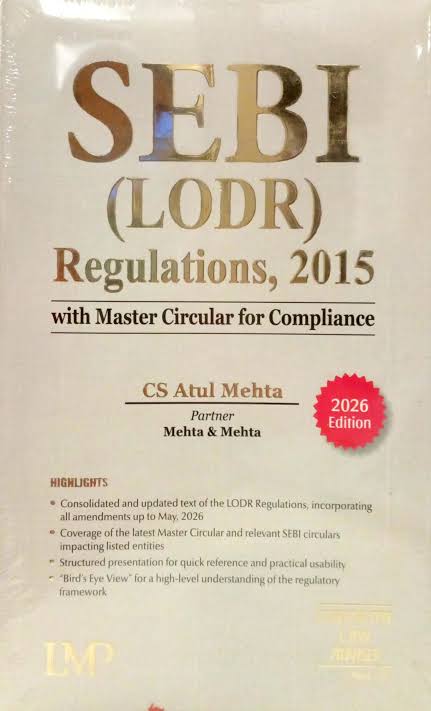
| LMP's SEBI (LODR) Regulations, 2015 with Master Circular for Compliance by CS Atul Mehta (Partner, Mehta & Mehta), 2026 Edition, gives the consolidated text of the Listing Obligations and Disclosure Requirements Regulations with all amendments up to May 2026, together with the latest SEBI Master Circular and the circulars impacting listed entities. It covers the principles under Regulation 4, board composition and the Audit, Nomination and Remuneration, Stakeholders Relationship and Risk Management Committees, independent directors, related party transactions under Regulation 23, corporate governance under Regulation 27 and Schedule V, disclosure of material events and rumour verification under Regulation 30, periodic filings including financial results, shareholding pattern, BRSR and the Annual Secretarial Compliance Report, obligations for non-convertible and other classes of securities, schemes of arrangement, and the SOP for non-compliance. Includes a "Bird's Eye View" of the framework. Hardbound. ISBN 9789384345839. |


Tags: Company Law, SEBI, SEBI (LODR), Corporate Governance
SEBI (LODR) Regulations, 2015 with Master Circular for Compliance by CS Atul Mehta, Partner at Mehta & Mehta, published by LMP (Legal Matrix Publications) — Corporate Law Adviser, is a consolidated working text of the Listing Obligations and Disclosure Requirements Regulations together with the SEBI Master Circular that governs their application. This is the 2026 Edition, incorporating all amendments up to May 2026. Hardbound. ISBN 9789384345839.
The LODR Regulations are amended more often than almost any other Indian securities instrument, and the obligations they impose do not live in the Regulations alone — a great deal of what a listed entity must actually do is set out in the Master Circular and in the circulars issued under it. A compliance officer working from the bare Regulations alone will miss the timeline, the format, or the filing that the circular prescribes. This volume puts both in one place, current to the same date.
Highlights
- Consolidated and updated text of the LODR Regulations, incorporating all amendments up to May 2026
- Coverage of the latest Master Circular and the relevant SEBI circulars impacting listed entities
- Structured presentation for quick reference and practical usability
- A "Bird's Eye View" giving a high-level understanding of the regulatory framework
- 2026 Edition · Hardbound · English
- Authored by a practising Company Secretary, Partner at Mehta & Mehta
Coverage
Preliminary and Definitions. Applicability of the Regulations to the various classes of listed securities, and the defined terms on which the obligations turn.
Principles Governing Disclosures and Obligations — Regulation 4. The general principles applicable to a listed entity, and the common obligations that run across all classes of securities under Regulations 4 to 27.
Board of Directors and Committees. Composition of the board, independent directors and their appointment, re-appointment and resignation; the Audit Committee, the Nomination and Remuneration Committee, the Stakeholders Relationship Committee and the Risk Management Committee; performance evaluation; and the obligations of the board towards subsidiaries.
Related Party Transactions — Regulation 23. Materiality thresholds, prior approval of the Audit Committee, shareholder approval, the industry standards on RPT disclosure, and periodic reporting.
Corporate Governance — Regulation 27 and Schedule V. The corporate governance report, the compliance certificate, and the annual report requirements.
Disclosure of Material Events — Regulation 30 and Schedule III. Deemed material events, the materiality policy, timelines for disclosure, verification of market rumours, and disclosure of agreements binding the listed entity.
Periodic Filings. Financial results under Regulation 33, the shareholding pattern under Regulation 31, the corporate governance report under Regulation 27(2), the investor complaints statement, the Annual Secretarial Compliance Report, and the Business Responsibility and Sustainability Report.
Obligations Relating to Securities. Record date and corporate actions, transfer and transmission, dematerialisation, dividend and interest payment, and the reclassification of promoters.
Specific Classes of Securities. Obligations for listed non-convertible securities, commercial paper, securitised debt instruments, units of mutual funds, Indian depository receipts, and entities listed on the SME platform.
Scheme of Arrangement — Regulations 37 and 94. Prior approval of the stock exchanges and the SEBI observation letter.
Delisting, Suspension and Enforcement. Continuous listing requirements, minimum public shareholding, the Standard Operating Procedure for non-compliance, fines and penalties, freezing of promoter holding, and suspension of trading.
Master Circular for Compliance. The SEBI Master Circular for listed entities as updated, together with the circulars and industry standards that supplement the Regulations.
Who Should Buy This Book?
- Company Secretaries and Compliance Officers of listed entities
- Practising Company Secretaries issuing the Annual Secretarial Compliance Report
- Securities lawyers and corporate counsel
- Chartered Accountants and statutory auditors of listed companies
- Directors, independent directors and Audit Committee members
- Merchant bankers, investment bankers and capital market intermediaries
- Stock exchange and regulatory officials
- CS and CA students taking securities laws and capital markets papers
- Corporate libraries and professional firms
Why Choose This Book?
The practical problem with the LODR is not understanding it but keeping up with it. Amendments arrive several times a year, the Master Circular is reissued, and industry standards are notified between the two. Working from a text that is a year old is how a filing deadline gets missed. An edition current to May 2026, with the Master Circular alongside, removes that risk for the compliance calendar it covers.
The "Bird's Eye View" is the other reason to prefer this volume. The LODR is structured by class of security rather than by activity, so the obligations attaching to any one listed company are scattered across several chapters. A high-level map of the framework lets a compliance officer see which provisions apply to their entity before descending into the text — which is the order in which the question actually arises.