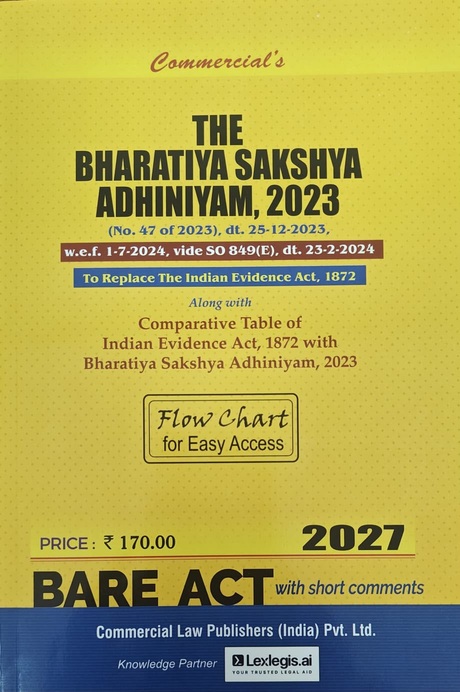
Commercial's The Bharatiya Sakshya Adhiniyam, 2023 (BSA) - Bare Act with Short Comments - Edition 2027
| Author : | Bare Act |
|---|
| The full text of the Bharatiya Sakshya Adhiniyam, 2023 (No. 47 of 2023), which came into force on 1 July 2024 vide SO 849(E) dated 23 February 2024 and replaces the Indian Evidence Act, 1872, published as a bare act with short comments. This edition carries a Comparative Table of the Indian Evidence Act, 1872 with the Bharatiya Sakshya Adhiniyam, 2023 — the mapping a practitioner needs in order to carry a century and a half of authority decided under the old numbering into the new Act — together with a Flow Chart for easy access to the scheme of the Adhiniyam. Coverage runs through the definitions, relevancy of facts, conspiracy, admissions and confessions, statements by persons who cannot be called as witnesses including dying declarations, judgments of courts, expert and other opinion evidence, character, facts which need not be proved, oral evidence, documentary evidence with primary and secondary evidence and the presumptions as to documents, electronic and digital records and the certificate requirement, burden of proof and the special presumptions, estoppel, the competency and privileges of witnesses, and the examination, cross-examination and re-examination of witnesses. 2027 Edition, Commercial Law Publishers (India) Pvt. Ltd. |


Tags: Bharatiya Sakshya Adhiniyam (BSA), Evidence Law, BARE ACT, New Criminal Law
Commercial's The Bharatiya Sakshya Adhiniyam, 2023 — Bare Act with short comments, published by Commercial Law Publishers (India) Pvt. Ltd. 2027 Edition.
The Bharatiya Sakshya Adhiniyam, 2023 (No. 47 of 2023), dated 25 December 2023, came into force on 1 July 2024 vide SO 849(E) dated 23 February 2024, replacing the Indian Evidence Act, 1872. A hundred and fifty years of Indian evidence law was built on the numbering of the 1872 Act: every textbook, every digest and every reported judgment refers to its sections. The new Adhiniyam renumbers the whole subject.
That is the practical problem this edition is designed around. It carries a Comparative Table of the Indian Evidence Act, 1872 with the Bharatiya Sakshya Adhiniyam, 2023, which is what allows a practitioner to take a judgment decided under Section 65B of the old Act and find the provision that now carries it. It also includes a Flow Chart for easy access to the structure of the Act — useful for a reader learning the new scheme from scratch.
Key Features
- The full text of the Bharatiya Sakshya Adhiniyam, 2023 (No. 47 of 2023), in force from 1 July 2024.
- Comparative Table mapping the Indian Evidence Act, 1872 against the Bharatiya Sakshya Adhiniyam, 2023 — the key to carrying old authority into the new Act.
- Flow Chart for easy access, giving the scheme of the Act at a glance.
- Short comments alongside the bare text.
- The commencement position set out — SO 849(E) dated 23-2-2024, with effect from 1-7-2024.
- 2027 Edition, from Commercial Law Publishers (India) Pvt. Ltd., with Lexlegis.ai as knowledge partner.
- Pocket-priced at ₹170 — an easy second copy for chambers, the bag or the examination hall.
Coverage
- Preliminary — short title, extent and commencement, and the definitions, including "document", "evidence", "fact in issue", "proved", "disproved" and "not proved".
- Relevancy of facts — facts forming part of the same transaction, occasion, cause and effect, motive, preparation and conduct, and facts necessary to explain or introduce relevant facts.
- Conspiracy — things said or done by a conspirator.
- Admissions — what they are, by whom they may be made, their proof and their effect.
- Confessions — confessions caused by inducement, threat or promise, confessions to a police officer, confessions in custody, and how much of a statement may be proved.
- Statements by persons who cannot be called as witnesses — dying declarations and the other categories.
- Judgments of courts, when relevant.
- Opinions of third persons — experts, handwriting, electronic evidence, custom, and the opinion of persons with special means of knowledge.
- Character, when relevant.
- Facts which need not be proved — judicial notice and admitted facts.
- Oral evidence and the requirement that it be direct.
- Documentary evidence — primary and secondary evidence, proof of documents, public and private documents, and presumptions as to documents.
- Electronic and digital records — their admissibility and the certificate requirement, and the treatment of information in semiconductor memory and communication devices.
- Exclusion of oral by documentary evidence.
- Burden of proof — on whom it lies, the presumptions, and the special burdens, including in prosecutions for rape and for abetment of suicide by a married woman.
- Estoppel, including estoppel of a tenant and of a licensee.
- Witnesses — competency, the dumb witness, privileged communications, and the compellability of production.
- Examination of witnesses — examination-in-chief, cross-examination and re-examination, leading questions, questions lawful in cross-examination, impeaching credit, and refreshing memory.
- Improper admission and rejection of evidence.
- Repeal and savings, and the Schedule.
Who Should Buy This Book?
- Criminal and civil trial advocates — the law of evidence is the daily instrument of a trial practice.
- Judges, judicial officers and Magistrates.
- Judicial service and APO aspirants, for whom the BSA has replaced the Evidence Act on the syllabus.
- LL.B. and B.A. LL.B. students taking Law of Evidence.
- AIBE candidates, who may carry a bare act into the open-book examination.
- Police officers, investigating officers and prosecutors framing and proving cases under the new scheme.
- Practitioners trained on the Indian Evidence Act, 1872 who need the comparative table to reconcile old authority with new numbering.
- Law college and court libraries, and chambers needing multiple copies.
Why Choose This Book?
The comparative table is the reason to buy this particular edition. Almost every reported decision on the law of evidence in India was decided under the Indian Evidence Act, 1872, and will be for years to come — the authority on confessions, on dying declarations, on electronic records under the old Section 65B is all under the old numbering. Citing it now requires knowing which provision of the Adhiniyam carries it forward and whether the language survived intact. A table that does that mapping saves the work on every single reference.
The flow chart serves the other kind of reader: a student or a young advocate meeting the Act for the first time, who needs to see its architecture before learning its sections. At ₹170 for the current text, a comparative table and a structural chart, this is the cheapest way to be properly equipped on the new evidence law — and inexpensive enough to keep a spare copy in the bag.