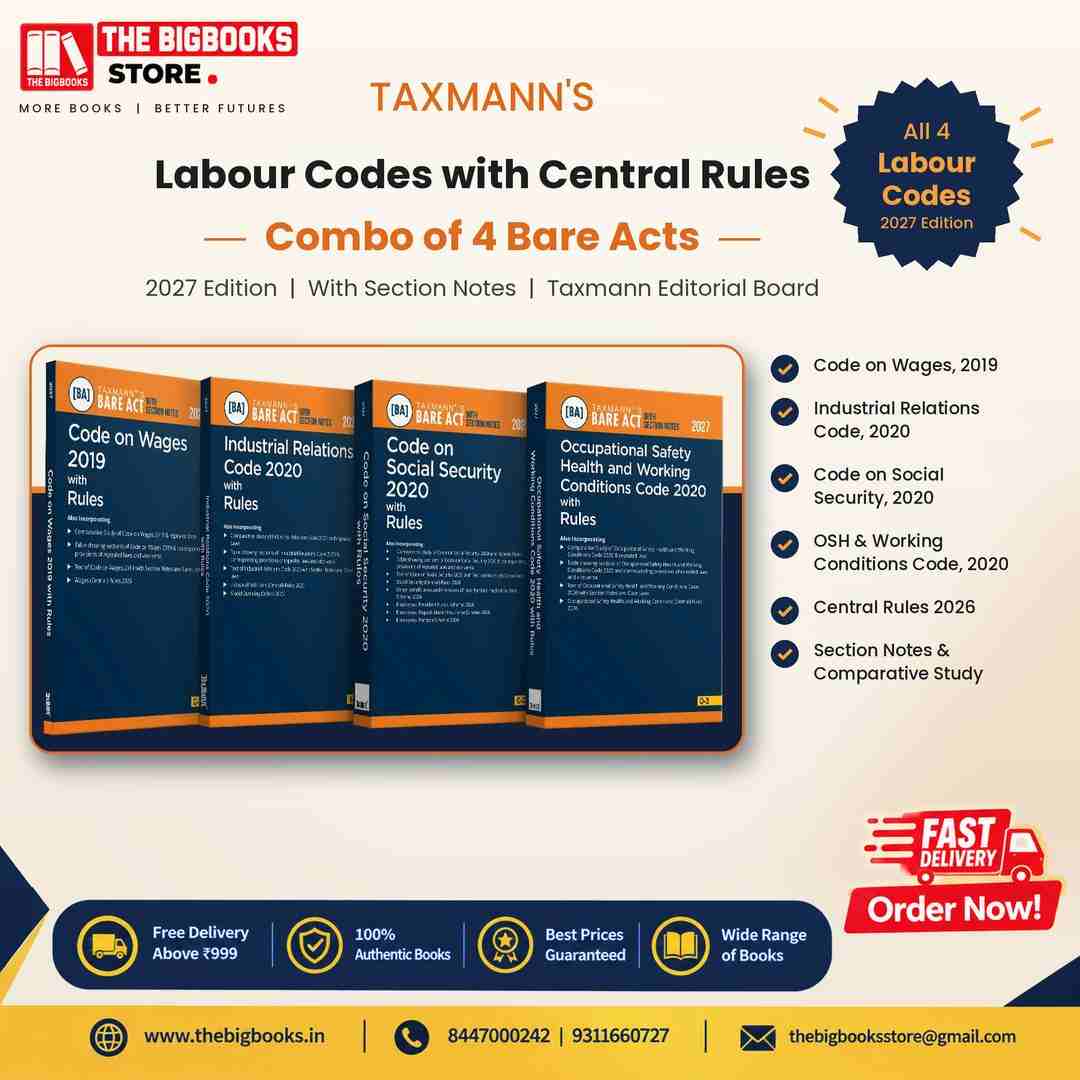
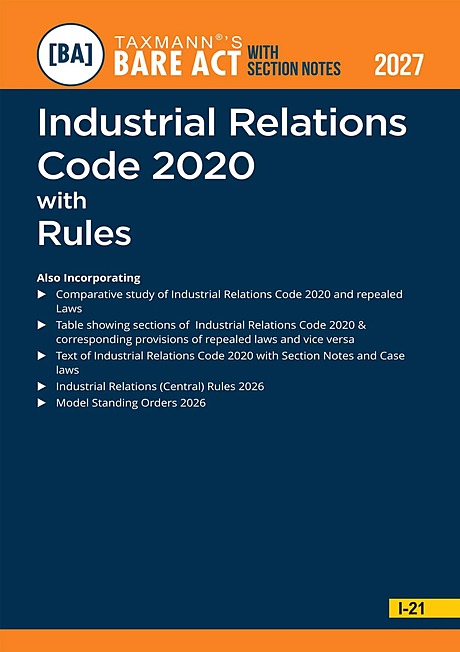
Taxmann's Industrial Relations Code 2020 with Rules [Bare Act with Section Notes] - Edition 2027
| Author : | Bare Act |
|---|
| Taxmann's Industrial Relations Code 2020 with Rules, Bare Act with Section Notes, Edition 2027, carries the text of the Industrial Relations Code, 2020 with section notes and case laws, a comparative study of the Code and the repealed laws, a table showing the sections of the Code and the corresponding provisions of the repealed laws and vice versa, the Industrial Relations (Central) Rules 2026 and the Model Standing Orders 2026. The Code consolidates the Trade Unions Act 1926, the Industrial Employment (Standing Orders) Act 1946 and the Industrial Disputes Act 1947, and covers the registration and rights of trade unions and the recognition of a negotiating union or negotiating council, standing orders and their certification and modification, notice of change in conditions of service, Works Committees, Grievance Redressal Committees and conciliation, Industrial Tribunals and the National Industrial Tribunal, strikes and lock-outs, lay-off, retrenchment and closure with the compensation payable, unfair labour practices, offences and penalties, and the worker re-skilling fund. For HR and IR managers, employment lawyers, trade unions, employers, consultants, conciliation officers and students. |


Tags: Labour Law, BARE ACT, The Industrial Relations Code, Labour Codes
Taxmann's Industrial Relations Code 2020 with Rules – Bare Act with Section Notes, Edition 2027
Taxmann presents the Edition 2027 of its Bare Act with Section Notes on the Industrial Relations Code, 2020, with the Industrial Relations (Central) Rules, 2026 and the Model Standing Orders, 2026 in the same volume.
Three Acts replaced by one Code
The Industrial Relations Code consolidates the Trade Unions Act, 1926, the Industrial Employment (Standing Orders) Act, 1946 and the Industrial Disputes Act, 1947. Seventy years of case law sits behind those three statutes, and the practical question in every dispute is how much of it carries across. The two-way section tables in this volume are what make that check quick.
What the volume contains
- The text of the Industrial Relations Code, 2020, with Section Notes and case laws.
- A Comparative Study of the Code and the repealed laws.
- A table showing the sections of the Code and the corresponding provisions of the repealed laws, and vice versa — mapping in both directions.
- The Industrial Relations (Central) Rules, 2026.
- The Model Standing Orders, 2026.
Why the Model Standing Orders matter
Standing orders govern the day-to-day terms of employment in an industrial establishment — classification of workers, shifts, attendance, leave, misconduct and the disciplinary procedure. Until an establishment's own standing orders are certified, the Model Standing Orders apply. Having the 2026 Model Standing Orders printed alongside the Code is what turns this from a reference text into something an HR department can act on.
What the Code covers
- Trade unions — registration, rights, and recognition of the negotiating union or negotiating council.
- Standing orders — applicability, certification and modification.
- Notice of change in conditions of service.
- Works Committee, Grievance Redressal Committee and conciliation.
- Industrial Tribunals and the National Industrial Tribunal, references and awards.
- Strikes and lock-outs, and the notice requirements.
- Lay-off, retrenchment and closure, and the compensation payable.
- Unfair labour practices, offences, penalties and compounding.
- The worker re-skilling fund.
Who should buy this book
- HR heads, IR managers and disciplinary authorities conducting domestic enquiries.
- Labour and employment lawyers, and advocates before labour courts and industrial tribunals.
- Trade unions and their office-bearers.
- Employers, management associations and factory managements.
- Labour law consultants and compliance teams.
- Conciliation officers and labour department officers.
- Students of labour and industrial law, and CS, CMA and judicial service candidates.
About the publisher
Taxmann's Editorial Board compiles the Bare Act with Section Notes series. Taxmann has published on Indian law and taxation for more than six decades.