Taxmann's Law & Practice Relating to Industrial Relations Code - A Section-wise Commentary by Sunil Kumar Tripathi - Edition October 2026
| Author : | Sunil Kumar Tripathi |
|---|
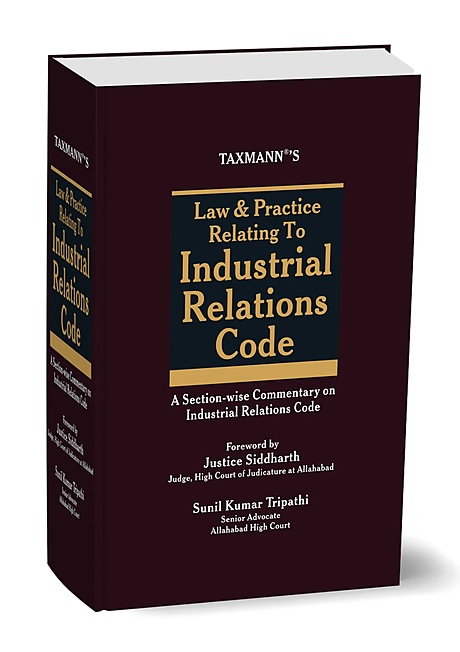
| Taxmann's Law & Practice Relating to Industrial Relations Code by Sunil Kumar Tripathi, Senior Advocate of the Allahabad High Court, with a Foreword by Justice Siddharth, Edition October 2026, is a single-volume section-wise commentary on the Industrial Relations Code, 2020 covering Sections 1 to 104 with the law stated as at 30 September 2026. It reads every provision against the three Acts the Code replaced - the Industrial Disputes Act 1947, the Industrial Employment (Standing Orders) Act 1946 and the Trade Unions Act 1926 - through four front tables linking old and new in both directions, and cites nearly 1,500 cases up to a nine-judge Constitution Bench ruling of 20 August 2026. It carries about 250 pages of commentary on the 44 defined terms, a list of cases of some 55 pages, and for each section the statutory text, an overview box, a comparative study, section notes, comments and footnotes, with Section 50 on disciplinary proceedings running to about 90 pages. The Industrial Relations (Central) Rules, 2026 notified on 8 May 2026 are printed alongside more than twenty sections. For labour lawyers, judges and presiding officers, HR and IR managers, trade unions, employers, consultants and students. |


Tags: Labour Law, Industrial Disputes Act, Standing Orders, The Industrial Relations Code
Taxmann's Law & Practice Relating to Industrial Relations Code – A Section-wise Commentary, by Sunil Kumar Tripathi, Edition October 2026
Taxmann presents Law & Practice Relating to Industrial Relations Code by Sunil Kumar Tripathi, Senior Advocate of the Allahabad High Court, with a Foreword by Justice Siddharth, Judge of the High Court of Judicature at Allahabad — a single-volume, section-wise commentary on the Industrial Relations Code, 2020 covering Sections 1 to 104, with the law stated as at 30 September 2026.
What makes this commentary useful
The Industrial Relations Code replaces three statutes at once — the Industrial Disputes Act, 1947, the Industrial Employment (Standing Orders) Act, 1946 and the Trade Unions Act, 1926. Seventy years of case law sits behind those Acts, and the only question that matters in practice is how much of it survives. This book reads every provision against the three Acts it replaced, and cites nearly 1,500 cases — up to and including a nine-judge Constitution Bench ruling of 20 August 2026.
How the book is organised
- Four front tables, running over twenty pages, linking the Code to the old Acts in both directions — old provision to new and new to old, across the Industrial Disputes Act, the Standing Orders Act and the Trade Unions Act.
- Commentary on the 44 defined terms, running to roughly 250 pages. Definitions decide most industrial disputes, and they are treated at that length for a reason.
- A List of Cases of about 55 pages with nearly 1,500 entries.
- Section-wise commentary on Sections 1 to 104, each section carrying the statutory text, an overview box, a comparative study against the old law, section notes, comments and footnotes.
- Section 50 on disciplinary proceedings treated at about 90 pages across 39 paragraphs — the fullest treatment in the book, and the provision that generates the most litigation.
- The Industrial Relations (Central) Rules, 2026, notified on 8 May 2026, printed alongside more than twenty sections, with the forms and notifications.
Why buy this edition
- Current to 30 September 2026, with the Central Rules of 8 May 2026 in place.
- The old case law assessed, not ignored — the single hardest thing to get from a new-Code commentary.
- Definitions given proper weight, at around 250 pages.
- Written in plain language for HR managers, unions and employers as well as the Bench and the Bar.
- Foreword by a sitting judge of the Allahabad High Court.
- Rules printed next to the sections they belong to, so the Code and the Rules are read together.
Who should buy this book
- Labour and employment lawyers and advocates before labour courts, industrial tribunals and the High Courts.
- Judges and presiding officers of labour courts and industrial tribunals.
- HR heads, IR managers and disciplinary authorities conducting domestic enquiries.
- Trade unions and their office-bearers, and employers and management associations.
- Labour law consultants and compliance teams.
- Academics, researchers and students of labour and industrial law.
About the author
Sunil Kumar Tripathi is a Senior Advocate of the Allahabad High Court. He took his LL.B. from Banaras Hindu University in 1976, enrolled with the Bar Council of Uttar Pradesh in 1977, and has practised before the Allahabad High Court since 2001. He also writes Taxmann's commentaries on the Occupational Safety, Health and Working Conditions Code, the Code on Wages and the Code on Social Security.