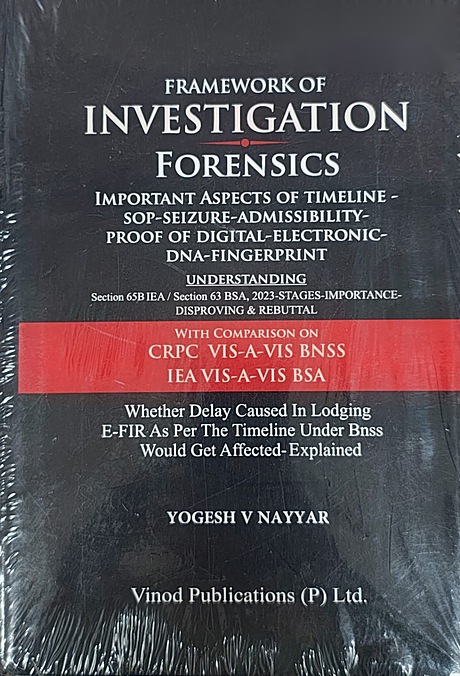
Vinod Publications' Framework of Investigation Forensics by Yogesh V. Nayyar (Timeline, SOP, Seizure, Admissibility & Proof of Digital, Electronic, DNA and Fingerprint Evidence)
| Author : | Yogesh V Nayyar |
|---|
| Vinod Publications' Framework of Investigation Forensics by Yogesh V. Nayyar is a hardbound work on the forensic and procedural side of a criminal investigation under the new criminal laws. It covers the important aspects of investigation timelines, standard operating procedures, seizure, admissibility and the proof of digital and electronic, DNA and fingerprint evidence, and it takes Section 65B of the Indian Evidence Act and Section 63 of the Bharatiya Sakshya Adhiniyam, 2023 through their stages and importance and through how such a certificate is disproved and rebutted. It carries a comparison of the CrPC with the BNSS and of the Indian Evidence Act with the BSA, and explains whether a delay caused in lodging an e-FIR, measured against the timeline under the BNSS, would affect the case. For investigating officers, police and prosecution agencies, criminal lawyers and defence counsel, public prosecutors, judges and magistrates ruling on admissibility, forensic and cyber forensic examiners, and judicial service aspirants and students of criminology and forensic science. |

English

Tags: Evidence Law, Forensic Science, Electronic Evidence, Investigating Officers (I .O)
Vinod Publications' Framework of Investigation Forensics – by Yogesh V. Nayyar
Vinod Publications (P) Ltd. presents Framework of Investigation Forensics by Yogesh V. Nayyar — a hardbound work on the forensic and procedural side of a criminal investigation under the new criminal laws, written around the questions that actually decide whether evidence survives a trial.
The problem this book addresses
An investigation can be sound and still collapse in court, because the material was seized the wrong way, the certificate was defective, or a step fell outside the statutory timeline. Since the Bharatiya Nagarik Suraksha Sanhita and the Bharatiya Sakshya Adhiniyam replaced the CrPC and the Evidence Act, every one of those requirements has been restated — and this book is built to show what changed and what it means in practice.
What the book covers
- Timelines in an investigation, and the consequences of missing them.
- Standard Operating Procedures for the handling of evidence.
- Seizure — how material is lawfully taken and preserved.
- Admissibility, and the proof of digital and electronic evidence.
- DNA evidence and fingerprint evidence.
- Section 65B of the Indian Evidence Act and Section 63 of the Bharatiya Sakshya Adhiniyam, 2023 — the certificate requirement for electronic records, taken through its stages, its importance, and how it is disproved and rebutted.
- A comparison of the CrPC with the BNSS, and of the Indian Evidence Act with the BSA.
- The e-FIR question — whether a delay in lodging an e-FIR, measured against the timeline under the BNSS, affects the case, explained in full.
Why this book is useful
- Section 63 BSA treated at length. The electronic-evidence certificate is the single most common point of failure in digital evidence, and it is given the room it deserves — including how to attack one.
- Both sides of the certificate — proving it and disproving it — which most texts cover only from the prosecution's side.
- Old law set against new throughout, so practitioners trained on the CrPC and the Evidence Act can carry their knowledge across.
- The e-FIR timeline question answered, a live issue since the BNSS introduced electronic first information reports.
- Procedure and forensics in one volume — the SOPs, the seizure rules and the scientific evidence together, rather than in separate books.
- Hardbound, for a working reference.
Who should buy this book
- Investigating Officers, police officers and prosecution agencies, and officers of the CBI, ED and state investigation wings.
- Criminal lawyers and defence counsel — particularly for the chapters on disproving and rebutting a Section 63 certificate.
- Public Prosecutors and Assistant Public Prosecutors.
- Judges, Magistrates and judicial officers ruling on admissibility.
- Forensic scientists, cyber forensic examiners and FSL officers.
- Judicial Services and APO aspirants, and students of criminology and forensic science.
About the author
Yogesh V. Nayyar writes on criminal investigation and forensic evidence in India. He is also the author of Law Relating to Panchnama (An Integral Part of Investigation) and DNA Profiling and DNA Finger Printing, and a co-author of the two-volume Criminal Trial (Law, Practice & Procedure).