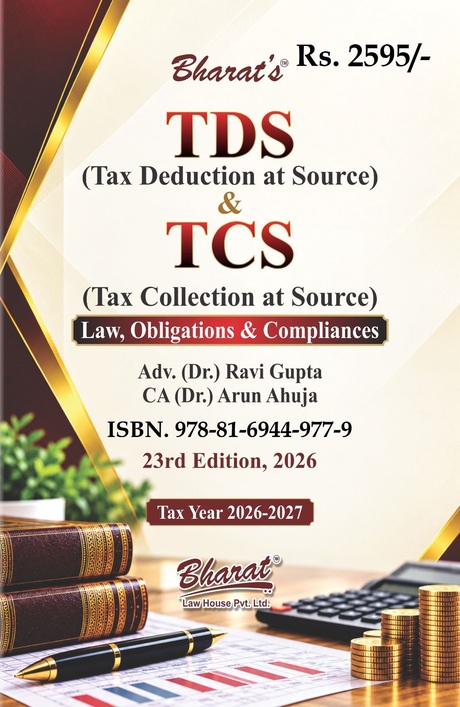
Bharat's TDS & TCS - Law, Obligations & Compliances by Ravi Gupta & Arun Ahuja - 23rd Edition 2026
| Author : | Dr. Ravi Gupta, CA (Dr.) Arun Ahuja |
|---|
| Bharat's TDS (Tax Deduction at Source) & TCS (Tax Collection at Source): Law, Obligations & Compliances by Adv. (Dr.) Ravi Gupta and CA (Dr.) Arun Ahuja, 23rd Edition 2026 for Tax Year 2026-2027, is a 1,296-page hardbound desk reference arranged payment by payment across fifty chapters. It opens with four referencers - the TDS rate chart for 2026-27, the First Schedule, a tabular mapping of TDS rules and forms, and a comparison of rates under the DTAAs and the Income-tax Act - and then works through salary, insurance commission and brokerage, rent, transfer of immovable property and development agreements, units and trusts, interest, contractors, professional and technical fees, dividends, purchase of goods, e-commerce payments, virtual digital assets, twelve chapters on payments to non-residents and foreign companies including DTAA relief, winnings and cash withdrawals, payments to partners, blanket exemptions, the whole of Tax Collection at Source, and compliance, reporting and the consequences of default. For CAs, payroll and finance teams, tax counsel and TDS wing officers. |


1296

English

23rd Edition 2026,

Tags: TDS, Income Tax, TCS, INCOME TAX 2026
Bharat's TDS (Tax Deduction at Source) & TCS (Tax Collection at Source) – Law, Obligations & Compliances, 23rd Edition 2026 (Tax Year 2026-2027)
Bharat Law House publishes the Twenty-Third Edition (2026) of TDS & TCS: Law, Obligations & Compliances by Adv. (Dr.) Ravi Gupta and CA (Dr.) Arun Ahuja, covering the Tax Year 2026-2027. Running to 1,296 pages across fifty chapters, it is the standard desk reference on withholding obligations — the part of direct tax that every business touches every month, and where defaults are the most expensive and the least excusable.
The book is organised payment by payment rather than section by section. A deductor who needs to know the position on a particular outgoing — rent, a contract payment, a professional fee, a purchase of goods, a remittance abroad — turns to that chapter and finds the rate, the threshold, the time of deduction, the forms and the consequences of getting it wrong, in one place.
Referencers
- Referencer I — TDS Rate Chart for Tax Year 2026-27.
- Referencer II — The First Schedule.
- Referencer III — Tabular mapping of TDS Rules and Forms.
- Referencer IV — Comparison of tax rates under the DTAAs and the Income-tax Act.
Contents — fifty chapters
Foundations and salary (Chapters 1–5) — the system of collection of tax; salary and accumulated balance due to an employee; estimating income under the head "Salaries" for TDS purposes; TDS on insurance commission; and TDS on commission (non-insurance) or brokerage.
Rent, property, units and trusts (Chapters 6–14) — rent paid by a person other than a specified person and by a specified person; consideration for transfer of immovable property; consideration under a specified development agreement; compulsory acquisition compensation; income in respect of units; distributed income from units of a business trust; income from units of an investment fund; and investment in a securitisation trust.
Interest, contracts, fees and other payments (Chapters 15–26) — interest on securities and other interest; payments to contractors and work contracts; certain sums paid by individuals or HUF; fees for professional or technical services; dividends; payment under a life insurance policy; purchase of goods; specified senior citizens; benefit or perquisite in respect of business or profession; payment by an e-commerce operator to an e-commerce participant; and transfer of a virtual digital asset.
Non-residents and foreign income (Chapters 27–38) — payments to non-residents and non-resident sportsmen or sports associations; interest on foreign currency loans and rupee-denominated borrowings; interest paid by an infrastructure debt fund; distributed income from business trusts to non-resident unitholders; units of an investment fund and securitisation trusts; units of a mutual fund or specified company; income from units and long-term capital gains; interest, dividends and long-term capital gains; income in respect of securities; other interest or sums; and the special provisions relating to non-residents and foreign companies, including the DTAAs.
Winnings, withdrawals and partner payments (Chapters 39–45) — winnings from lotteries, crossword puzzles and card games, from online games and from horse races; commission, remuneration or prize on lottery tickets; cash withdrawals from banking accounts; repayment under the National Savings Scheme and deferred annuity plans; and salary, remuneration, commission, bonus or interest paid to a partner of a firm.
Exemptions, TCS, compliance and defaults (Chapters 46–50) — no deduction at source and blanket exemptions; Tax Collection at Source in full; applications, declarations and certificates; compliance, reporting and processing of statements; and the consequences of defaults.
Why this book
- Updated for Tax Year 2026-27, with the rate chart and forms as they now stand.
- Payment-wise arrangement — the structure a deductor actually works in.
- Complete treatment of TCS alongside TDS, in the same volume.
- Cross-border coverage — twelve chapters on non-resident payments and the DTAA position, with the comparative rate referencer.
- Compliance and consequences — returns, certificates, declarations, processing of statements, interest, fee, penalty and prosecution for default.
Who should buy this book
- Chartered Accountants and tax practitioners handling TDS compliance, certificates and defaults.
- Accounts, payroll and finance teams in companies, firms and institutions responsible for monthly deduction and quarterly returns.
- Tax counsel and advocates appearing in TDS default, certificate and recovery proceedings.
- Income Tax Department officers in the TDS wing.
- Banks, e-commerce operators and payment intermediaries with statutory collection obligations.