CLP's The Transfer Of Property Act With The Indian Easements Act And The Registration Act - 3rd Edition 2026
| Author : | Dr. Ashok Kumar Srivastava |
|---|
| The Transfer of Property Act with The Indian Easements Act and The Registration Act by Dr. Ashok Kumar Srivastava, published by Central Law Publications, is a students' textbook on property transfer law, now in its 3rd Edition 2026 and running to about 580 pages. It presents the subject in easy form and language for law students, competitive examination candidates and practitioners, explaining several sections with diagrammatical representations and worked examples, and incorporating current case law and recent amendments. Part one covers the Transfer of Property Act - preliminary provisions, transfers of property by act of parties, sales, mortgages, leases, exchanges, gifts and actionable claims - and part two covers the Indian Easements Act, including easements generally, their acquisition and transfer, remedies for disturbance, and extinction. |


580

English

3rd Edition 2026

Tags: Property Law, Transfer of Property Act, Easements Act, Central Civil Acts
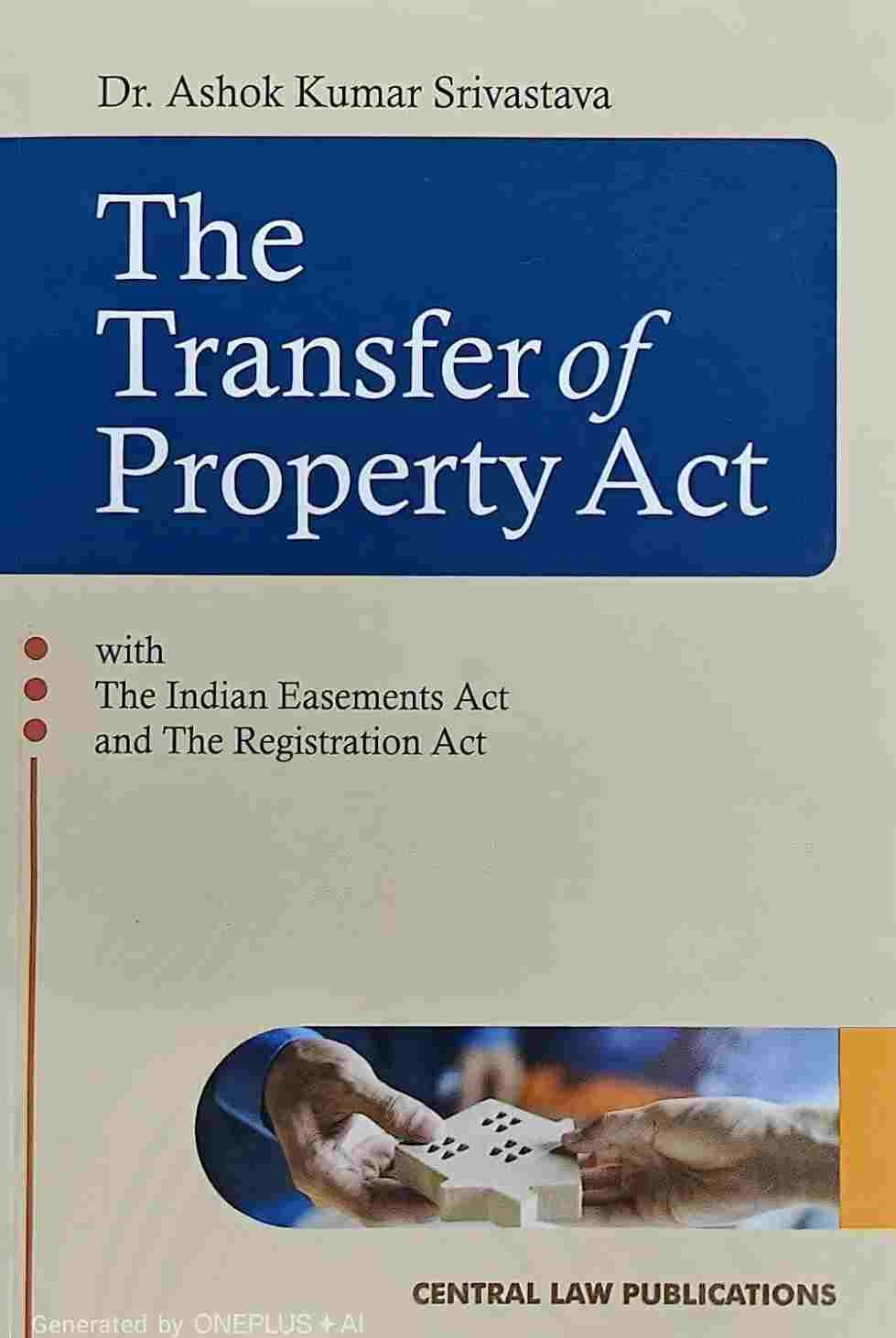
The Transfer of Property Act — with The Indian Easements Act and The Registration Act — by Dr. Ashok Kumar Srivastava, published by Central Law Publications, is a students' textbook on the law governing transfers of property. This is the 3rd Edition, 2026, running to about 580 pages.
The book sets out to bring the subject before the reader "in an easy form and language" — for law students, for candidates in competitive examinations, and for those in practice. Several sections of the Act are explained with diagrammatical representations and worked examples, which is what distinguishes this book from the standard run of property law texts: the harder provisions, where a transfer passes through several hands or a condition operates on a future interest, are drawn out rather than merely described. Current case law and recent amendments are incorporated throughout.
Part One — The Transfer of Property Act, 1882
- Preliminary — definitions, immovable and movable property, and the scope of the Act
- Transfers of property by act of parties — what may be transferred, who is competent to transfer, conditions and conditional transfers, vested and contingent interests, the rule against perpetuity, and the doctrines of election, lis pendens, part performance and fraudulent transfer
- Sales of immovable property — the contract for sale, rights and liabilities of buyer and seller, and marshalling
- Mortgages — the kinds of mortgage, rights and liabilities of mortgagor and mortgagee, redemption and foreclosure, priority, and charges
- Leases — creation and duration, rights and liabilities of lessor and lessee, determination of a lease, and holding over
- Exchanges
- Gifts — requisites of a valid gift, onerous gifts, and suspension or revocation
- Actionable claims — transfer and its effect
Part Two — The Indian Easements Act, 1882
- Easements generally — the nature of an easement, dominant and servient heritages
- Imposition, acquisition and transfer of easements, including easements of necessity and by prescription
- Incidents and disturbance of easements, and the remedies available
- Extinction, suspension and revival of easements
- Licences
Key Features
- 3rd Edition 2026, published by Central Law Publications
- Diagrammatical representations and examples for the difficult provisions
- Current case law and recent amendments incorporated
- Written in plain language for students and examination candidates
- Approximately 580 pages, paperback, English
- ISBN 978-93-47394-03-4
Who Should Buy This Book?
- LL.B. and B.A. LL.B. students taking Property Law or Transfer of Property
- Candidates for judicial service examinations, where the Act is a standing subject
- Candidates for the All India Bar Examination and other competitive examinations
- Young advocates handling sale, mortgage, lease and gift matters
- Conveyancers and property lawyers wanting a clear refresher
- Law college and institutional libraries
Why Choose This Book?
Transfer of Property is the paper students most often struggle with, because its rules operate on interests rather than on things: a contingent interest, a mortgage by conditional sale, a transfer pending litigation. Those ideas are far easier to hold once they are drawn, and this book draws them.
Binding the Easements Act and the Registration Act in with the principal Act also puts the neighbouring subjects where they belong. A transfer of immovable property is rarely a question about the Transfer of Property Act alone — the instrument has to be registered, and the land it concerns usually carries rights of way, light or water over it.