Whitesmann's Commentary On The Indian Easements Act, 1882 And Licences - Edition 2026
| Author : | Y P BHAGAT KUMAR KESHAV |
|---|
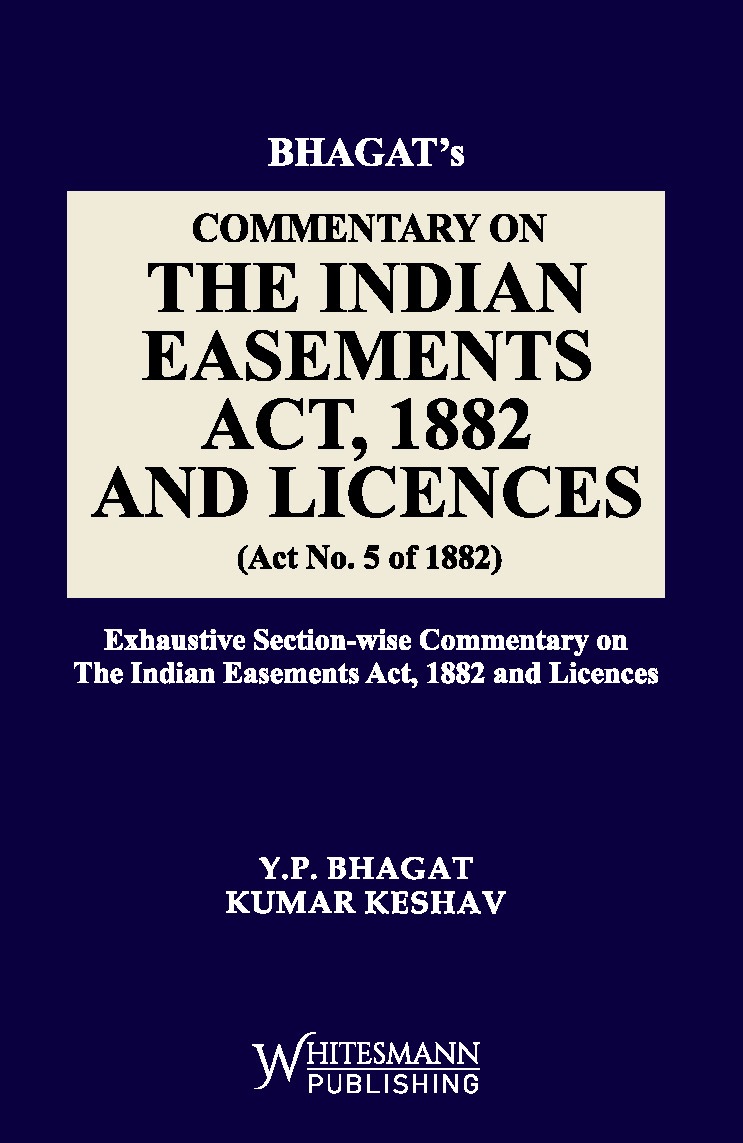
| Bhagat's Commentary on the Indian Easements Act, 1882 and Licences by Y.P. Bhagat and Kumar Keshav, published by Whitesmann Publishing, is an exhaustive section-wise commentary on the Indian Easements Act, 1882 (Act No. 5 of 1882) and on the law of licences it contains. Easement disputes - rights of way, the flow of water, light and air, drains and passages used for decades - are rarely written down and come to court only when a wall goes up or a gate is locked. The commentary takes the reader through every provision with the case law of the Supreme Court and High Courts: the definition and classes of easements, easements of necessity and quasi-easements under section 13, acquisition by twenty years' prescription under section 15, incidents and disturbance of easements, extinction, suspension and revival, and the full law of licences under sections 52 to 64, including when a licence becomes irrevocable. First Edition 2024, hardback. |


Tags: Property Law, Transfer of Property Act, Easements Act, Central Civil Acts
Bhagat's Commentary on the Indian Easements Act, 1882 and Licences by Y.P. Bhagat and Kumar Keshav, published by Whitesmann Publishing, is an exhaustive section-wise commentary on the Indian Easements Act, 1882 (Act No. 5 of 1882) and on the law of licences contained in it. This is the First Edition, 2024, hardback.
Easement disputes are among the oldest and most persistent in Indian civil litigation. A right of way across a neighbour's land, the flow of water, light and air to a building, a drain or a passage used for decades — these rights are rarely written down, are usually claimed by long user or by necessity, and come to court only when a wall goes up or a gate is locked. The Act is short, but the case law under it is vast, and this commentary takes the reader through it provision by provision.
Key Features
- Exhaustive section-wise commentary on every provision of the Act
- Full treatment of licences under Chapter VI alongside the law of easements
- Case law of the Supreme Court and the High Courts under each section
- Authored by Y.P. Bhagat and Kumar Keshav, whose Bhagat's commentaries on civil statutes are widely used in practice
- First Edition, 2024, published by Whitesmann Publishing
- Hardback, English
Scheme of the Act
Chapter I — Preliminary (Sections 1–3). Extent and application, and the savings.
Chapter II — Imposition, Acquisition and Transfer of Easements (Sections 4–19). The definition of an easement and of the dominant and servient heritage under section 4; continuous and discontinuous, apparent and non-apparent easements; who may impose and acquire an easement; easements of necessity and quasi-easements under section 13; and the acquisition of an easement by prescription through twenty years' peaceable and open enjoyment as of right under section 15.
Chapter III — Incidents of Easements (Sections 20–32). The extent of the right, the duties of the dominant and servient owners, accessory rights, and the prohibition on increasing the burden on the servient heritage.
Chapter IV — Disturbance of Easements (Sections 33–36). The right to sue for disturbance, the measure of substantial damage, and injunctions.
Chapter V — Extinction, Suspension and Revival of Easements (Sections 37–51). Extinction by release, by unity of ownership, by the cessation of necessity and by non-enjoyment, together with suspension and revival.
Chapter VI — Licences (Sections 52–64). The definition of a licence under section 52; its personal and non-transferable character; revocation, and the circumstances in which a licence becomes irrevocable under section 60; and the rights of a licensee on revocation and eviction.
Who Should Buy This Book?
- Civil practitioners handling easement, right-of-way and injunction suits
- Advocates in property, tenancy and licence disputes
- Counsel for builders, housing societies and landowners in access and light-and-air disputes
- Civil judges and judicial officers hearing property suits
- Conveyancers and real estate lawyers drafting grants of easement and licence agreements
- Candidates for judicial service examinations, where the Act is part of the civil syllabus
- LL.B. and LL.M. students of property law
- Law libraries and institutional collections
Why Choose This Book?
The line between an easement and a licence, and between a licence and a lease, decides most of the cases that arise under this Act — and it is drawn case by case rather than by rule. A section-wise commentary that sets the decided cases against each provision is the most direct way to find where that line has been drawn on facts like one's own.
The inclusion of licences matters as much as the easements. Licence arrangements are everywhere in modern property practice — leave and licence agreements, permissive occupation, rights granted to utility providers — and the question of when a licence can no longer be revoked is one of the most litigated in the field.