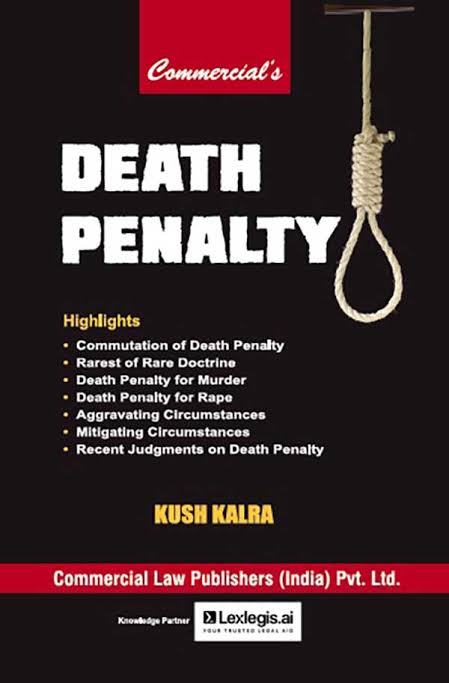
Commercial's Death Penalty - Edition 2027
| Author : | KUSH KALRA |
|---|
| Commercial's Death Penalty by Kush Kalra, Edition 2027, is a comprehensive study of capital punishment in India across roughly 696 pages - the constitutional framework, the statutory provisions, the judicial decisions and the sentencing considerations that govern when a court may impose death and when it must not. It covers commutation of the death penalty, the rarest of rare doctrine, death penalty for murder and for rape, aggravating and mitigating circumstances, and recent judgments on the subject, with around 80 detailed case analyses spanning constitutional challenges, clemency and sentencing guidelines. The Bharatiya Nagarik Suraksha Sanhita, 2023 and the international standards on capital punishment are taken into account. Written for advocates, judges, law students, academicians and researchers in criminal and constitutional law. |


696

English

2027

Tags: Bharatiya Nagarik Suraksha Sanhita(BNSS), Human Rights, New Criminal Law, Criminal Law
Death Penalty by Kush Kalra, published by Commercial Law Publishers (India) Pvt. Ltd., is a comprehensive study of capital punishment in India. This is the Edition 2027, running to approximately 696 pages.
No sentencing question in Indian criminal law is argued as hard, or as often, as this one. The law permits death only in the rarest of rare cases, but what makes a case rarest of rare is decided judgment by judgment, and the reported decisions do not always sit comfortably together. A practitioner on either side of a capital case needs the whole body of that law in front of them — which is what this volume sets out to provide.
Highlights
- Commutation of Death Penalty
- Rarest of Rare Doctrine
- Death Penalty for Murder
- Death Penalty for Rape
- Aggravating Circumstances
- Mitigating Circumstances
- Recent Judgments on Death Penalty
Key Features
- Edition 2027, published by Commercial Law Publishers
- Around 80 detailed case analyses — constitutional challenges, clemency and sentencing
- Constitutional framework, statutory provisions, judicial decisions and sentencing considerations in one volume
- Takes account of the Bharatiya Nagarik Suraksha Sanhita, 2023
- International standards on capital punishment
- Approximately 696 pages, English
- ISBN 978-93-7833-021-6
What the Book Covers
The constitutional position. The challenges to capital punishment under Articles 14 and 21, the requirement of a procedure established by law, and the constitutional standards the sentence must satisfy.
The rarest of rare doctrine. Its origin and development, the balancing of aggravating against mitigating circumstances, and the requirement that the alternative of life imprisonment be unquestionably foreclosed.
Sentencing. The separate hearing on sentence, the material a court must consider — including the age, background and circumstances of the accused and the possibility of reformation — and the reasons a court must record.
Offences. The death penalty for murder and for the aggravated forms of rape, and the other offences for which it may be imposed.
After the sentence. Confirmation by the High Court, appeal, review, commutation, mercy petitions to the Governor and the President, and the effect of delay in deciding them.
Who Should Buy This Book?
- Criminal defence advocates appearing in capital cases
- Public Prosecutors and Special Public Prosecutors
- Judges of Sessions Courts and High Courts hearing murder trials, references and appeals
- Counsel handling mercy petitions and clemency proceedings
- Legal aid counsel and organisations working on death row matters
- Human rights organisations and prison reform groups
- LL.M. students, academicians and researchers in criminal law and sentencing
- Law libraries and institutional collections
Why Choose This Book?
Capital sentencing turns almost entirely on precedent and on the facts placed before the court in mitigation. A defence that cannot point to comparable cases in which the sentence was commuted, or a prosecution that cannot show why this case falls on the other side of the line, argues at a disadvantage.
A volume of this size, built around detailed case analyses rather than summaries, is the working tool for that argument — and for the judge who must record reasons that will survive confirmation and appeal.