L&J's Landmark Judgments On Prisons And Prisoners - Edition 2026
| Author : | DR. KALPESHKUMAR L GUPTA |
|---|
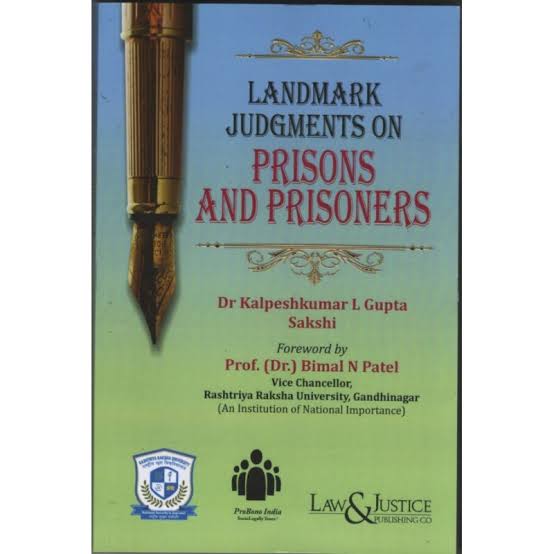
| Landmark Judgments on Prisons and Prisoners by Dr Kalpeshkumar L Gupta and Sakshi, published by Law & Justice Publishing Co. under the ProBono India banner, compiles the leading judicial decisions governing prisons and the rights of prisoners in India, with a Foreword by Prof. (Dr.) Bimal N Patel, Vice Chancellor of Rashtriya Raksha University, Gandhinagar. Prison law in India has been built largely by the courts, on the principle that imprisonment removes liberty of movement but does not extinguish a prisoner's other fundamental rights. The subject area spans Article 21 and the conditions of confinement, custodial treatment and violence, solitary confinement and restraints, undertrial prisoners and prolonged detention, legal aid, health and medical care, women prisoners and children in custody, overcrowding, prison labour and wages, remission, parole and furlough, and the oversight of prisons through the writ jurisdiction. Edition 2026. |


Tags: Human Rights, Landmark Judgements, Supreme Court, Criminal Law
Landmark Judgments on Prisons and Prisoners by Dr Kalpeshkumar L Gupta and Sakshi, published by Law & Justice Publishing Co., is a compilation of the leading judicial decisions governing prisons and the rights of prisoners in India. It carries a Foreword by Prof. (Dr.) Bimal N Patel, Vice Chancellor of Rashtriya Raksha University, Gandhinagar, an Institution of National Importance, and appears under the ProBono India banner.
Prison law is an area built almost entirely by the courts. The statutory framework is thin and in places dates back to the nineteenth century, so the working rules on how a prisoner may be treated, what conditions are permissible, and what remedies exist have come largely from constitutional adjudication. A compilation of the governing judgments is therefore closer to a source book than a supplement.
Key Features
- Edition 2026
- Compilation of landmark judgments on prisons and prisoners
- Foreword by Prof. (Dr.) Bimal N Patel, Vice Chancellor, Rashtriya Raksha University
- Authored by Dr Kalpeshkumar L Gupta and Sakshi
- Part of the ProBono India Landmark Judgments series
- Published by Law & Justice Publishing Co.
- English, paperback
The Subject Area
The jurisprudence on prisons and prisoners in India rests on the principle that a sentence of imprisonment removes liberty of movement but does not extinguish the remaining fundamental rights of the person confined. The questions that arise from that principle run through the case law: the extent to which Article 21 continues to protect a prisoner, the conditions of confinement that amount to a violation, and the courts' supervisory role over institutions that are otherwise closed to public view.
The field takes in custodial treatment and custodial violence, solitary confinement and the use of restraints, the classification and segregation of prisoners, the position of undertrial prisoners and the effect of prolonged pre-trial detention, access to legal aid and to counsel, the right to communicate with family and the outside world, and health, hygiene, food and medical care within prisons.
It also covers the rights of women prisoners and of children living with their mothers in custody, prison overcrowding and capacity, labour and wages for prison work, remission, parole, furlough and premature release, and the treatment of prisoners under sentence of death. Running through all of it is the machinery of oversight — prison visitors, inspection, and the writ jurisdiction through which most of this law has been made.
Who Should Buy This Book?
- Advocates and legal practitioners handling criminal and constitutional matters
- Counsel appearing in bail, remission, parole and custodial matters
- Judicial officers and Presiding Officers of criminal courts
- Prison administration officers and correctional services staff
- Police officers and officers of investigating agencies
- Human rights organisations, legal aid bodies and prison reform groups
- Members and staff of State and National Human Rights Commissions
- Legal services authorities and panel lawyers
- Law students, research scholars and academicians in criminal law, criminology and human rights
- Candidates for judicial service and other law examinations
Why Choose This Book?
Prisoners' rights matters arrive in practice as urgent applications, and the governing authority is scattered across decades of writ petitions, public interest litigation and continuing mandamus proceedings rather than collected in a code. Having the leading judgments compiled in one volume shortens the search considerably.
The association with Rashtriya Raksha University and ProBono India also places the book in a body of work aimed at legal aid and public interest practice, where prison matters are frequently taken up and where a single accessible source on the decided law is of the most use.