Lawyear's Bail Granted In NDPS Act Commercial Quantity - 1st Edition 2026
| Author : | Gajanan B. Chavan and Arun Sheoran |
|---|
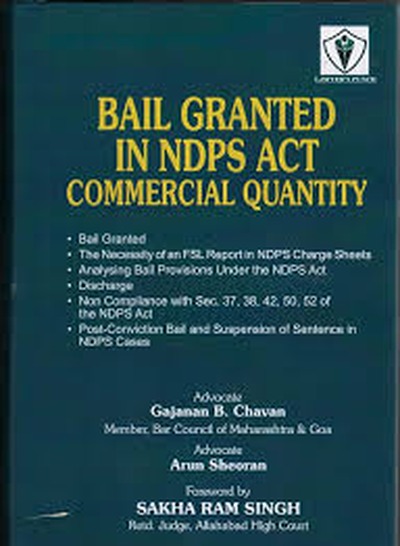
| Bail Granted in NDPS Act - Commercial Quantity by Advocate Gajanan B. Chavan, Member of the Bar Council of Maharashtra & Goa, and Advocate Arun Sheoran, published by Priytej Publications with a Foreword by Sakha Ram Singh, Retd. Judge, Allahabad High Court, is built around the hardest bail question in Indian criminal practice: when can an accused charged with a commercial quantity offence be released despite the twin conditions of section 37 of the NDPS Act. It collects the cases in which bail was actually granted and analyses the bail provisions under the Act, the necessity of an FSL report in NDPS charge sheets, discharge, non-compliance with sections 37, 38, 42, 50 and 52, and post-conviction bail and suspension of sentence in NDPS cases. 1st Edition 2026, hardbound. |


1963

English

1st Edition 2026

Tags: Bail, Narcotics Drugs & Cosmetics Act, NDPS Act, Criminal Law
Bail Granted in NDPS Act — Commercial Quantity by Advocate Gajanan B. Chavan, Member, Bar Council of Maharashtra & Goa, and Advocate Arun Sheoran, published by Priytej Publications, carries a Foreword by Sakha Ram Singh, Retd. Judge, Allahabad High Court. This is the First Edition, 2026, hardbound.
The book is built around the hardest bail question in Indian criminal practice. Where the quantity alleged is a commercial quantity, section 37 of the NDPS Act permits release only if the Public Prosecutor has been heard and the court is satisfied that there are reasonable grounds for believing that the accused is not guilty and is not likely to commit an offence while on bail. Those twin conditions make bail the exception, and the defence has to show the court why this case is one. This volume is about the cases in which that was done.
Key Features
- Bail granted — the decisions in which bail was actually allowed in commercial quantity cases
- Analysis of the bail provisions under the NDPS Act
- The necessity of an FSL report in NDPS charge sheets
- Discharge in NDPS prosecutions
- Non-compliance with sections 37, 38, 42, 50 and 52 of the NDPS Act
- Post-conviction bail and suspension of sentence in NDPS cases
- Foreword by Sakha Ram Singh, Retd. Judge, Allahabad High Court
- First Edition 2026, hardbound, English
- ISBN 978-93-7636-762-7
What the Book Covers
Bail under section 37. The section overrides the ordinary law of bail for the offences it covers, and the question in every commercial quantity application is how the court is to form a view on "reasonable grounds" at a stage when the evidence has not been tested. The book analyses how the courts have approached that satisfaction, and the circumstances in which they have found it made out.
The FSL report and the charge sheet. Whether the substance seized is a narcotic drug or psychotropic substance, and in what quantity, is established by the forensic report. Whether a charge sheet filed without that report is complete — and what follows for the accused's right to default bail if it is not — is one of the most contested procedural questions in NDPS practice.
Procedural safeguards and their breach. The Act's stringency is balanced by mandatory procedure: the recording and reporting of information and searches without warrant under section 42, the right of a person to be searched before a Gazetted Officer or Magistrate under section 50, and the disposal of persons arrested and articles seized under section 52, together with the liability of companies under section 38. Non-compliance with these provisions is frequently the ground on which bail, discharge or acquittal turns.
Discharge. The standard at the stage of framing charge, and the cases in which the material on record did not support a prosecution.
Post-conviction bail and suspension of sentence. Relief pending appeal after conviction, where the considerations differ again from those governing bail before trial.
Who Should Buy This Book?
- Criminal defence advocates handling NDPS matters
- Counsel appearing in bail applications before Special Courts, Sessions Courts and High Courts
- Public Prosecutors and Special Public Prosecutors in NDPS cases
- Judges of Special Courts under the NDPS Act and Sessions Judges
- Officers of the Narcotics Control Bureau, police and other investigating agencies
- Legal aid counsel and panel lawyers
- Law students and research scholars in criminal law and procedure
- Law libraries and institutional collections
Why Choose This Book?
Most NDPS commentaries explain why bail in a commercial quantity case is difficult. A practitioner preparing an application needs the opposite — the orders in which it was granted, and the reasons the court gave. A collection organised around successful applications shows which arguments have worked: a flaw in the search, a missing forensic report, a delayed trial, a doubtful quantity, a breach of mandatory procedure.
Written by practising advocates and introduced by a retired High Court judge, the book is designed for use in court rather than on the shelf. For defence counsel in NDPS matters it is a direct working tool; for prosecutors and judges it sets out the ground on which the defence will stand.