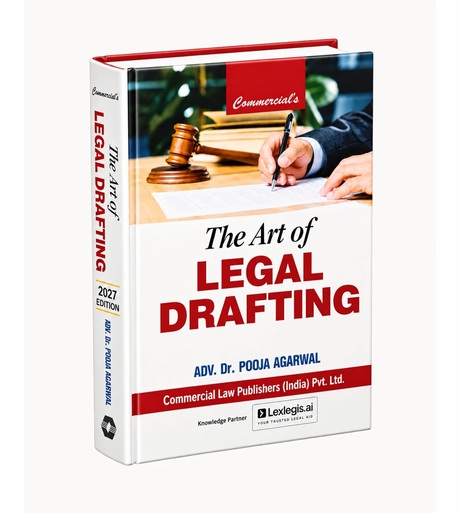
Commercial's The Art of Legal Drafting - Edition 2027
| Author : | Adv. Dr. Pooja Agarwal |
|---|
| A 712-page practical drafting manual covering the pleadings, petitions, applications, notices and deeds used in everyday Indian practice, organised in three parts. The civil part opens with the principles of pleading — material facts, particulars, verification and amendment — and then gives drafts under the Code of Civil Procedure, 1908 together with petitions under the Arbitration and Conciliation Act, the Consumer Protection Act, the Specific Relief Act, the Hindu Marriage Act, the Special Marriage Act and Muslim law, the Industrial Disputes Act, 1947, the Minimum Wages Act, 1948, motor accident claims, rent control and property tax, along with pleadings for breach and rescission of contract and for principal and surety. The criminal part covers complaints, bail and anticipatory bail, revision, quashing and habeas corpus with reference to the Cr.P.C. and to the Bharatiya Nagarik Suraksha Sanhita, 2023 and Bharatiya Nyaya Sanhita, 2023, and complaints under the Negotiable Instruments Act. The conveyancing part covers agreements and deeds, powers of attorney and legal notices. 2027 Edition, Commercial Law Publishers (India) Pvt. Ltd. |


712

English

Edition 2027

Tags: Drafting, Pleading and Conveyancing, Conveyancer, Pleadings and Practice, Legal Drafting
Commercial's The Art of Legal Drafting by Adv. Dr. Pooja Agarwal, published by Commercial Law Publishers (India) Pvt. Ltd., is a practical drafting manual of 712 pages covering the pleadings, petitions, applications, notices and deeds used in everyday Indian practice. 2027 Edition.
Drafting is the part of litigation practice that decides a case before it is argued. A plaint that omits a necessary averment invites rejection under Order VII Rule 11; a bail application that does not address the right considerations is refused on the first reading; a deed with a defective recital produces litigation years later. Yet it is taught thinly and learned mostly by copying whatever the chamber happens to have on file.
This book is organised the way a practice is organised — in three parts, Civil, Criminal and Conveyancing — with the principles of pleading stated first and then worked drafts for each category of proceeding. It is current for the new criminal laws: the criminal applications are given with reference to the Bharatiya Nagarik Suraksha Sanhita, 2023 and the Bharatiya Nyaya Sanhita, 2023 alongside the Code of Criminal Procedure, which is what a practitioner needs while both bodies of work run in parallel.
Key Features
- 712 pages of drafting material across civil, criminal and conveyancing practice.
- Principles of pleading treated first, at length, before the specimen drafts — so the reader learns the reasoning and not only the form.
- Criminal drafts referenced to the BNSS, 2023 and BNS, 2023 as well as the Cr.P.C.
- Specimen drafts across the Code of Civil Procedure, 1908 — suits, applications and interlocutory matters.
- Special-statute petitions — matrimonial, consumer, arbitration, rent control, motor accident claims, industrial disputes and minimum wages.
- A full conveyancing part — agreements, deeds, powers of attorney and legal notices.
- Written by a practising advocate, Adv. Dr. Pooja Agarwal.
- 2027 Edition, from Commercial Law Publishers, with Lexlegis.ai as knowledge partner.
Coverage
Part I — Civil
- Introduction — the foundations of legal drafting, language, precision and structure.
- Pleadings generally — the principles: material facts and not evidence, particulars, verification, amendment, and the consequences of defective pleading.
- Civil Procedure Code — plaints, written statements, set-off and counter-claim, applications under the principal Orders, interlocutory applications, execution and appeals.
- Arbitration Act — applications and petitions under the Arbitration and Conciliation Act.
- Principal and surety — drafts arising from contracts of guarantee.
- Consumer Protection — complaints and appeals before the Consumer Commissions.
- Breach of contract and rescission of contract — the pleadings for each.
- Specific Relief Act — suits for specific performance, injunction and declaration.
- Matrimonial — petitions under the Hindu Marriage Act, the Special Marriage Act and Muslim law.
- Industrial Disputes Act, 1947 and the Minimum Wages Act, 1948.
- Motor Accident Claims — claim petitions and connected applications.
- Rent Control — eviction petitions and the grounds.
- Property tax matters.
Part II — Criminal
- Criminal drafting under the Cr.P.C., the BNSS, 2023 and the BNS, 2023 — complaints, bail and anticipatory bail applications, revision, quashing petitions, habeas corpus and connected applications.
- Negotiable Instruments Act — complaints and applications in cheque dishonour proceedings.
Part III — Conveyancing
- Agreements and deeds — sale, lease, mortgage, gift, partition, relinquishment, partnership and allied instruments.
- Powers of attorney, general and special.
- Legal notices of every common kind.
Who Should Buy This Book?
- Advocates in civil, criminal and conveyancing practice — the book is built as a desk reference for exactly that spread of work.
- Junior advocates and new entrants to the bar, who need the reasoning behind a draft and not just a form to copy.
- Law firms and in-house legal teams maintaining standard drafts.
- Judicial service aspirants — drafting is an examined paper in most State judicial service examinations.
- LL.B. and B.A. LL.B. students taking Drafting, Pleading and Conveyancing, which is a compulsory practical paper under the Bar Council of India curriculum.
- Company secretaries and other professionals who prepare formal legal documents.
- Legal aid lawyers and clerks preparing routine petitions at volume.
- Law college and bar association libraries.
Why Choose This Book?
Drafting books divide into two kinds: form books, which supply specimens and leave the reasoning out, and textbooks on pleading, which explain the principles and supply few usable drafts. A practitioner needs both, and buying both is expensive and awkward. This volume puts a substantial treatment of the principles of pleading at the front and then runs specimen drafts across the full span of practice, which is why 712 pages are needed and why it works as a single desk reference.
The timely reason to prefer this edition is the criminal part. Bail applications, complaints, revisions and quashing petitions are now filed under the BNSS, 2023 while the authorities and the pending matters remain under the Cr.P.C. A drafting book that gives the provisions under both saves the practitioner from converting section numbers on every application — and from the more serious risk of citing a repealed provision in a filed document.