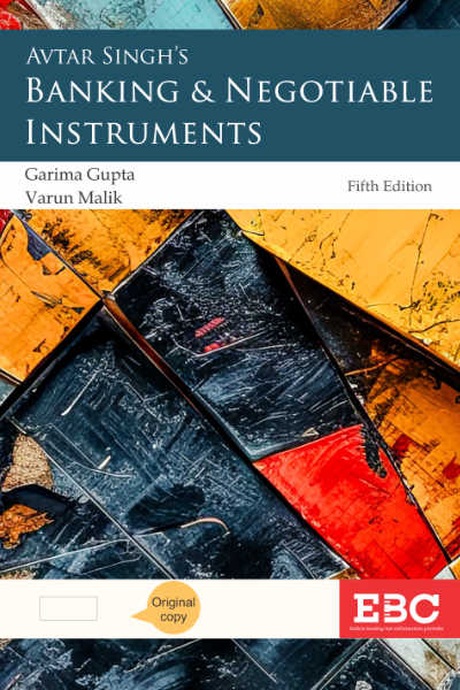
EBC' Banking and Negotiable Instruments - 5th Edition 2026
| Author : | AVTAR SINGH, Garima Gupta, Varun Malik |
|---|
| A comprehensively revised fifth edition of Avtar Singh's classic banking law textbook, rewritten by Garima Gupta and Varun Malik and current to 2026 in 704 pages. Part I covers the evolution and types of banks, the Banking Regulation Act, 1949 as amended in 2020 and 2025, customers and accounts, the banker-customer relationship, the duty of secrecy, lien and set-off, and the bank's responsibility under the Consumer Protection Act. Part II gives full chapters to the SARFAESI Act, 2002 and the Recovery of Debts and Bankruptcy Act, 1993, with the Finance Act, 2021 amendments and the interface with the Insolvency and Bankruptcy Code. Part III covers negotiable instruments, negotiation and liability, presentment, discharge, crossed cheques and the law on dishonour of cheques updated after the 2015 and 2018 amendments to the Negotiable Instruments Act, 1881 — including interim compensation under Section 143A, payment pending appeal under Section 148 and the territorial jurisdiction decisions. With Table of Cases and Subject Index. 5th Edition 2026, Eastern Book Company. |


704

English

5th Edition, 2026

Tags: Banking Law, Negotiable Instrument Act, Dishonour Of Cheques Of NI Act ( From Complaint To Conviction), Banking and Debt Recovery
Avtar Singh's Banking and Negotiable Instruments, revised by Garima Gupta and Varun Malik, published by Eastern Book Company, is a comprehensively revised edition of a classic text that has taught banking law to generations of Indian law students. Fifth Edition, 2026, 704 pages.
Banking law moves faster than most areas of commercial law because the statutes are amended in response to events — a bank failure, a wave of defaults, a shift in RBI policy. The fourth edition of this book was published in 2018. Since then the Banking Regulation Act has been amended twice, in 2020 and again in 2025; the cheque dishonour provisions have been reworked by the 2015 and 2018 amendments to the Negotiable Instruments Act and then substantially developed by the Supreme Court on interim compensation, territorial jurisdiction and payment pending appeal; and the interface between debt recovery and the Insolvency and Bankruptcy Code has been redrawn. This edition is a rewrite rather than a reprint.
What has not changed is the method. Avtar Singh's books are read because they explain the commercial transaction before they explain the law governing it — what a bank actually does when it collects a cheque, what the relationship between banker and customer actually consists of — and the legal rules then make sense rather than having to be memorised.
Key Features
- Banking Regulation Act, 1949 updated for the 2020 and 2025 amendments.
- Separate chapters on the SARFAESI Act, 2002 and the Recovery of Debts and Bankruptcy Act, 1993, with the Finance Act, 2021 amendments and the IBC interface.
- Cheque dishonour law fully updated after the 2015 and 2018 amendments to the Negotiable Instruments Act, 1881, and reorganised for clarity.
- Landmark Supreme Court decisions on interim compensation, territorial jurisdiction and payment pending appeal in Section 138 matters.
- Recent Supreme Court decisions on banking regulation, consumer protection and the banker–customer relationship.
- A chapter on the bank's responsibility under the Consumer Protection Act, which is where a great many banking disputes are now actually litigated.
- Table of Cases and a full Subject Index.
- 5th Edition, 2026, 704 pages, paperback, from Eastern Book Company.
Coverage
Part I — Law of Banking
- Evolution and types of banks — the structure of Indian banking, scheduled and non-scheduled banks, cooperative banks, and the role of the Reserve Bank of India.
- Banks and banking business under the Banking Regulation Act, 1949 — licensing, business a bank may and may not undertake, management, inspection, directions, moratorium and amalgamation, as amended in 2020 and 2025.
- Customers and accounts — who is a customer, the nature of the banker–customer relationship, the duty of secrecy and its exceptions, the banker's lien and right of set-off, types of account, and the paying and collecting banker's protections.
- Responsibility under the Consumer Protection Act — deficiency in service by a bank, the reliefs available and the case law before the Consumer Commissions.
Part II — DRT and SARFAESI
- The SARFAESI Act, 2002 — securitisation and asset reconstruction, enforcement of security interest without the court, the Section 13 notice and the borrower's remedies, and the appeal to the Debts Recovery Tribunal.
- The Recovery of Debts and Bankruptcy Act, 1993 — the DRT and DRAT, procedure, recovery certificates, and the interface with the Insolvency and Bankruptcy Code.
Part III — Negotiable Instruments
- Negotiable instruments — promissory notes, bills of exchange and cheques, their essentials and the concept of negotiability.
- Negotiation and liability — endorsement, holder and holder in due course, the presumptions, and the liability of the parties.
- Presentment — for acceptance and for payment, and the consequences of default.
- Dishonour of cheques — Section 138 and the connected provisions in full: the ingredients of the offence, notice, limitation, the complaint, who may be prosecuted, the liability of a company and its officers, compounding, interim compensation under Section 143A, payment pending appeal under Section 148, and territorial jurisdiction.
- Discharge from liability and the circumstances in which it occurs.
- Crossed cheques — general and special crossing, "not negotiable" and "account payee", and the protection of the paying and collecting banker.
- Miscellaneous provisions, including noting, protest, acceptance for honour and the rules on foreign instruments.
Who Should Buy This Book?
- LL.B. and B.A. LL.B. students taking Banking Law or Negotiable Instruments — this is a standard textbook for the paper.
- Advocates practising in Section 138 cheque dishonour matters, which make up a very large share of the magistrate's docket.
- Advocates in DRT and SARFAESI proceedings, and in borrower challenges to enforcement.
- Judges and judicial officers, particularly magistrates handling cheque bounce complaints, and judicial service aspirants.
- Bank officers and legal departments — recovery, compliance and branch legal functions.
- Company secretaries, chartered accountants and others advising on banking and credit.
- Candidates for banking and financial services examinations where law is a paper.
- Law college and institutional libraries.
Why Choose This Book?
Two things make this edition worth having over an older copy or a cheaper competitor. The first is that cheque dishonour law has changed more in the last decade than in the sixty years before it, and the changes are the kind that decide cases — interim compensation under Section 143A, the deposit requirement under Section 148, and the long-running territorial jurisdiction question. A practitioner working from a pre-2018 text is working from a different statute.
The second is the inclusion of SARFAESI and the DRT Act as full chapters rather than as appendices. Banking law in practice is mostly recovery law, and a student who has read about the banker–customer relationship but not about enforcement of security interest has learned only half the subject. Putting all three parts — regulation, recovery and negotiable instruments — in one 704-page volume is what makes this a genuine textbook rather than a cheque bounce manual.