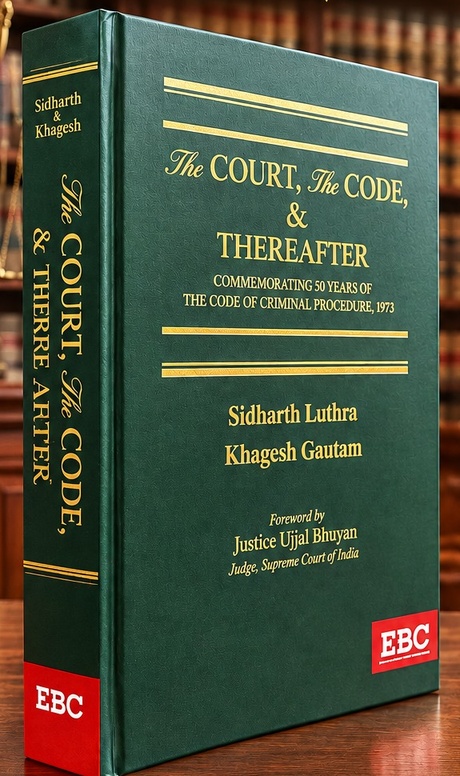
EBC's The Court, The Code, & Thereafter: Commemorating 50 Years of the Code of Criminal Procedure, 1973 - Edition 2026
| Author : | Sidharth Luthra, Khagesh Gautam |
|---|
| Eastern Book Company's The Court, The Code, & Thereafter: Commemorating 50 Years of the Code of Criminal Procedure, 1973, by Sidharth Luthra, Senior Advocate, Supreme Court of India, and Khagesh Gautam, with a Foreword by Hon'ble Justice Ujjal Bhuyan, Judge, Supreme Court of India, is a 376-page hardbound retrospective on the Code that governed every criminal trial in India for half a century before its repeal by the Bharatiya Nagarik Suraksha Sanhita, 2023. It traces the drafting and amendment history of the 1973 Code, the body of Supreme Court and High Court decisions built around it, and the themes that defined it in practice - arrest and its safeguards, bail, investigation and police powers, the rights of the accused and the victim, speedy trial and delay - and then considers what the BNSS retains, changes and leaves open. A scholarly work rather than a section-wise commentary, for criminal law practitioners, judges, academics, research scholars, policy makers and law libraries. |


Tags: Code Of Criminal Procedure, Criminal Trial, Indian Legal And Constitutional History, Criminal Law
EBC's The Court, The Code, & Thereafter: Commemorating 50 Years of the Code of Criminal Procedure, 1973 — by Sidharth Luthra and Khagesh Gautam
Eastern Book Company publishes The Court, The Code, & Thereafter, edited and written by Sidharth Luthra, Senior Advocate, Supreme Court of India, and Khagesh Gautam, with a Foreword by Hon'ble Justice Ujjal Bhuyan, Judge, Supreme Court of India. A 376-page hardbound volume marking the fiftieth year of the Code of Criminal Procedure, 1973.
The timing is what makes this book unusual. The CrPC completed fifty years and was then repealed — replaced by the Bharatiya Nagarik Suraksha Sanhita, 2023 with effect from 1 July 2024. This volume therefore sits at a hinge in Indian criminal procedure: it is both a retrospective on the Code that governed every criminal trial in India for half a century, and an assessment of what carries forward into the Sanhita that has taken its place.
What the book does
- Traces the life of the 1973 Code — its drafting and the reasons for the 1973 overhaul of the 1898 Code, the major amendments, and the shape it had taken by the time of its repeal.
- Examines how the Supreme Court and the High Courts built the law around it — the guidelines, readings and directions that, over fifty years, came to matter as much as the text of the sections themselves.
- Looks at the themes that defined the Code in practice — arrest and the safeguards around it, bail, investigation and the powers of the police, the rights of the accused and of the victim, speedy trial, and the chronic problem of delay.
- Considers what comes after — "thereafter": what the BNSS retains, what it changes and what questions it leaves open.
Why this book
- A scholarly retrospective, not a commentary — it explains how the law got to where it is, which is the part no bare act or section-wise manual covers.
- Written by a leading criminal law practitioner and an academic — Sidharth Luthra is a Senior Advocate of the Supreme Court and a former Additional Solicitor General of India.
- Foreword by a sitting Judge of the Supreme Court of India.
- Of lasting value through the transition — with the BNSS now in force, the reasoning behind the provisions the Sanhita inherited is exactly what practitioners and courts are being asked to argue about.
- 376 pages, hardbound, from Eastern Book Company.
Who should buy this book
- Criminal law practitioners and Senior Advocates who argued under the Code and now argue under the Sanhita.
- Judges and judicial officers, for the interpretive history behind provisions carried into the BNSS.
- Academics and researchers in criminal law, criminal procedure and legal history.
- Law students and research scholars working on criminal procedure, the rights of the accused or criminal justice reform.
- Policy makers, law commissions and criminal justice reform bodies.
- Law school, bar association and court libraries — a reference volume on a Code that will be cited for decades yet.
About the authors
Sidharth Luthra is a Senior Advocate of the Supreme Court of India and a former Additional Solicitor General of India, with a long practice in criminal law, and teaches at National Law University, Delhi. Khagesh Gautam is a legal academic writing on constitutional and criminal law. The Foreword is by Hon'ble Justice Ujjal Bhuyan, Judge, Supreme Court of India.