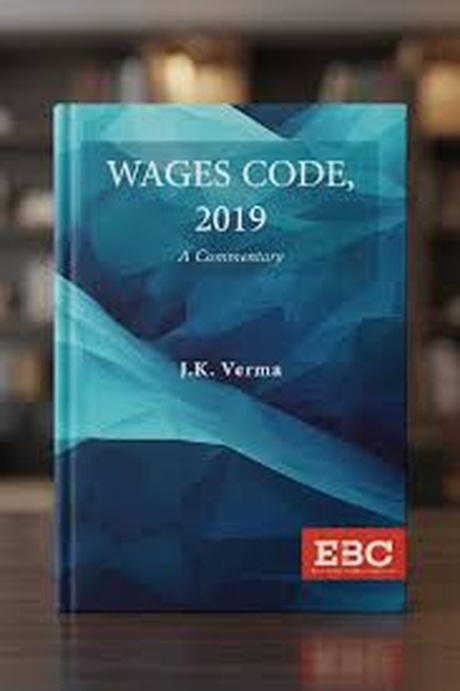
EBC's Wages Code, 2019: A Commentary - 1st Edition 2026
| Author : | J. K. Verma |
|---|
| A section-wise commentary on the Code on Wages, 2019, which consolidates and replaces the Payment of Wages Act, 1936, the Minimum Wages Act, 1948, the Payment of Bonus Act, 1965 and the Equal Remuneration Act, 1976, all repealed by Section 69. Dr. J. K. Verma, Advocate of the Patna High Court, works through all nine chapters — the preliminary definitions including the much-litigated definition of "wages", minimum wages and the floor wage, payment of wages, wage periods and authorised deductions, payment of bonus with gross profits, allocable surplus and set on and set off, the Central and State Advisory Boards, payment of dues, claims, limitation, appeals, recovery, records and audit, the Inspector-cum-Facilitator scheme, offences, penalties and compounding, and the miscellaneous provisions and repeal. A comparative table maps every provision of the Code against the four repealed enactments, notifications are placed under the provisions they relate to, and the Wages (Central) Rules, 2026 are included in full. With Table of Cases and Subject Index. 1st Edition 2026, Eastern Book Company. |


Tags: Labour Law, Setting Up of Business, Industrial and Labour Laws, The Code on Wages,, Labour Codes
Wages Code, 2019: A Commentary by Dr. J. K. Verma, Advocate, Patna High Court, published by Eastern Book Company, is a section-wise commentary on the Code on Wages, 2019. First Edition, 2026.
The Wages Code consolidates, simplifies and rationalises four central labour enactments that governed wages for the better part of a century: the Payment of Wages Act, 1936, the Minimum Wages Act, 1948, the Payment of Bonus Act, 1965 and the Equal Remuneration Act, 1976. Section 69 of the Code repeals all four. For an employer, a practitioner or an officer, that is not a tidy-up; it is the replacement of the statutory basis on which every wage claim, bonus computation and minimum wage notification in the country has been made.
The practical difficulty of a consolidating Code is that the case law and the administrative practice are attached to the repealed Acts. An argument is still worth making, a precedent is still worth citing — but only if one can show which provision of the Code now carries the old rule, and whether it carries it unchanged. That is why the comparative table in this book, mapping the Code's provisions against the four repealed enactments, is its single most useful feature.
Dr. J. K. Verma has a long association with Eastern Book Company. He is the author of Laws Relating to Premature Retirement and Resignation and the reviser of B. R. Ghaiye's Departmental Enquiries and Misconduct in Employment — both standards in service and employment law.
Key Features
- A comparative table setting the provisions of the Wages Code, 2019 against the four repealed enactments — the tool a practitioner needs to carry old authority into the new Code.
- Includes the Wages (Central) Rules, 2026, without which the Code cannot be applied.
- Notifications placed under the provisions they relate to, rather than collected in an appendix where they are easily missed.
- Notifications on the date of enforcement set out, so the reader knows what is actually in force and from when.
- Section-wise commentary across all nine chapters of the Code.
- Table of Cases and a full Subject Index.
- By Dr. J. K. Verma, Advocate of the Patna High Court, reviser of Ghaiye's Departmental Enquiries and Misconduct in Employment.
- 1st Edition, 2026, from Eastern Book Company.
Coverage
- Introduction to the Wages Code, 2019 — the rationale for consolidation, the four Acts repealed by Section 69, and what the Code changes in substance as against form.
- Comparative Table — provision-by-provision correspondence between the Code and the Payment of Wages Act, 1936, the Minimum Wages Act, 1948, the Payment of Bonus Act, 1965 and the Equal Remuneration Act, 1976.
- Notifications on enforcement — the commencement position.
- Chapter I — Preliminary: application, and the definitions that carry the Code, including the much-litigated definition of "wages" and its exclusions, "employee", "worker", "employer", "establishment" and "contractor".
- Chapter II — Minimum Wages: payment of minimum rate of wages, fixing and revising the minimum rate, the floor wage, the components and method of fixation, normal working hours, overtime, and wages for different classes of work.
- Chapter III — Payment of Wages: mode of payment, wage period, time limits for payment, authorised deductions and their ceiling, fines, deductions for absence, damage, services and recovery of advances.
- Chapter IV — Payment of Bonus: eligibility, disqualification, minimum and maximum bonus, computation of gross profits and available and allocable surplus, set on and set off, proportionate reduction, and deduction for customary bonus.
- Chapter V — Advisory Board: the Central and State Advisory Boards, their composition and functions, including advice on women's employment.
- Chapter VI — Payment of Dues, Claims and Audit: responsibility for payment, the authority for claims, limitation, appeals, recovery of amounts due, and the records, returns and audit obligations.
- Chapter VII — Inspector-cum-Facilitator: the shift from inspection to facilitation, the inspection scheme, powers and duties.
- Chapter VIII — Offences and Penalties: the penalty structure, compounding of offences, the opportunity to comply before prosecution, cognizance and the burden of proof.
- Chapter IX — Miscellaneous: bar of suits, protection of action taken in good faith, the rule-making power, and the repeal and savings in Section 69.
- The Wages (Central) Rules, 2026 in full.
Who Should Buy This Book?
- Labour law practitioners appearing in wage, bonus and minimum wage claims.
- Employers, HR heads and payroll teams, for whom the definition of "wages" alone changes contribution and benefit calculations.
- Company secretaries and compliance officers responsible for labour law compliance.
- Trade unions and employee representatives.
- Labour department officers, Inspectors-cum-Facilitators and authorities deciding claims under the Code.
- Judges and judicial officers hearing wage and bonus matters, and appellate authorities.
- Academics and LL.B. / LL.M. students of Labour and Industrial Law, where the Codes have replaced the old Acts on the syllabus.
- Chartered Accountants and auditors dealing with bonus computation and allocable surplus.
- Law and corporate libraries.
Why Choose This Book?
Most of what has been published on the labour Codes so far is either the bare text with a short note, or a general survey covering all four Codes in one volume at a level too shallow to settle a question. A single-Code commentary at commentary length is a different proposition: it can afford to take the definition of "wages" seriously, work through the bonus computation provisions properly, and deal with what the Inspector-cum-Facilitator model actually means for an employer facing an inspection.
The two features that earn the book its place on a desk are the comparative table and the inclusion of the Wages (Central) Rules, 2026. The first solves the problem every user of a consolidating Code has — knowing which of a century's accumulated authority survives and where it now lives. The second matters because a Code of this kind is substantially operated through its Rules, and a commentary that omits them leaves the reader with half the law.