Law & Justice's All India Bar Examination (AIBE) Solved Papers 2017 To 2026 By Anshul Jain - 8th Edition
| Author : | ANSHUL JAIN |
|---|
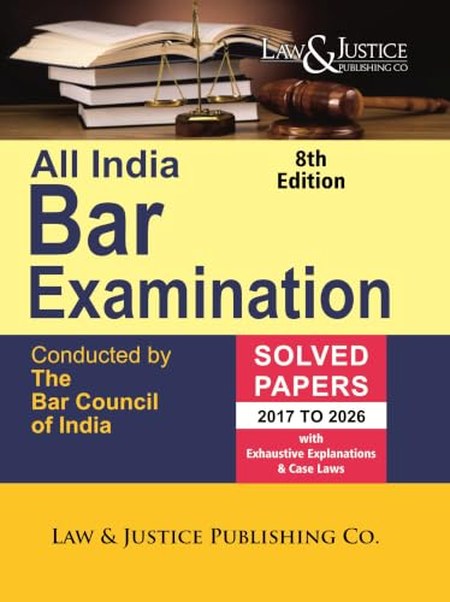
| All India Bar Examination - Solved Papers 2017 to 2026 by Anshul Jain, published by Law & Justice Publishing Co., compiles a full decade of the papers set by the Bar Council of India, answered in full with exhaustive explanations and supporting case laws. The AIBE is the qualifying examination a law graduate must clear to obtain the Certificate of Practice, and because it is an open-book objective paper the skill it tests is knowing the ground well enough to find the right provision quickly. Previous years' papers are therefore the core of the preparation: the Bar Council returns to the same provisions year after year, and a candidate who has worked through ten years of papers has seen most of what the next one will ask. 308 pages, paperback, 8th Edition. |


Tags: All India Bar Examination, Legal Ethics, ADVOCATES ACT, Professional Ethics
All India Bar Examination — Solved Papers 2017 to 2026 by Anshul Jain, published by Law & Justice Publishing Co., is a compilation of the previous years' papers of the examination conducted by the Bar Council of India, answered in full with exhaustive explanations and case laws. This is the Eighth Edition.
The AIBE is a qualifying examination. A law graduate who has enrolled with a State Bar Council must clear it to obtain the Certificate of Practice and appear before courts. It is an open-book, objective paper, which changes what preparation means: the difficulty is not recall but knowing the ground well enough to find the answer quickly and to recognise which of four plausible options is correct.
That is why previous years' papers matter more here than in almost any other examination. The Bar Council returns to the same provisions year after year, and a candidate who has worked through a decade of papers has seen most of what the next paper will ask.
Key Features
- Eighth Edition, published by Law & Justice Publishing Co.
- Solved papers from 2017 to 2026 — a full decade of the examination
- Exhaustive explanations for each answer, not a bare answer key
- Supporting case laws cited alongside the explanations
- Conducted by the Bar Council of India — papers reproduced as set
- 308 pages, paperback, English
- ISBN 978-81-69453-39-4
About the Examination
The All India Bar Examination is set by the Bar Council of India and tests the subjects a practising advocate is expected to know across substantive law, procedure and professional conduct — constitutional law, criminal law and procedure, civil procedure and evidence, contract and specific relief, family law, company law, labour and industrial law, public interest litigation, administrative law, taxation, land acquisition, intellectual property, cyber law, alternative dispute resolution, and professional ethics under the Advocates Act, 1961.
The decade covered by this volume — 2017 to 2026 — spans the period in which India's criminal law was recast, so the later papers are set against a different statutory landscape from the earlier ones. Working through the papers in sequence shows how the examiners' ground has shifted.
Who Should Buy This Book?
- Law graduates preparing for the All India Bar Examination
- Final-year LL.B. and B.A. LL.B. students planning to enrol and appear
- Advocates newly enrolled with a State Bar Council
- Candidates reappearing after an unsuccessful attempt
- Candidates assembling their open-book material and wanting to know what to index
- Law colleges and coaching institutes preparing students for the AIBE
- Law libraries and institutional collections
Why Choose This Book?
An answer key tells a candidate they were wrong. An explanation tells them why, and which provision they should have gone to. In an open-book examination that second thing is the whole skill being tested, and it is what separates this volume from a bare compilation of question papers.
Ten years of solved papers also reveal the pattern. Certain sections of the Advocates Act, certain articles of the Constitution and certain provisions of the procedural codes come up again and again, and a candidate who has worked through the decade knows where to look before the clock starts. For an examination taken once, under time pressure, with a practising certificate depending on it, that preparation is worth more than any amount of general reading.