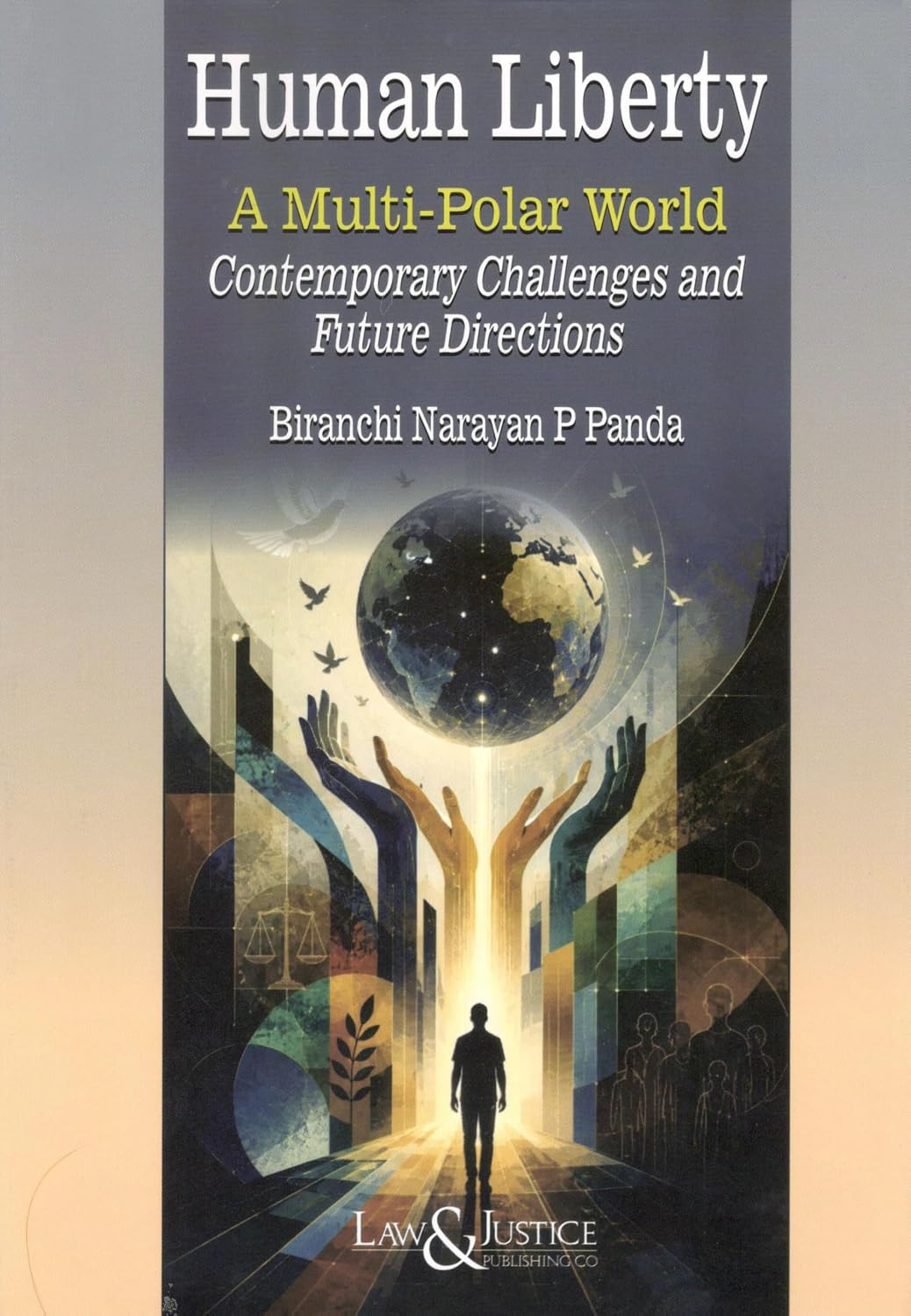
L&J's Human Liberty: A Multi-Polar World - Contemporary Challenges and Future Directions - Edition 2027
| Author : | Biranchi Narayan P Panda |
|---|
| Human Liberty: A Multi-Polar World - Contemporary Challenges and Future Directions by Dr. Biranchi Narayan P. Panda of Xavier Law School, XIM University, published by Law & Justice Publishing Co., examines what personal and political freedom means in a world no longer organised around a single dominant power. The book works through the philosophical idea of liberty, the shift to a multi-polar order, the universalism debate and its critics, the Universal Declaration and the Covenants, liberty under Articles 19 and 21 of the Indian Constitution and the reasonable-restrictions doctrine, surveillance, data and artificial intelligence, counter-terrorism and emergency powers, freedom of expression and the space for civil society, and the relationship between liberty, equality and development - closing with the future directions open to law and policy. 242 pages, hardbound, English, ISBN 9788169453431. |


Tags: Human Rights, International Law & Human Rights, Political Science, The Philosophy of Law
Human Liberty: A Multi-Polar World — Contemporary Challenges and Future Directions by Dr. Biranchi Narayan P. Panda, published by Law & Justice Publishing Co., is a 2027 edition study of what personal and political freedom now means in a world no longer organised around a single dominant power. 242 pages, hardbound, English.
For most of the period in which the modern human rights system was built, liberty had a settled vocabulary: a set of universal guarantees, a shared standard against which States could be measured, and institutions willing to apply it. That consensus has fractured. Power is distributed among several competing centres, each advancing its own account of rights and of the legitimate limits of State authority. Technology has given governments capacities of surveillance and control that the drafters of the post-war instruments never had to imagine. Security, public order, public health and the regulation of speech are all now routinely offered as reasons to narrow freedoms that were once treated as settled.
Dr. Panda, who teaches law at Xavier Law School, XIM University, Bhubaneswar, takes that altered landscape as his subject. The book asks what remains of the universalist claim, where the pressure on liberty is actually coming from, and what directions the law might take in response — written for Indian readers, with the constitutional guarantees under Articles 19 and 21 and the Indian experience never far from the argument.
Key Features
- Edition 2027, Law & Justice Publishing Co.
- A focused monograph on human liberty in a multi-polar world order
- Examines the contemporary challenges to personal freedom and the future directions open to law and policy
- Connects international human rights standards to Indian constitutional guarantees
- Written by a serving legal academic, in analytical rather than purely descriptive form
- Suitable as supplementary reading for human rights, international law and constitutional law papers
- 242 pages · Hardbound · English · ISBN 9788169453431
Themes Covered
The Idea of Liberty. The philosophical foundations of human freedom — negative and positive liberty, autonomy, dignity and the relationship between individual freedom and collective self-government.
A Multi-Polar World Order. The shift from a unipolar to a multi-polar distribution of power, and what it means for a rights framework that was drafted on the assumption of a shared normative centre.
Universalism and Its Critics. The claim that human rights are universal, set against cultural relativism, the "Asian values" argument, and the civilisational and sovereigntist accounts of rights now advanced by major powers.
The International Human Rights Framework. The Universal Declaration of Human Rights, the two Covenants and the treaty-body machinery; the limits of international enforcement; and the credibility problems of the institutions themselves.
Liberty under the Indian Constitution. Article 19 and the freedoms, Article 21 and the expanded content of personal liberty, the reasonable-restrictions doctrine, and the judicial development of the right to privacy.
Technology, Surveillance and Privacy. Mass surveillance, data collection, digital identity, algorithmic decision-making and artificial intelligence, and the pressure each places on autonomy and private life.
Security, Emergency and the State. Counter-terrorism powers, preventive detention, emergency measures and public-health restrictions, and the recurring question of how much freedom can be traded for safety before the trade becomes permanent.
Speech, Dissent and Civil Society. Freedom of expression and its regulation online, the position of the press, protest and assembly, and the operating space available to non-governmental organisations.
Equality, Development and Social Freedom. The relationship between liberty and material conditions — poverty, inequality, development and the freedoms of the vulnerable and of minorities.
Future Directions. Where the law, the institutions and the argument may go from here, and what an account of liberty adequate to a multi-polar century would have to contain.
Who Should Buy This Book?
- LL.B., B.A. LL.B. and LL.M. students taking Human Rights, International Law or Constitutional Law
- Research scholars working on human rights, civil liberties or international legal order
- Students of political science, international relations and public policy
- Advocates and law officers appearing in constitutional and civil-liberties matters
- Candidates for judicial service, UGC NET (Law) and civil services examinations
- Human rights commissions, NGOs and civil society organisations
- Journalists, policy researchers and the general reader interested in freedom and the world order
- Law college, university and institutional libraries
Why Choose This Book?
Most writing on human rights in India is either a commentary on the statutes and the case law, or a textbook restating the international instruments. This book does something different: it treats liberty as a live and contested idea, asks why it is under pressure now, and does so with the shift in the global balance of power as the explicit backdrop. That framing is unusual in the Indian legal literature.
It is also short and self-contained. At 242 pages the argument can be read end to end, which makes it useful as supplementary reading beside a prescribed text, as a starting point for a dissertation or seminar paper, or as a single-sitting orientation for a practitioner or policy professional who needs the contemporary debate rather than the full doctrinal apparatus.
Finally, it is written from the Indian vantage point. The constitutional material under Articles 19 and 21, and the Indian experience of security legislation, surveillance and the regulation of speech, are treated as part of the global argument rather than as a footnote to it.