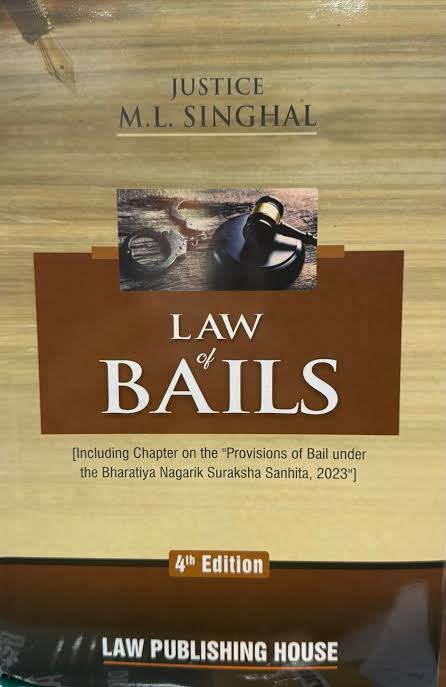
LPH's Law of Bails (Including Chapter on Provisions of Bail under the Bharatiya Nagarik Suraksha Sanhita, 2023) - 4th Edition
| Author : | JUSTICE M L SINGHAL |
|---|
| Justice M.L. Singhal's Law of Bails (Law Publishing House, 4th Edition) is a dedicated treatment of the law of bail, including a chapter on the provisions of bail under the Bharatiya Nagarik Suraksha Sanhita, 2023. It covers the principles governing bail and the triple test, bailable and non-bailable offences, anticipatory bail, default bail on failure to complete investigation in time, bail after conviction and suspension of sentence, conditions, sureties and bonds and their forfeiture, cancellation of bail, the stringent conditions under the NDPS Act, UAPA, PMLA, SC/ST Act and POCSO, bail for women, juveniles and the infirm, and the BNSS provisions including the mandatory release of undertrials. Supported throughout by Supreme Court and High Court decisions. Hardbound. ISBN 9788189639167. |


1963

English

4th Edition 2026

Tags: Bail, Bharatiya Nagarik Suraksha Sanhita(BNSS), Code Of Criminal Procedure, Criminal Trial
Law of Bails by Justice M.L. Singhal, published by Law Publishing House, is a full-length treatment of the law of bail, written by a former judge. This is the 4th Edition, and it includes a chapter on the provisions of bail under the Bharatiya Nagarik Suraksha Sanhita, 2023. Hardbound. ISBN 9788189639167.
Bail is the most frequently argued application in the Indian criminal courts and among the least codified. The statute says comparatively little; the principles — that bail is the rule and jail the exception, that the triple test of flight risk, tampering and influencing witnesses governs, that the gravity of the offence is a factor and not an answer — come almost entirely from the decisions. The BNSS, in force from 1 July 2024, has renumbered the provisions and added the mandatory release provision for undertrials, so the practitioner now argues new sections on the strength of authority reported under the old ones.
Key Features
- 4th Edition, published by Law Publishing House
- Dedicated chapter on the provisions of bail under the Bharatiya Nagarik Suraksha Sanhita, 2023
- Written by Justice M.L. Singhal, from the perspective of the bench that grants and refuses bail
- Supported throughout by the decisions of the Supreme Court and the High Courts
- Covers bail under the special enactments, where the ordinary principles are displaced
- Hardbound · English
Coverage
Principles Governing Bail. The presumption of innocence and personal liberty under Article 21; "bail is the rule, jail is the exception"; the triple test — likelihood of absconding, tampering with evidence and influencing witnesses; the relevance of the gravity of the offence, the antecedents of the accused, the stage of investigation and the period already undergone; and parity between co-accused.
Bailable and Non-Bailable Offences. The right to bail in bailable offences; the discretion in non-bailable offences and how it is exercised; and bail in offences punishable with death or imprisonment for life.
Anticipatory Bail. The scope of the power, the conditions that may be imposed, the duration of protection, interim protection pending hearing, anticipatory bail in economic offences and in matrimonial cases, and the circumstances in which it is refused.
Default Bail. The indefeasible right to bail on the failure to complete investigation within the prescribed period, the computation of the period, the effect of a charge sheet filed during the application, and default bail under the special Acts.
Bail after Conviction and Suspension of Sentence. Bail pending appeal, suspension of sentence, and bail in revision.
Conditions, Sureties and Bonds. The conditions a court may impose and the limits on them, personal bonds and sureties, the sufficiency and discharge of sureties, forfeiture of the bond, and the release of an indigent accused.
Cancellation of Bail. The distinction between setting aside an order granting bail and cancelling bail on supervening grounds, breach of conditions, and the powers of the superior courts.
Bail under Special Enactments. The stringent conditions applicable under the NDPS Act, the UAPA, the PMLA, the SC/ST (Prevention of Atrocities) Act, POCSO, the Companies Act and other special laws — and how the ordinary principles are read alongside them.
Bail of Particular Categories. Women, juveniles under the Juvenile Justice Act, the sick and infirm, and foreign nationals.
Provisions of Bail under the BNSS, 2023. The bail provisions of the Sanhita and their correspondence with the repealed Code of Criminal Procedure, 1973; the mandatory release of undertrials who have undergone the prescribed portion of the maximum sentence; bonds and bail bonds; and the procedural changes the Sanhita introduces.
Who Should Buy This Book?
- Criminal lawyers moving bail and anticipatory bail applications
- Public prosecutors and additional public prosecutors opposing bail
- Sessions Judges, Magistrates and High Court judges
- Law clerks and research assistants to judges
- Investigating officers and police prosecutors
- Candidates for judicial service and APO examinations
- Legal aid lawyers and undertrial review committee members
- LL.B. and LL.M. students of criminal procedure
- Bar association and institutional libraries
Why Choose This Book?
Most criminal procedure commentaries give bail a chapter. A bail application, though, is argued on a body of authority large enough to fill a volume of its own — and it is argued at short notice, often on the same morning the matter is listed. A dedicated work is what makes the relevant line of cases findable in that time.
The BNSS chapter is what makes this fourth edition worth having over an earlier one. Every reported bail decision predating 1 July 2024 speaks in the numbering of the CrPC, while the application before the court is drawn under the Sanhita. Having the new provisions set out and mapped in the same volume as the case law removes the step that is now the commonest source of error in a bail petition. That the author sat on the bench adds the other thing a practitioner wants from such a book — a sense of what actually persuades a court to grant or refuse.