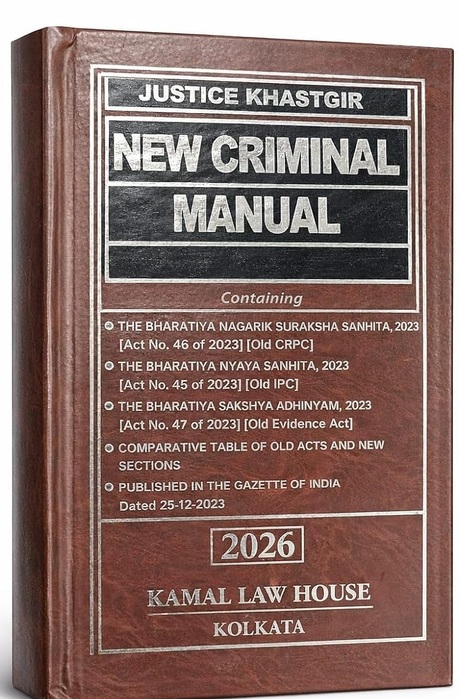
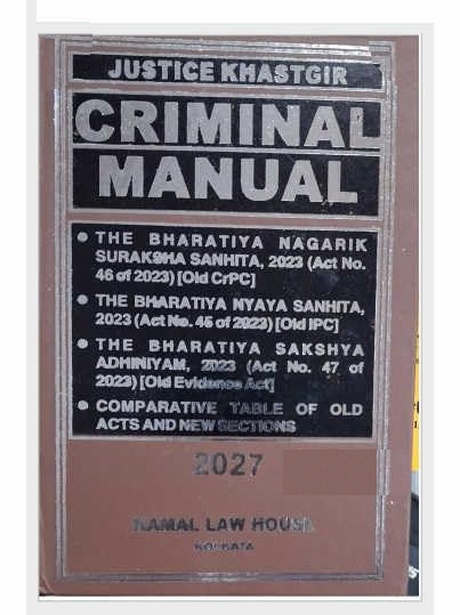
Kamal's Justice Khastgir Criminal Manual (Criminal Major Acts) (BNS, BNSS & BSA) Big- Edition 2027
| Author : | JUSTICE KHASTGIR |
|---|
| Kamal Law House's Justice Khastgir Criminal Manual (Criminal Major Acts), Edition 2027, is a hardbound manual carrying the complete text of India's three new criminal statutes in one volume: the Bharatiya Nagarik Suraksha Sanhita, 2023 [Act No. 46 of 2023], replacing the Code of Criminal Procedure, 1973; the Bharatiya Nyaya Sanhita, 2023 [Act No. 45 of 2023], replacing the Indian Penal Code, 1860; and the Bharatiya Sakshya Adhiniyam, 2023 [Act No. 47 of 2023], replacing the Indian Evidence Act, 1872, all in force with effect from 1 July 2024. It also carries a comparative table of the old Acts and the new sections, mapping IPC to BNS, CrPC to BNSS and the Indian Evidence Act to the BSA, which is what converts the old numbering used in every reported judgment, charge-sheet and precedent. For criminal law practitioners, judicial officers, police and investigating agencies, judiciary and AIBE aspirants and law students. |


Tags: Bharatiya Nyaya Sanhita (BNS), Bharatiya Nagarik Suraksha Sanhita(BNSS), Bharatiya Sakshya Adhiniyam (BSA), New Criminal Major Acts
Justice Khastgir's Criminal Manual – Criminal Major Acts, Kamal Law House, Kolkata (Edition 2027)
Kamal Law House, Kolkata publishes the 2027 Edition of Justice Khastgir's Criminal Manual, a hardbound manual carrying the complete text of India's three new criminal statutes together with the old-to-new concordance, in the compact format the criminal bar has used for years.
Statutes contained in this manual
- The Bharatiya Nagarik Suraksha Sanhita, 2023 [Act No. 46 of 2023] — replacing the Code of Criminal Procedure, 1973.
- The Bharatiya Nyaya Sanhita, 2023 [Act No. 45 of 2023] — replacing the Indian Penal Code, 1860.
- The Bharatiya Sakshya Adhiniyam, 2023 [Act No. 47 of 2023] — replacing the Indian Evidence Act, 1872.
All three Sanhitas came into force with effect from 1 July 2024, and the text in this edition is updated for the 2027 printing.
Comparative table of old Acts and new sections
The manual carries a comparative table mapping the old Acts to the new sections — IPC to BNS, CrPC to BNSS and the Indian Evidence Act to the BSA. For the years in which the profession works across both regimes, this is the most used part of the book: every reported judgment, charge-sheet, FIR and precedent still speaks in the old numbering, and the table is what converts it on the spot.
What the three Sanhitas cover
- Bharatiya Nyaya Sanhita, 2023 — the substantive criminal law: general exceptions, abetment, criminal conspiracy, offences against the State, against the human body including murder, culpable homicide and organised crime, offences against women and children, against property, document and property marks, defamation, and the scale of punishments.
- Bharatiya Nagarik Suraksha Sanhita, 2023 — the procedure: constitution of criminal courts, powers of police and magistrates, information to the police and investigation, arrest, summons and warrants, search and seizure, bail and bonds, charge, trial before Courts of Session and Magistrates, summary trials, judgment, appeals, revision and execution of sentences, and the timelines now built into the Sanhita.
- Bharatiya Sakshya Adhiniyam, 2023 — the law of evidence: relevancy of facts, admissions and confessions, oral and documentary evidence, electronic and digital records, expert opinion, burden of proof and presumptions, estoppel, witnesses and their examination, and improper admission or rejection of evidence.
Why this manual
- All three Sanhitas in one hardbound volume — the penal provision, the procedure and the evidentiary rule together.
- Comparative concordance included, not sold separately.
- Bare text without editorial interpolation — a manual for use in court, not a commentary to be read at leisure.
- Compact and hardbound, built to be carried daily and to survive it.
- Edition 2027 from Kamal Law House, Kolkata, under the name of Justice Khastgir.
Who should buy this book
- Criminal law practitioners who need the three Sanhitas and the concordance in hand at the bar table.
- Judicial officers and court staff working with charges, bail, framing and evidence under the new codes.
- Police officers and investigating agencies, for the procedural provisions and the classification of offences.
- Judiciary aspirants and AIBE candidates, where the new section numbering has to be learned and the comparative table is the fastest route to it.
- Law students reading criminal law, criminal procedure and the law of evidence under the new statutes.