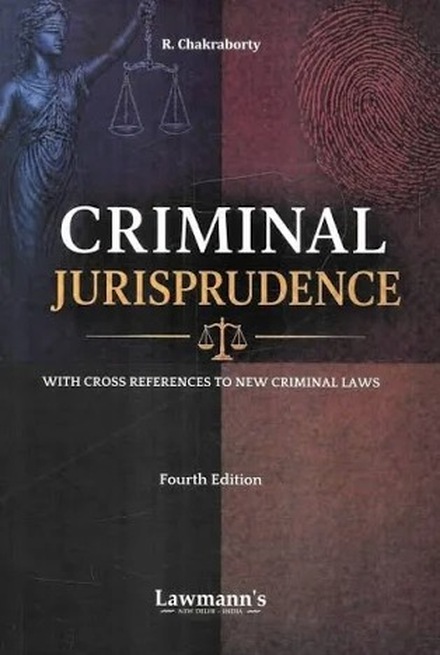
Lawmann's Criminal Jurisprudence With Cross References to New Criminal Laws by R. Chakraborty - 4th Edition 2027
| Author : | R CHAKRABORTY |
|---|
| Lawmann's Criminal Jurisprudence with Cross References to New Criminal Laws by R. Chakraborty, Fourth Edition 2027, is a focused commentary on the principles underlying Indian criminal law, cross-referenced throughout to the Bharatiya Nyaya Sanhita, 2023 and the other new criminal laws that came into force on 1 July 2024. It explains the nature and definition of crime, the elements of criminal liability through actus reus and mens rea, the mental element of intention, knowledge, motive, rashness and negligence, strict and vicarious liability, the general exceptions including unsoundness of mind, intoxication, consent and the right of private defence, inchoate liability through attempt, abetment and criminal conspiracy, common intention and common object, and the theories of punishment with the kinds of sentence recognised by the Sanhita including community service. Written for students, judicial service aspirants, advocates and researchers moving from the IPC regime to the BNS era. English, ISBN 9789349586505. |


Tags: Bharatiya Nyaya Sanhita (BNS), Jurisprudence, New Criminal Law, Criminal Law
Lawmann's Criminal Jurisprudence — With Cross References to New Criminal Laws by R. Chakraborty, published by Lawmann's (Kamal Publishers), is the Fourth Edition, 2027 of a focused commentary on the principles that underlie Indian criminal law, now cross-referenced throughout to the Bharatiya Nyaya Sanhita, 2023 and the other new criminal laws. English.
Criminal jurisprudence is the layer beneath the sections. Why is intention required at all? When does the law punish a person for a consequence they did not intend? Why are some offences made out on proof of the act alone? What is punishment actually for? A practitioner can work a case without ever answering these questions, but a student cannot write a good paper without them, and a judge cannot write a reasoned judgment without them either.
That layer has just been disturbed. The Bharatiya Nyaya Sanhita, 2023 replaced the Indian Penal Code, 1860 with effect from 1 July 2024, and with it came the Bharatiya Nagarik Suraksha Sanhita and the Bharatiya Sakshya Adhiniyam. The underlying principles did not change, but the provisions that embody them were renumbered, some were redrafted, and a century and a half of case law continues to speak in the language of the old Code. This edition's contribution is the cross-referencing: the doctrine is stated, and the reader is shown where it now sits in the new framework.
Key Features
- Fourth Edition, 2027, published by Lawmann's
- Cross references to the Bharatiya Nyaya Sanhita, 2023 and the other new criminal laws throughout
- A focused treatment of the foundational principles rather than a section-by-section commentary
- Covers criminal liability, mens rea, negligence, strict liability, general exceptions and theories of punishment
- Built for the transition from the IPC regime to the BNS era
- Concise enough to be read through, and priced for a student
- ISBN 9789349586505 · English
Coverage
The Nature and Definition of Crime. What makes conduct criminal, the distinction between crime and civil wrong, the relationship between crime, morality and public policy, and the sources of Indian criminal law.
Elements of Criminal Liability. Actus reus and mens rea — the physical and mental elements, the requirement of a voluntary act, omissions, causation, and the concurrence of act and intention.
The Mental Element. Intention, knowledge, motive, rashness and negligence, and the gradations between them; the role of motive in proof as distinct from liability; and transferred malice.
Strict and Vicarious Liability. Offences that dispense with proof of a guilty mind, the statutory contexts in which they arise, and the liability of companies and of persons in charge.
General Exceptions. Mistake of fact, accident, necessity, infancy, unsoundness of mind, intoxication, consent, acts done in good faith, compulsion, trifling acts, and the right of private defence of body and property.
Inchoate Liability and Participation. Attempt and the tests distinguishing it from preparation; abetment; criminal conspiracy; common intention and common object, and the liability of joint offenders.
Theories of Punishment. Retribution, deterrence, prevention, reformation and rehabilitation; the kinds of punishment recognised by the Sanhita, including community service as a newly introduced sentence; and the principles governing sentencing discretion.
Criminal Responsibility and the New Framework. How the principles above are expressed in the Bharatiya Nyaya Sanhita, 2023, with the corresponding Indian Penal Code provisions identified so that the existing case law remains usable.
Who Should Buy This Book?
- LL.B. and B.A. LL.B. students taking Criminal Law / Law of Crimes and criminal jurisprudence
- LL.M. students and research scholars in criminal law and criminology
- Candidates for judicial service examinations, where the BNS is now the prescribed law
- APO, public prosecutor and law officer examination candidates
- Criminal practitioners working through the move from the IPC to the Sanhita
- Police officers, investigating officers and training academies
- Teachers of criminal law looking for a compact supplementary text
- Law college and university libraries
Why Choose This Book?
Most criminal law books on the market are section-by-section commentaries running to a thousand pages or more. They are indispensable in chambers and almost unusable for understanding why the law is as it is. This book is written for the other purpose: it takes the doctrines on their own terms, in an order that builds, and can be read end to end.
The second reason is the cross-referencing. The practical problem of the next few years is not learning new principles — it is finding them again under new numbers. A book that states the doctrine and then points to its place in the Bharatiya Nyaya Sanhita saves the reader the step that currently consumes the most time.
The third is value. For a student preparing a jurisprudence or criminal law paper, or an aspirant working through the new criminal laws, this is a compact and affordable text that does a job the larger commentaries do not attempt.